
Most healthy adults can take magnesium and L-theanine together, and the combination is one of the more sensible evening supplement pairings for relaxation and sleep support. A typical starting point is 100–200 mg of L-theanine alongside around 200 mg of elemental magnesium, taken 30–60 minutes before bed. The NHS advises that supplementing with 400 mg of magnesium or less per day is unlikely to cause harm for most adults, though doses above that threshold can cause diarrhoea, particularly with poorly absorbed forms.
Two caveats matter before you start. First, if you have reduced kidney function, magnesium can accumulate to dangerous levels, so a renal check is worth having before supplementing. Second, magnesium reduces the absorption of several common medicines, including tetracyclines, quinolones, bisphosphonates, and levothyroxine, so timing and separation matter if you take any of these.
- Typical starting dose: 100–200 mg L-theanine + 200 mg elemental magnesium, evening
- NHS supplement safety threshold: 400 mg elemental magnesium per day or less
- Primary safety check: kidney function and any interacting medicines
- Evidence strength: moderate for each ingredient individually; limited for the combination specifically
Key takeaways
Magnesium and L-theanine work through complementary mechanisms and can be taken together safely by most healthy adults, with the strongest evidence for those whose magnesium status is suboptimal.
| Point | Details |
|---|---|
| Safe to combine | Most healthy adults can take 100–200 mg L-theanine with 200 mg elemental magnesium in the evening. |
| NHS safety ceiling | Keep supplemental magnesium at 400 mg/day or less; above this, diarrhoea risk rises sharply. |
| Form matters | Bisglycinate and citrate are better tolerated than oxide and more appropriate for sleep and recovery. |
| Check interactions first | Magnesium reduces absorption of tetracyclines, quinolones, bisphosphonates, and levothyroxine; separate doses by at least 2–4 hours. |
| Runcomplete Ready | UK-made magnesium bisglycinate, no fillers, vegan-friendly, with a 30-day guarantee for everyday runners. |
Table of Contents
- What are magnesium and L-theanine, and how do they work?
- What does the evidence actually show?
- What are the right doses and forms for sleep in the UK?
- Side effects, interactions and who should be cautious
- How to start safely: a practical evening plan
- Why Runcomplete recommends magnesium bisglycinate
- When should you see a doctor before or during supplementation?
- Runcomplete’s magnesium bisglycinate for runners
- Sources
What are magnesium and L-theanine, and how do they work?
L-theanine is an amino acid found almost exclusively in the leaves of Camellia sinensis, the tea plant. A standard cup of green tea contains roughly 25–60 mg, which is why tea drinkers often describe a calm, focused state rather than the jittery edge associated with coffee. At supplemental doses, L-theanine crosses the blood-brain barrier within about an hour, increases EEG alpha-wave activity associated with relaxed alertness, and appears to modulate glutamate receptors, reducing excitatory signalling without causing sedation. That is a meaningful distinction: it relaxes without knocking you out.
Magnesium is an essential mineral involved in over 300 enzymatic reactions. For sleep and relaxation specifically, its most relevant roles are blocking overactive NMDA receptors (which drive neuronal excitation) and supporting GABA activity, the brain’s primary inhibitory system. It also reduces neuromuscular excitability, which is why magnesium deficiency so often shows up as cramps, restless legs, and poor sleep quality.
The two mechanisms are complementary rather than redundant. L-theanine works primarily at the level of calm, focused brain activity; magnesium works deeper, at the receptor and neuromuscular level. Taking them together is biologically plausible precisely because they approach relaxation from different angles.
What does the evidence actually show?
L-theanine: what trials tell us
The evidence for L-theanine is most consistent for anxiety reduction and the promotion of relaxed alertness. Small-scale trials indexed on PubMed show reductions in self-reported anxiety and stress responses, with EEG studies confirming increased alpha activity at doses of 100–200 mg. Direct sleep-onset evidence is thinner; most trials show modest improvements in sleep quality rather than dramatic reductions in time to fall asleep. Evidence strength: moderate for relaxation and anxiety; limited for sleep onset specifically.
Magnesium: stronger mechanistic rationale
Magnesium’s case for sleep support is stronger where deficiency exists. Trials in older adults and people with insomnia show improvements in sleep efficiency, sleep time, and early-morning waking. The mechanistic rationale is well-established. For people with replete magnesium status, the effect is smaller and less consistent. Evidence strength: moderate to strong for sleep in deficient populations; limited for already-replete healthy adults.
Combined use: promising but early
A magnesium-L-theanine complex showed protective effects against stress-related liver and intestinal damage in preclinical models, which is an interesting signal. But preclinical is the key word. There are no large-scale randomised controlled trials of the two taken together in healthy adults. The combination is mechanistically sensible and the individual evidence is reasonable, yet anyone expecting a dramatic, guaranteed effect should calibrate expectations accordingly.
Realistic expectations: supplementation tends to take the edge off rather than transform sleep overnight. If your magnesium status is already good and your sleep hygiene is poor, no supplement will compensate for a bright screen at midnight.
What are the right doses and forms for sleep in the UK?
UK reference intakes and supplement thresholds
The NHS sets the recommended nutrient intake (RNI) for magnesium at 300 mg per day for men and 270 mg per day for women aged 19–64. Supplementing with up to 400 mg of elemental magnesium daily is considered unlikely to cause harm; above that, diarrhoea becomes a real risk, especially with oxide-based products.
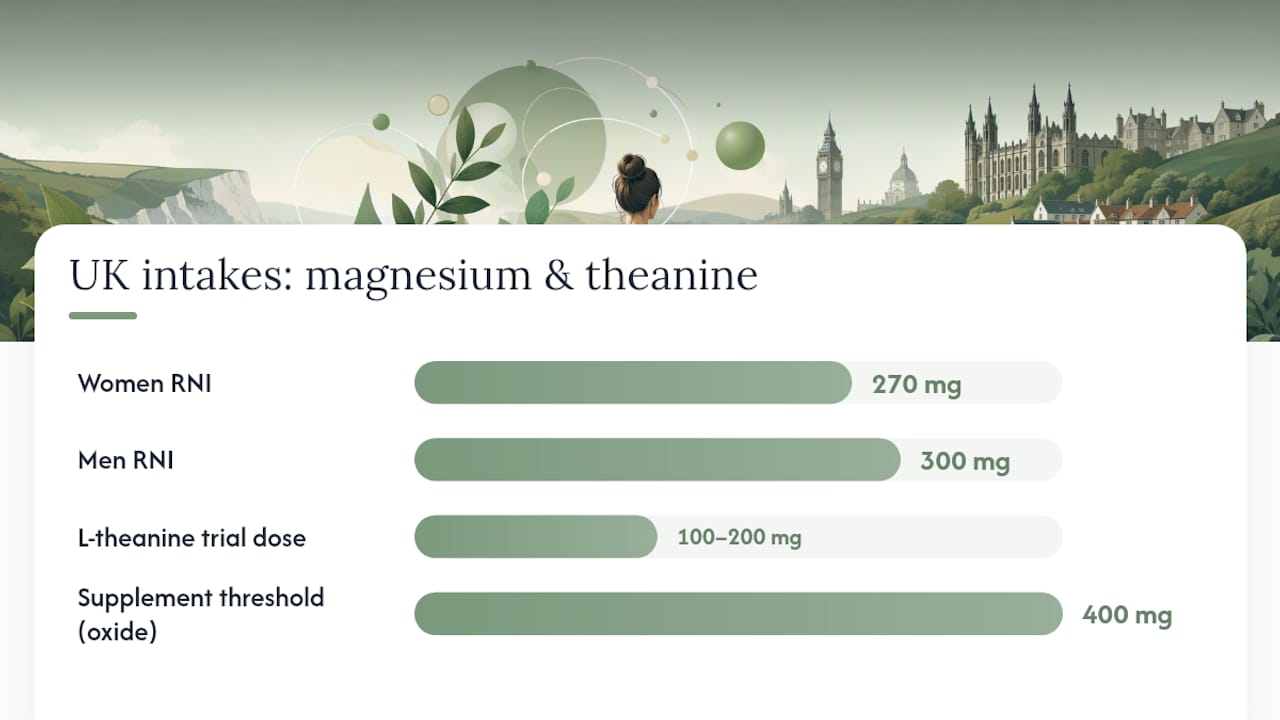
For L-theanine, there is no UK RNI because it is not classified as an essential nutrient. Trials commonly use 100–200 mg per dose, and that range is where most people find a useful effect without side effects.
Reading labels: elemental magnesium vs salt weight
This trips people up constantly. The weight on the front of a magnesium supplement packet is usually the weight of the salt, not the elemental magnesium inside it. Always check the label for the elemental figure.
For reference, the BNSSG oral magnesium supplementation guide notes that a Magnaspartate® 6.5 g sachet provides 10 mmol, which equals approximately 243 mg of elemental magnesium. That context helps when comparing licensed preparations with consumer supplements.
Pro Tip: When comparing products, always look for the elemental magnesium figure in the supplement facts panel, not the total salt weight. If it is not listed, contact the manufacturer or choose a product that states it clearly.
Which form should you choose?
For sleep and relaxation, bisglycinate is the form most consistently recommended for tolerability and absorption. Oxide has the highest elemental percentage but is poorly absorbed and more likely to cause loose stools. Citrate sits in the middle and works well for most people.

A practical evening dose for sleep support centres around 200 mg of elemental magnesium as bisglycinate or citrate, with L-theanine at 100–200 mg taken at the same time. If you are new to magnesium supplements, start at the lower end and increase after a week if your digestion is comfortable.
Side effects, interactions and who should be cautious
Common side effects
- Magnesium: loose stools or diarrhoea, particularly at doses above 400 mg/day or with oxide forms. Splitting doses across the day reduces this risk. See magnesium side effects for practical strategies.
- L-theanine: generally well tolerated. Mild headache or dizziness is occasionally reported at higher doses. It can potentiate the effects of sedative medicines, so caution applies if you take anything in that category.
Drug interactions that matter
Magnesium reduces the absorption of several medicines when taken at the same time. The interactions most worth knowing:
- Tetracyclines and quinolone antibiotics (e.g. doxycycline, ciprofloxacin): separate by at least 2 hours before or 4–6 hours after the antibiotic.
- Bisphosphonates (e.g. alendronic acid): take the bisphosphonate on an empty stomach at least 2 hours before any mineral supplement.
- Levothyroxine: separate by at least 4 hours; magnesium can reduce thyroid hormone absorption.
- Anticonvulsants: some interact with magnesium at higher doses; check with your prescriber.
- L-theanine with sedatives or anxiolytics: additive CNS-depressant effects are possible; discuss with your GP.
Groups who should check with a clinician first
- Chronic kidney disease (CKD): the kidneys excrete excess magnesium. With reduced eGFR, magnesium can accumulate, causing hypermagnesaemia, which at severe levels affects cardiac conduction. The SPS guidance on treating acute hypomagnesaemia recommends monitoring serum magnesium, renal function, and electrolytes during replacement therapy.
- Pregnancy and breastfeeding: both ingredients lack sufficient safety data for these groups; medical advice is needed before supplementing.
- Anyone on the interacting medicines listed above.
Red flags: stop and seek urgent advice
- Severe or persistent diarrhoea with signs of dehydration
- Muscle weakness, confusion, or irregular heartbeat in someone with known kidney disease (possible hypermagnesaemia)
- Any new or worsening symptoms after starting supplementation
How to start safely: a practical evening plan
Starting with a single ingredient for one week before adding the second is the most informative approach. It tells you which ingredient is doing what, and it makes any side effect easier to trace.
- Week 1: take 200 mg elemental magnesium as bisglycinate or citrate, 30–60 minutes before bed. Note sleep quality and any GI changes in a simple diary.
- Week 2: if tolerated well, add 100 mg L-theanine at the same time. Keep the sleep diary running.
- Week 3 onwards: if you want to increase L-theanine to 200 mg, do so now. Only increase magnesium above 200 mg if you have a specific reason (e.g. confirmed low status, high sweat losses from regular running) and stay within the 400 mg/day ceiling.
- Review at 4 weeks: if sleep or relaxation has not improved meaningfully, consider whether magnesium status, sleep hygiene, or other factors are the limiting issue.
Timing is straightforward: both supplements sit comfortably together in the evening. Taking magnesium with a small amount of food reduces the chance of GI upset without meaningfully affecting absorption for bisglycinate or citrate forms.
Pro Tip: Keep a brief sleep diary for the first two weeks, noting time to fall asleep, night wakings, and morning energy. It gives you actual data rather than a vague impression, and it makes it much easier to decide whether to continue.
Why Runcomplete recommends magnesium bisglycinate
Magnesium bisglycinate is the form Runcomplete chose for its Ready supplement because it consistently outperforms oxide and most other salts on two measures that matter most for everyday runners: gut tolerance and bioavailability. Higher absorption means more magnesium reaching the tissues that need it; better tolerance means you will actually keep taking it. For sleep and recovery, those two properties matter more than the elemental percentage on the label.
Runcomplete’s approach to formulation reflects what the evidence and practical guidance consistently point toward:
- Bisglycinate is better tolerated for sleep and recovery than oxide, and absorption is meaningfully higher
- The Ready capsules are UK-made, free of unnecessary fillers, and suitable for vegetarians and vegans
- A 30-day guarantee removes the financial risk of trying a new supplement
- For recreational runners with higher sweat losses, magnesium status is more likely to be suboptimal, making supplementation more likely to produce a noticeable benefit
Clinical conditions, pregnancy, and significant drug interactions all require clinician input before supplementing, regardless of the product chosen.
When should you see a doctor before or during supplementation?
Some scenarios call for a GP or pharmacist conversation before you open the packet.
- Tests worth requesting if you suspect deficiency: serum magnesium (note: this reflects only extracellular stores and can be normal even with intracellular depletion), renal function (eGFR), electrolytes, and an ECG if cardiac symptoms are present.
- Monitoring during higher-dose replacement: the BNSSG guidance recommends dose adjustment in renal impairment and monitoring serum magnesium during replacement courses. If your eGFR is below 60 mL/min/1.73 m², supplementing without monitoring is not advisable.
- Scenarios requiring review before starting: any change in prescribed medication, a new diagnosis affecting kidney or GI function, pregnancy, or breastfeeding.
- Symptoms during supplementation that need review: persistent GI upset beyond the first few days, any neurological symptoms (unusual fatigue, confusion, muscle weakness), or palpitations.
The Right Decisions Joint Adult Formulary lists licensed oral magnesium preparations and monitoring recommendations for clinical use, which is a useful reference if you are discussing options with a prescriber.
What I actually think about supplement expectations
Individual variability in this space is large, and it is worth being honest about that. Some people notice a clear improvement in sleep depth and morning recovery within a week or two of starting magnesium bisglycinate; others feel very little, usually because their magnesium status was already adequate. L-theanine tends to produce a subtler, same-evening effect, a quieter mind rather than a heavy sedation, which most people find easier to live with than a strong sleep aid.
The most useful thing you can do alongside any supplement trial is address the basics: consistent sleep timing, reduced light exposure in the hour before bed, and managing evening stress. Supplements work best as a complement to those habits, not a substitute. Start low, monitor honestly, and give it at least three to four weeks before drawing conclusions.
Runcomplete’s magnesium bisglycinate for runners
Runners who want the sleep and recovery benefits described in this guide without navigating a wall of competing products will find Runcomplete’s Ready supplement a straightforward fit. It delivers magnesium bisglycinate in a clean capsule format, made in the UK, with no fillers and no proprietary blends obscuring the dose. It is suitable for vegetarians and vegans, and a 30-day money-back guarantee means you can assess the effect on your own sleep and recovery without committing long-term.

For recreational runners especially, where sweat losses can quietly erode magnesium status over weeks of training, a reliable bisglycinate supplement taken consistently in the evening is one of the more evidence-grounded additions to a recovery routine. If you are on interacting medicines or have any kidney concerns, check with your GP first. Otherwise, try Runcomplete’s Ready and give it four weeks to show what it can do.
Sources
- Vitamins and minerals – other vitamins and minerals | NHS
- Magnesium-L-theanine complex protects against liver and … | PubMed
- Oral Magnesium Supplementation Guide (Adults) 2023 | BNSSG
- L‑Theanine | Camden Medicals
- Magnesium benefits for runners | Runner’s World UK

