
Most magnesium side effects are mild and digestive. In the UK, the NHS advises that supplemental magnesium at or below a moderate daily dose of elemental magnesium is unlikely to cause harm for most healthy adults. Serious toxicity is rare in people with normal kidney function, but it does happen, and knowing the warning signs matters.
Here is the practical bottom line before anything else:
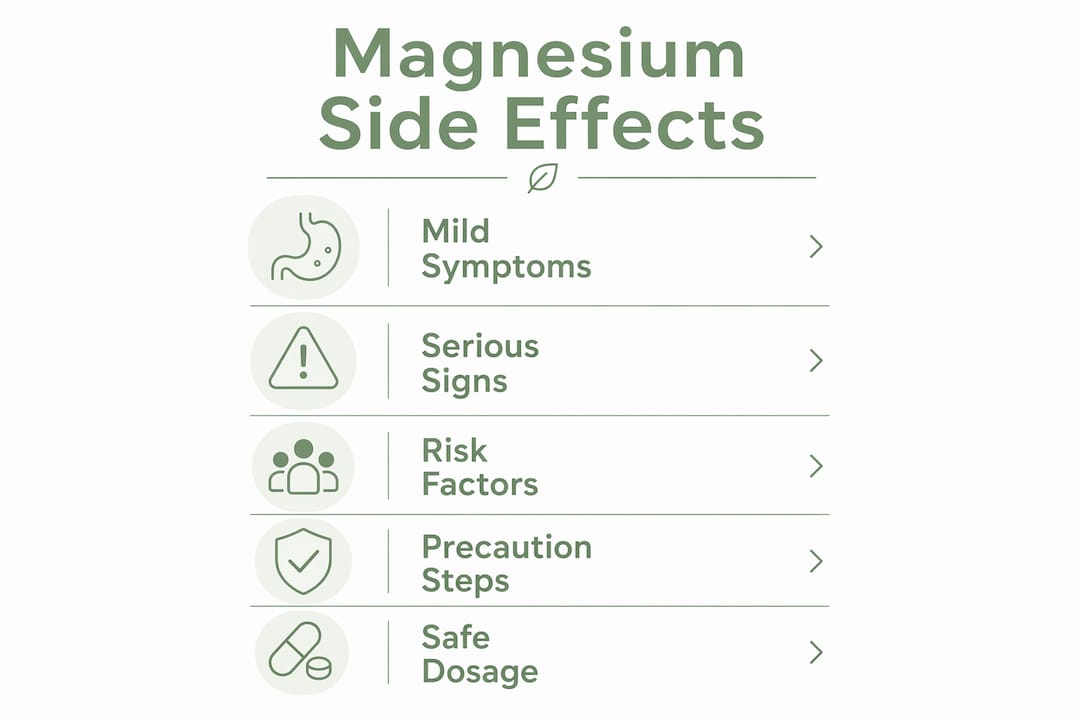
- Common effects are loose stools, diarrhoea, nausea, and stomach cramps. They are dose-related and usually resolve when you reduce the dose or stop.
- Serious overdose symptoms (hypermagnesaemia) include low blood pressure, profound drowsiness, muscle weakness, breathing difficulty, and irregular heartbeat. These require urgent medical attention.
- UK safety threshold: the Department of Health and Social Care, NHS, and the GOV.UK advisory label guidance all flag that products supplying more than 400 mg elemental magnesium per day may cause mild stomach upset in sensitive individuals.
- If severe symptoms appear: stop the supplement immediately. Call NHS 111 for non-emergency guidance, or 999 if you experience severe breathlessness, collapse, or chest pain.
The British National Formulary (BNF) and NICE clinical guidance back these thresholds and provide the clinical reference points used throughout this article.
Table of Contents
- Why do people take magnesium supplements?
- What are the common magnesium side effects?
- Serious side effects and magnesium overdose: what to watch for
- Who should take extra care with magnesium supplements?
- How does magnesium interact with other medicines?
- What is the safe magnesium dose in the UK?
- Which magnesium form is gentlest on your stomach?
- What should you do if you experience side effects?
- Key takeaways
- The case for choosing your form carefully
- Runcomplete Ready: a gentler option for runners
- Useful sources and further reading
Why do people take magnesium supplements?
Magnesium is an essential mineral involved in more than 300 enzymatic reactions in the body. It supports muscle contraction and relaxation, nerve signalling, energy metabolism, protein synthesis, and sleep regulation. For runners specifically, adequate magnesium is tied to muscle recovery, reducing cramps, and supporting deeper sleep after training.
Most healthy people get enough magnesium from food. Green leafy vegetables (spinach, kale), nuts (almonds, cashews), wholegrains, legumes, and fish are all good sources. The Department of Health and Social Care is clear that a varied diet usually supplies adequate magnesium, and supplements are an aid for specific needs rather than a replacement for good eating.
Common reasons people turn to supplements include:
- Muscle recovery and cramp prevention after exercise
- Sleep support, particularly in people with low dietary intake
- Migraine prophylaxis (higher doses, typically under clinical supervision)
- Correcting documented deficiency, often identified via blood test
One label detail worth understanding early: supplement packaging lists the magnesium salt (oxide, citrate, bisglycinate), but the figure that actually matters for dosing and side effects is the elemental magnesium content. A 500 mg tablet of magnesium oxide contains far less elemental magnesium than its weight suggests, while a 500 mg tablet of magnesium bisglycinate contains a different proportion again. Always read the elemental figure, not the salt weight.

What are the common magnesium side effects?
The most frequently reported side effects of magnesium supplements are gastrointestinal. They are dose-dependent and almost always reversible.
- Loose stools or diarrhoea — the most common complaint, particularly with higher doses or poorly absorbed forms
- Abdominal cramps or discomfort
- Nausea, especially when taken on an empty stomach
- Mild bloating
The mechanism is straightforward. When magnesium salts are not fully absorbed in the small intestine, the unabsorbed portion reaches the colon and draws water in by osmosis. This osmotic effect is what produces loose stools. Magnesium oxide is particularly prone to this because its fractional absorption is low compared with organic salts, meaning more of it arrives in the colon unabsorbed.
Typical timeline: digestive symptoms usually appear within a few hours of taking a dose. If you reduce the dose or stop the supplement, symptoms generally settle within one to two days. Persistent symptoms beyond that warrant a pharmacist or GP review.
The NHS Specialist Pharmacy Service (SPS) recommends a practical approach to managing these effects:
- Start with a low dose (for example, one tablet) and increase gradually to the maximum tolerated dose.
- Take magnesium with meals rather than on an empty stomach.
- Split the total daily dose across two or three occasions rather than taking it all at once.
- If diarrhoea occurs, reduce the dose or withhold treatment until symptoms subside.
Splitting doses is not just a comfort measure. Taking a single large dose creates a high peak concentration in the gut, which amplifies the osmotic effect. Spreading the same total amount across the day reduces that peak load considerably.
Pro Tip: If you experience loose stools after starting a magnesium supplement, do not stop immediately. Try halving the dose and taking it with your main meal for three to five days. Many people find their gut adapts and symptoms resolve without needing to abandon the supplement entirely.
Serious side effects and magnesium overdose: what to watch for
Hypermagnesaemia (elevated serum magnesium) from oral supplements is uncommon in people with healthy kidneys because the kidneys excrete excess magnesium efficiently. When it does occur, it is usually in people with impaired renal function, those taking very high doses, or those using magnesium-containing laxatives or antacids repeatedly over time.
The BNF/NICE clinical guidance lists the following symptoms of magnesium overdose, roughly in order of severity:
- Nausea and vomiting
- Facial flushing
- Low blood pressure (hypotension)
- Drowsiness and sedation
- Muscle weakness and loss of deep tendon reflexes
- Respiratory depression (slow, shallow breathing)
- Cardiac arrhythmias
- Cardiac arrest in severe cases
Severe hypermagnesaemia is a medical emergency. Urgent hospital assessment including serum magnesium measurement and supportive care may be required.
Who faces the highest risk?

People with significant renal impairment are at materially increased risk. The BNSSG NHS oral magnesium supplementation guide recommends halving standard oral doses when eGFR falls below 30 mL/min/1.73 m², and avoiding supplementation in severe cases. The kidneys are the primary route of magnesium excretion; when they cannot keep up, serum levels rise.
Emergency action steps
- Stop the supplement immediately if you develop any of the serious symptoms listed above.
- Call NHS 111 for non-emergency but concerning symptoms (persistent drowsiness, unusual muscle weakness, low blood pressure).
- See your GP for persistent or unexplained symptoms that do not resolve within 24–48 hours of stopping.
- Call 999 for life-threatening signs: severe breathlessness, collapse, loss of consciousness, severe chest pain, or absent reflexes.
Pro Tip: If you have kidney disease or are unsure of your kidney function, ask your GP for a serum magnesium measurement before starting supplementation. A simple blood test can confirm whether your kidneys are clearing magnesium adequately.
Who should take extra care with magnesium supplements?
Some groups face a meaningfully higher risk of adverse effects and should speak to a GP or pharmacist before starting any magnesium supplement.
Higher-risk groups:
- Chronic kidney disease (CKD), particularly with eGFR below 30 mL/min/1.73 m² — reduced renal clearance means magnesium accumulates more readily
- Older adults taking multiple prescription medicines (polypharmacy increases interaction risk and kidney function often declines with age)
- People on interacting medicines — see the interactions section below
- Pregnant and breastfeeding people — individual assessment is needed; dietary magnesium is generally safe, but high-dose supplementation should be discussed with a midwife or GP
- Infants and young children — dose caution applies; supplementation should only be under medical supervision
Comorbidities that increase risk:
- Heart failure (electrolyte balance is already precarious)
- Significant liver disease
- Any condition requiring close electrolyte monitoring
Pro Tip: If you take three or more prescription medicines regularly, or if you have never had your kidney function checked, speak to your pharmacist before adding any magnesium supplement. Pharmacists can review your full medicines list and flag interactions in minutes, without needing a GP appointment.
How does magnesium interact with other medicines?
Magnesium salts can reduce the absorption of several important medicines by binding to them in the gut before they are absorbed. This is a chelation or adsorption effect, not a pharmacological interaction in the traditional sense, but the clinical consequence is the same: the medicine may not work as intended.
Key drug classes and examples:
- Bisphosphonates (alendronate, risedronate) — magnesium significantly reduces absorption; these medicines already require strict fasting and timing protocols
- Tetracycline antibiotics (doxycycline, tetracycline) — chelation reduces antibiotic levels in the blood
- Quinolone antibiotics (ciprofloxacin, levofloxacin) — same chelation mechanism; reduced efficacy is a real clinical concern
- Levothyroxine (thyroid replacement therapy) — absorption is reduced when taken alongside magnesium; consistent timing matters for stable thyroid control
- Some antifungals and antivirals — check with a pharmacist for specific agents
The BNF and the BNSSG supplementation guide both advise separating doses of magnesium from sensitive medicines.
| Medicine / class | Interaction concern | Practical guidance |
|---|---|---|
| Bisphosphonates | Reduced bisphosphonate absorption | Take bisphosphonate on an empty stomach; separate from magnesium by at least 2 hours |
| Tetracycline antibiotics | Chelation reduces antibiotic absorption | Separate by at least 2–3 hours; check product leaflet |
| Quinolone antibiotics | Chelation reduces antibiotic levels | Separate by at least 2 hours; confirm with pharmacist |
| Levothyroxine | Reduced thyroid hormone absorption | Take levothyroxine first thing in the morning; take magnesium at a different time of day |
| Antacids (magnesium-containing) | Cumulative magnesium load | Count antacid magnesium toward daily total; avoid doubling up |
For complex medicine regimens, consult the BNF directly or ask a pharmacist to review the full list. Starting a new prescription medicine is always a good moment to re-check whether your supplement timing needs adjusting.
What is the safe magnesium dose in the UK?
The NHS is clear: 400 mg or less of elemental magnesium per day from supplements is unlikely to cause harm for most healthy adults. The Department of Health and Social Care’s advisory label guidance reinforces this, stating that products supplying more than 400 mg elemental magnesium per day may cause mild stomach upset in sensitive individuals.
That 400 mg figure refers to elemental magnesium, not the total weight of the magnesium salt on the label. This distinction trips up a lot of people.
How to calculate your elemental intake:
- Find the “elemental magnesium” or “magnesium (as…)” figure on the supplement facts panel.
- If the label only lists the salt (e.g. “500 mg magnesium oxide”), the elemental content is a fraction of that weight. Magnesium oxide is roughly 60% elemental magnesium by weight, so 500 mg of the salt provides approximately 300 mg elemental. Bisglycinate, by contrast, is roughly 14–16% elemental magnesium by weight, so a 500 mg dose of the salt provides around 70–80 mg elemental.
- Add up all sources: food supplements, antacids, laxatives, and any prescribed magnesium preparations.
| Supplement form | Approximate elemental Mg (%) | Typical elemental Mg per 500 mg salt | GI tolerability |
|---|---|---|---|
| Magnesium oxide | ~60% | ~300 mg | Lower — more laxative |
| Magnesium citrate | ~16% | ~80 mg | Moderate |
| Magnesium bisglycinate | ~14–16% | ~70–80 mg | Higher — gentler |
| Magnesium malate | — | — | Moderate to good |
| Magnesium chloride | ~12% | ~60 mg | Moderate |
Higher therapeutic doses (for example, 400–600 mg elemental per day in migraine prevention trials) are used clinically but should be supervised by a clinician. Self-medicating at those levels without monitoring is not advisable.
Label-reading tip: always use the elemental magnesium figure for your dose calculation. If the label does not state it clearly, contact the manufacturer or ask a pharmacist before taking the product.
Which magnesium form is gentlest on your stomach?
The form of magnesium you take has a direct bearing on how likely you are to experience digestive side effects. This is not marketing; it is chemistry.
Research comparing magnesium forms shows that magnesium oxide has roughly 4% fractional absorption in some human studies, compared with around 28–33% for organic salts such as citrate and glycinate. Low absorption means more unabsorbed magnesium reaches the colon, where it draws in water and causes loose stools. Oxide is cheap and widely available, which is why it dominates budget supplements, but it is the form most likely to cause diarrhoea.
| Form | Relative bioavailability | Elemental Mg per typical dose | Expected GI effect |
|---|---|---|---|
| Oxide | Low (~4% in some studies) | High per gram of salt | Most laxative |
| Citrate | Moderate to good | Moderate | Mildly laxative at higher doses |
| Bisglycinate / glycinate | Good | Lower per gram of salt | Gentlest on digestion |
| Malate | Moderate | Moderate | Generally well tolerated |
| Chloride | Moderate | Moderate | Variable |
Bisglycinate (sometimes labelled as magnesium diglycinate or glycinate) is chelated to the amino acid glycine. The glycinate chelate reduces the unabsorbed osmotic load in the colon compared with inorganic salts, which is why it tends to be the preferred form for people with sensitive digestion or those who have previously experienced gut upset on other forms.
A randomised placebo-controlled trial of magnesium bisglycinate in adults with self-reported poor sleep found that 93% of participants reported no adverse events, with fewer adverse events in the bisglycinate group than in the placebo group. That is a useful tolerability signal, though it reflects one specific dose and population.
Practical guidance for switching forms:
- Start at a lower dose than you think you need and increase over one to two weeks.
- Split the daily dose across two occasions.
- Prefer chelated or organic salts (bisglycinate, citrate, malate) if digestive upset has been a problem before.
- Check the elemental magnesium per serving, not just the salt weight.
Pro Tip: For runners who need recovery support without gut upset the night before a long run, bisglycinate is worth trying first. It balances tolerability and efficacy well. You can find a practical comparison of glycinate versus citrate if you want to weigh up the options in more detail.
What should you do if you experience side effects?
A clear, step-by-step response is more useful here than general reassurance.
- Stop taking the supplement. Do not wait to see if symptoms worsen.
- Assess your symptoms. Mild loose stools or nausea after a high dose are likely dose-related and will resolve within one to two days. Drowsiness, muscle weakness, low blood pressure, or breathing changes are a different matter entirely.
- Note the dose and timing. Write down the product name, the elemental magnesium per dose, how many doses you took, and when you last took it. This information is useful for any clinician you speak to.
- Contact a pharmacist or NHS 111 for non-emergency but persistent or concerning symptoms. NHS 111 is available 24 hours a day online or by phone.
- See your GP if symptoms persist beyond 48 hours after stopping, if you have kidney disease, or if you are on multiple medicines and unsure about interactions.
- Call 999 for severe or life-threatening signs: severe breathlessness, collapse, loss of consciousness, severe chest pain, or absent deep tendon reflexes.
Preparing for a clinical assessment: bring the product label, your dose history, a list of all medicines you take (including over-the-counter products and antacids), and any recent blood test results showing kidney function. A serum magnesium measurement can confirm whether levels are elevated; ask your GP if you are unsure whether this is needed.
Symptoms from a dose-related digestive reaction typically resolve within one to two days of stopping. Symptoms of genuine hypermagnesaemia may take longer to clear and require clinical management.
Key takeaways
Most magnesium side effects are mild, dose-related, and digestive; staying at or below 400 mg elemental per day and choosing a well-absorbed form like bisglycinate keeps the risk low for most healthy adults.
| Point | Details |
|---|---|
| Common side effects | Diarrhoea, nausea, and stomach cramps are dose-related and usually resolve within one to two days of stopping or reducing the dose. |
| UK safety limit | The NHS advises that 400 mg elemental magnesium per day from supplements is unlikely to cause harm for most healthy adults. |
| High-risk groups | People with CKD (eGFR below 30 mL/min/1.73 m²), older adults on multiple medicines, and those on interacting drugs face the greatest risk. |
| Read the label correctly | Always use the elemental magnesium figure, not the salt weight, to calculate your daily dose. |
| Runcomplete bisglycinate | Runcomplete’s magnesium bisglycinate is a gentler-form option for runners seeking recovery support without digestive upset, made in the UK with no unnecessary fillers. |
This article provides general information only, not medical advice. Confirm current guidance with the NHS, a pharmacist, or a qualified clinician for your own situation.
The case for choosing your form carefully
There is a tendency in health writing to treat all magnesium supplements as interchangeable, as if the only variable is dose. That framing does a disservice to anyone who has tried a cheap magnesium oxide tablet, spent the next morning in the bathroom, and concluded that magnesium supplements simply do not agree with them.
The form genuinely matters. The difference in fractional absorption between oxide and bisglycinate is not a marginal rounding error; it is the difference between a supplement that spends most of its time in your colon acting as a laxative and one that is absorbed before it gets there. For runners who take magnesium in the evening to support sleep and recovery, that distinction is particularly relevant. A supplement that disrupts your night is not doing its job.
What I find underappreciated in most safety discussions is the cumulative magnesium load. People count their supplement tablet but forget the magnesium in their antacid, their laxative, or their fortified protein powder. The 400 mg/day threshold applies to the total supplemental intake, not just the dedicated magnesium capsule. Exceeding safe amounts accidentally is easier than most guides acknowledge.
The other thing worth saying plainly: if you have any doubt about your kidney function, get it checked before you start. A serum creatinine and eGFR calculation is a routine blood test. It takes minutes and removes the guesswork entirely. The risk profile for someone with an eGFR of 25 mL/min/1.73 m² is categorically different from someone with normal renal function, and no supplement label can tell you which category you are in.
Runcomplete Ready: a gentler option for runners
Disclosure: Runcomplete publishes this article and sells the product mentioned below.
If digestive side effects have put you off magnesium supplements before, the form is almost certainly the issue rather than magnesium itself. Runcomplete’s Ready magnesium bisglycinate is made in the UK, free of unnecessary fillers, and suitable for vegetarians and vegans. It is designed specifically for everyday runners who need recovery support and better sleep without the gut disruption that comes with cheaper oxide-based products.

The bisglycinate form means a lower osmotic load in the colon and a gentler experience overall, which is why it is the form Runcomplete chose. You can buy once or subscribe monthly, and every order comes with a 30-day guarantee. If you want to understand how magnesium supports overnight muscle recovery before committing, that is a good place to start. When you are ready, visit runcomplete.net to order.
If you have kidney disease, take multiple prescription medicines, or are pregnant, speak to your GP or pharmacist before starting any supplement.
Useful sources and further reading
The following UK-authoritative sources underpin the guidance in this article.
Patient-facing resources:
- NHS: Vitamins and minerals — Others — patient-facing guidance on supplemental magnesium, the 400 mg/day threshold, and dietary sources.
- GOV.UK: Magnesium general information — UK Health Security Agency overview of magnesium exposure, health effects, and when to seek help.
- Department of Health and Social Care: Food Supplements advisory label statements — official advisory label thresholds, including the 400 mg magnesium trigger for stomach upset warnings.
Clinical references:
- BNF/NICE: Magnesium glycerophosphate — clinical prescribing notes, overdose symptoms, renal cautions, and interaction guidance. Clinical reference.
- British National Formulary (BNF) — comprehensive drug interaction data for magnesium salts and co-administered medicines. Clinical reference.
- NHS Specialist Pharmacy Service (SPS): Treating acute hypomagnesaemia in adults — practical dosing strategy, tolerability tips, and clinical escalation guidance. Clinical reference.
- BNSSG NHS: Oral magnesium supplementation guide (2023) — regional NHS clinical guidance covering adverse effects, renal thresholds (eGFR <30 mL/min/1.73 m²), and drug interactions. Clinical reference.
Bioavailability and research:
- Nutrient Metrics: Magnesium forms and bioavailability — comparative absorption data for magnesium oxide, citrate, glycinate, and other forms.
- PMC: Magnesium bisglycinate supplementation in healthy adults reporting poor sleep (randomised controlled trial) — tolerability and sleep outcome data for bisglycinate at 250 mg elemental per day.
Recommended
- Magnesium glycinate benefits for runners: what you need to know – Run Complete
- Best magnesium bisglycinate UK: a guide for runners – Run Complete
- Gentle Magnesium for Runners: Recovery Without the Stomach Upset – Run Complete
- Magnesium glycinate vs citrate for runners: which to choose – Run Complete

