
For most casual runners, magnesium bisglycinate is the better choice. It absorbs well, sits gently on the stomach, and delivers glycine alongside the magnesium — an amino acid that supports nervous-system calming and helps you sleep more deeply after a hard run. Citrate is worth considering only when you specifically want a mild laxative effect, or when budget is tight and GI sensitivity is not a concern.
Pick bisglycinate (glycinate) when you want:
- Better sleep and overnight muscle recovery, with minimal digestive disruption
- A calming effect on the nervous system, thanks to the glycine component
Pick citrate when you want:
- Relief from constipation, where its osmotic laxative action is the actual point
- A lower cost per capsule, and your stomach handles it fine at standard doses
Pro Tip: Start with a moderate dose of elemental magnesium from bisglycinate, taken 1–2 hours before bed. Runcomplete’s Ready is a UK-made bisglycinate capsule built specifically for runners — filler-free, vegan-friendly, and backed by a 30-day guarantee.
Table of Contents
- How do glycinate and citrate compare side by side?
- How do bisglycinate and citrate actually work?
- Which form should runners choose for their specific goals?
- What are the safety limits and who should check with a GP?
- How to choose a magnesium supplement in the UK
- Our pick for runners: Runcomplete Ready
- Practical dosing and timing for runners
- Key takeaways
- A runner’s perspective on magnesium
- Ready for runners: Runcomplete’s magnesium bisglycinate
- Useful sources
How do glycinate and citrate compare side by side?
The table below covers the dimensions that matter most to runners. Bioavailability differences between the two forms are real but modest — what actually drives the choice is the secondary effect: glycine’s calming action versus citrate’s laxative tendency.

| Dimension | Magnesium bisglycinate | Magnesium citrate |
|---|---|---|
| Best for | Sleep, recovery, muscle cramps | Constipation, general repletion |
| GI tolerance | Excellent — minimal laxative risk | Moderate — loose stools at higher doses |
| Elemental Mg per gram of compound | ~14% (bisglycinate) | ~16% (citrate) |
| Onset of effect (sleep/cramps) | Gradual over days to weeks | Laxative onset 30 min–several hours |
| UK cost and availability | Widely available; slightly pricier | Very widely available; cheaper |
| Sensitive stomachs | Yes — well tolerated | Use caution at higher doses |
| Vegan suitability | Check label (often vegan) | Check label (often vegan) |
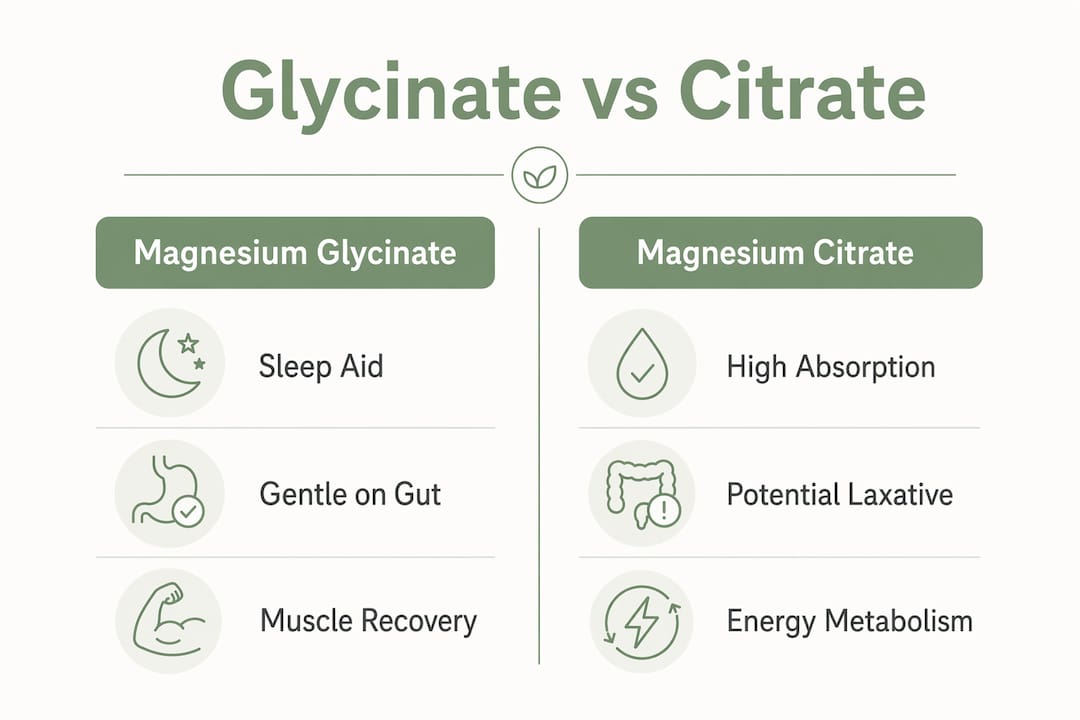
Always check the label for elemental magnesium per serving, not the total compound weight. A capsule labelled “500 mg magnesium bisglycinate” contains roughly 70 mg of elemental magnesium — the glycine makes up most of the mass; this reflects bisglycinate’s elemental content of about 14%. Third-party testing and a clear UK manufacturing note are worth looking for too.
How do bisglycinate and citrate actually work?
Bisglycinate: the chelated, calming form
Bisglycinate binds magnesium to two glycine molecules. The gut absorbs this chelated form via the dipeptide transporter PepT1, a separate pathway from standard mineral absorption — which is why it tends to cause far less irritation than inorganic forms. The glycine itself is not just a carrier: it supports GABAergic activity in the brain and may lower core body temperature slightly, both of which aid sleep onset. For a runner lying awake with twitchy legs at 11 PM, that dual action is genuinely useful.
Citrate: well absorbed, but with a catch
Magnesium citrate dissolves readily in water and is absorbed through standard mineral transporters in the small intestine; for a comprehensive overview of the benefits of magnesium in tablets, see Novonatur’s detailed guide. Any citrate that reaches the colon unabsorbed draws water into the gut lumen — the osmotic effect that makes it useful as a bowel preparation and a mild laxative. At typical supplementation doses (150–250 mg elemental), most people tolerate it fine. Push higher, and loose stools become likely.
Both forms are substantially better absorbed than magnesium oxide, which sits at roughly 4% fractional absorption in human studies. Oxide is cheap on the shelf and nearly useless for repletion.
Elemental magnesium matters more than compound weight. Citrate delivers around 16% elemental magnesium by mass; bisglycinate around 14%. The gap is small, but it means you may need slightly more bisglycinate capsules to hit the same elemental dose.
Which form should runners choose for their specific goals?
The answer depends almost entirely on what you are trying to fix.
Choose bisglycinate for:
- Night-time recovery and sleep quality — take it 1–2 hours before bed
- Nervous-system calming after a stressful training block
- Muscle cramps that wake you at night
- Sensitive stomachs that react badly to citrate
- Daily, long-term supplementation without GI disruption
Choose citrate for:
- Constipation, where the laxative effect is the goal, not a side effect
- A tighter budget, when GI tolerance is not a concern
- Short-term general repletion if bisglycinate is unavailable
Race week is worth a specific note. Introducing citrate in the days before a race is a risk — the last thing you need on the start line is an unpredictable bowel. Stick with bisglycinate during taper and race week.
Pro Tip: Some runners split their magnesium: a small citrate dose with lunch for general repletion, and bisglycinate before bed for sleep and overnight recovery. Keep the combined elemental total under 400 mg from supplements to stay within safe limits.
What are the safety limits and who should check with a GP?
The NHS advises that taking more than 400 mg of elemental magnesium per day from supplements can cause diarrhoea, and that 400 mg or less is unlikely to cause harm for most adults. That ceiling applies to supplemental magnesium only — food sources do not count toward it.
Watch for these signs of excess:
- Loose stools or diarrhoea (the most common signal)
- Stomach cramping or nausea
- With very high doses: low blood pressure, fatigue, or muscle weakness
Drug interactions to know:
- Magnesium can reduce absorption of certain antibiotics (tetracyclines, fluoroquinolones) — space doses by at least two hours
- It may interact with muscle relaxants and some osteoporosis medications
- Severe kidney disease impairs magnesium excretion, making supplementation risky
Titrate your dose upward gradually. Starting at 150 mg elemental and moving to 200–300 mg over a couple of weeks gives your gut time to adjust and makes it easier to identify your personal tolerance threshold.
How to choose a magnesium supplement in the UK
A short checklist before you buy:
- Elemental magnesium per serving — look for this figure specifically, not the compound weight
- Form name — “bisglycinate” or “glycinate” for sleep and recovery; “citrate” if you want the laxative effect
- Third-party testing — a batch-tested or independently verified product reduces the risk of contamination or label inaccuracy
- UK manufacture — shorter supply chains and domestic quality standards are a genuine reassurance
- Vegan and vegetarian suitability — check the capsule shell; many use gelatine unless stated otherwise
- No unnecessary fillers — magnesium stearate in small amounts is standard, but long ingredient lists with bulking agents are a red flag
- Avoid oxide-only products — at ~4% absorption, they are poor value for runners trying to correct a deficiency
Pro Tip: Capsules are easier to dose precisely than powders and avoid the flavouring additives common in drink formats. If you are new to magnesium supplements, start at the lower end of the dose range and assess GI tolerance over the first week before increasing.
Our pick for runners: Runcomplete Ready
Runcomplete’s Ready is a magnesium bisglycinate capsule made in the UK, formulated specifically for everyday runners rather than gym-goers or elite athletes. It is free of unnecessary fillers, suitable for vegetarians and vegans, and available on a one-time or monthly subscription basis.
What Ready offers:
- Magnesium bisglycinate — the chelated form with good GI tolerability and glycine’s calming benefit
- Vegan-friendly capsule shell, no unnecessary fillers
- UK manufacture — quality assurance without long international supply chains
- 30-day guarantee — low-risk to try
The bisglycinate form maps directly to the sleep and recovery goals most hobbyist runners have. You are not paying for a laxative effect you do not want, and the glycine component does real work on the nervous system overnight. For runners dealing with heavy-leg recovery and disrupted sleep after long runs, that combination is the point.
Practical dosing and timing for runners
Starting framework:
- Begin at 150–200 mg elemental bisglycinate per day for the first week
- Move to 200–300 mg if well tolerated, taken 1–2 hours before bed for sleep and overnight recovery
- Do not exceed 400 mg elemental magnesium from supplements in a single day
Timing by goal:
- Sleep and overnight muscle relaxation: bedtime dose, 1–2 hours before sleep
- General daily repletion during heavy training: split the dose, smaller amount at lunch and the remainder at night
- Cramp management: consistent nightly dosing tends to work better than reactive single doses
Evaluating whether it is working:
- Sleep onset and quality usually improve within 2–4 weeks of consistent dosing
- Night cramp frequency is a useful marker — track it over a month
- If you notice no change after four weeks at 300 mg elemental, consider whether dietary magnesium is already adequate, or whether other recovery factors need attention first
A consistent bedtime routine matters as much as the supplement itself. Magnesium supports sleep; it does not replace good sleep hygiene.
Key takeaways
Magnesium bisglycinate is the better choice for most runners because it combines good absorption with GI tolerability and glycine’s calming effect on the nervous system.
| Point | Details |
|---|---|
| Bisglycinate for sleep and recovery | Glycine calms the nervous system and aids sleep; GI tolerability is excellent at standard doses. |
| Citrate for constipation or budget | Its osmotic laxative action is a feature when that is the goal; a drawback for sleep-focused runners. |
| Elemental dose matters most | Aim for 200–300 mg elemental magnesium before bed; stay under 400 mg supplemental per day. |
| Read the label carefully | Check elemental Mg per serving, not compound weight; avoid oxide-only products. |
| Runcomplete Ready | UK-made bisglycinate capsule, vegan-friendly, filler-free, with a 30-day guarantee for runners. |
A runner’s perspective on magnesium
The conversation around magnesium supplements tends to swing between two extremes: either it is treated as a miracle fix for every ache and sleepless night, or it is dismissed as unnecessary if your diet is decent. Neither is quite right.
What the evidence actually supports is more modest and more useful: magnesium bisglycinate, taken consistently at an appropriate dose before bed, tends to improve sleep quality and reduce the frequency of night cramps for runners who are running enough to deplete their stores. That is a real and common situation for anyone training three or four times a week. The glycine component adds something citrate cannot: a direct calming signal to the nervous system that helps the body shift into recovery mode.
The caution worth keeping is that magnesium is one part of recovery, not the whole of it. Runners who sleep badly because they are overtraining, undereating, or staring at screens until midnight will not fix that with a capsule. But for a runner who is doing most things right and still waking stiff and tired, bisglycinate is a low-risk, well-evidenced place to start. Give it four weeks at a consistent dose before drawing conclusions.
Ready for runners: Runcomplete’s magnesium bisglycinate
Runners who want the sleep and recovery benefits of magnesium without the laxative risk of citrate have one clear option: a quality bisglycinate formulation taken consistently before bed.

Runcomplete’s Ready is exactly that. Made in the UK, free of fillers, suitable for vegans and vegetarians, and formulated around bisglycinate for runners who care about overnight recovery rather than gym performance. You can buy once or subscribe monthly — no long-term commitment required. The 30-day guarantee means you can try it without risk. If you are ready to sleep better and wake up less stiff after your long runs, Ready is the straightforward next step.
Useful sources
- NHS: Vitamins and minerals — magnesium — UK reference intakes, upper limits, and safety guidance
- Marathon Handbook: Magnesium for runners — practical dosing and timing for runners
- NutritionGeeks: Best magnesium supplements for runners’ sleep — sleep-focused dosing evidence
- Nutrient Metrics: Magnesium forms and bioavailability — detailed breakdown of absorption data across forms
- Runners World UK: Magnesium benefits for runners — nutrition context for runners
- Runcomplete: When to take magnesium for running — timing guidance for training and sleep
For medical questions, consult your GP or an NHS pharmacist before starting any supplement, particularly if you have kidney disease or take prescription medication.
Recommended
- Magnesium Bisglycinate for Runners: The Secret to Heavy Leg Recovery a – Run Complete
- Gentle Magnesium for Runners: Recovery Without the Stomach Upset – Run Complete
- When to Take Magnesium for Running: Timing Your Dose for Better Recove – Run Complete
- Magnesium for Runners’ Sleep: Unlocking Overnight Muscle Recovery – Run Complete

