
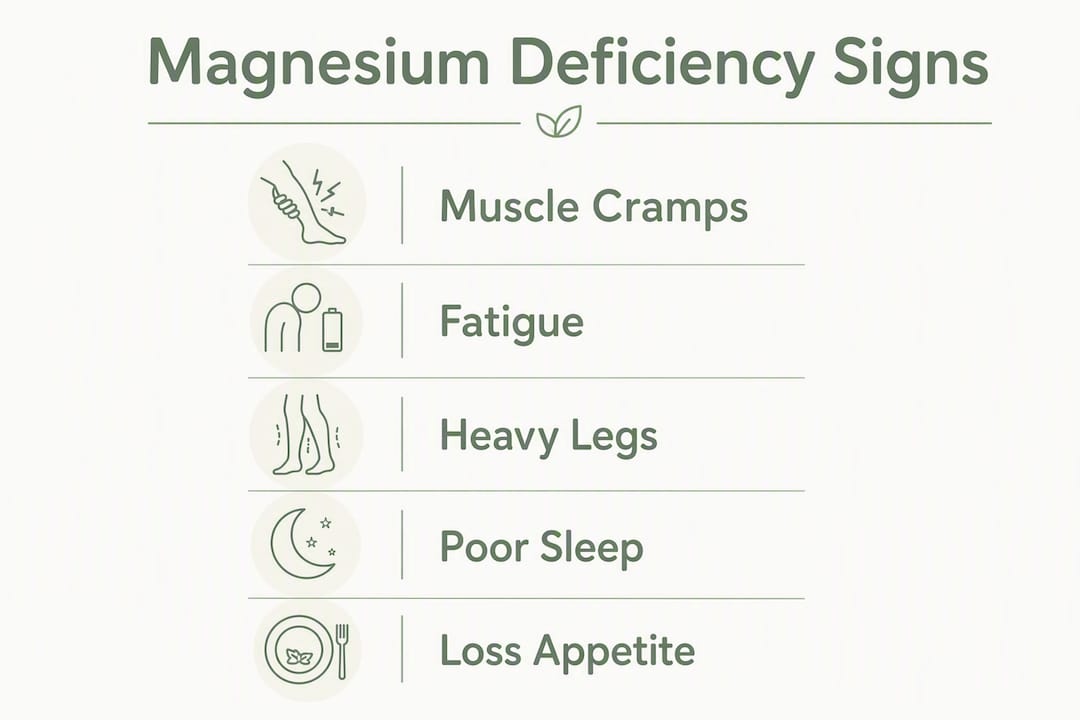
Muscle cramps mid-run, legs that feel heavy for days after a long effort, sleep that never quite restores you — these are the most common signs of low magnesium in runners, and the single most useful next step is to check your diet first, then see your GP if symptoms persist or feel serious.
UK clinical guidelines define hypomagnesaemia as a serum magnesium level below 0.7 mmol/L, though symptoms typically only appear when levels drop below 0.5 mmol/L. Many runners sit in a grey zone: technically normal on a blood test, but running on depleted stores.
If you suspect low magnesium, start here:
- Audit your diet for nuts, seeds, wholegrains, and leafy greens
- Note whether symptoms worsen after long runs or in hot weather
- See your GP if you experience palpitations, confusion, or symptoms that affect daily life
- Consider a magnesium-rich supplement as insurance during heavy training blocks
Pro Tip: A normal blood test does not rule out deficiency. Serum magnesium measures less than 1% of your body’s total stores — intracellular levels can be low even when your result looks fine.
Table of Contents
- What magnesium deficiency symptoms actually feel like
- Why casual runners are at higher risk than they realise
- How low magnesium is tested in the UK, and why results can mislead you
- How to correct low magnesium: food first, supplements as insurance
- When to see a GP, and when to go straight to A&E
- A practical weekly checklist for runners
- Key takeaways
- What I actually tell runners about magnesium
- Useful sources
What magnesium deficiency symptoms actually feel like
Early signs are easy to dismiss: fatigue that lingers past what your training load explains, a dull loss of appetite, mild nausea, and a recovery that feels slower than it should. These are the symptoms most runners attribute to overtraining or poor sleep, which is exactly why low magnesium goes unnoticed for so long.

The neuromuscular symptoms are harder to ignore. Cramps, muscle twitching, tremor, and a general weakness in the legs are the classic signs of low magnesium — particularly when they appear at rest or at night rather than during effort. A twitching eyelid that lasts for days is a surprisingly common early signal. These symptoms become more likely to point to magnesium when they cluster together and when dietary intake has been poor.
A simple severity scale:
- Mild: fatigue, nausea, reduced appetite, slower recovery
- Moderate: muscle cramps, twitching, tremor, numbness or tingling
- Severe: confusion, irregular heartbeat, profound weakness, seizures
One nuance worth knowing: the rate of decline matters. A rapid drop in magnesium tends to cause acute, obvious symptoms. A slow, chronic fall can be largely asymptomatic — which is why some runners suddenly cramp badly during a race despite feeling fine in training. Clinical experts also note that confusion, lethargy, and cardiac signs are as clinically significant as cramps, so non-muscular symptoms should not be dismissed.
Pro Tip: If your symptoms are persistent but mild and your blood test is normal, that result alone does not close the case. Bring a symptom diary and your training history to your GP — they can assess intracellular stores through clinical judgement rather than a single serum reading.
Why casual runners are at higher risk than they realise
Runners often have higher magnesium needs than sedentary people, and the mechanism is straightforward: sweat and urine losses increase during and after exercise, and the body’s metabolic demand for magnesium rises with training load. A 10K three times a week in summer heat can quietly erode stores that a decent diet would otherwise maintain.
The main risk factors for runners:
- Long runs or back-to-back training days without dietary recovery
- Hot or humid conditions that increase sweat volume
- A diet heavy in processed foods and low in whole plant foods
- Regular alcohol consumption, which increases urinary magnesium loss
- Gastrointestinal issues (diarrhoea, IBS) that reduce absorption
There is also an electrolyte interaction that matters practically. Low magnesium frequently coexists with low potassium and calcium, and correcting potassium levels can be difficult without first addressing magnesium. For runners experiencing cramps, this means a magnesium deficit can make other electrolyte imbalances harder to resolve. Understanding the role of nutrition in training as a whole — not just hydration — helps runners see where the gaps tend to appear.
How low magnesium is tested in the UK, and why results can mislead you
The standard test is a serum magnesium blood test, which your GP can request. UK clinical thresholds are:
| Severity | Serum magnesium (mmol/L) | Typical clinical action |
|---|---|---|
| Normal | 0.7 | No intervention needed |
| Mild | — | Oral supplementation, dietary review |
| Moderate | 0.5 | Supervised oral or IV replacement |
| Severe | 0.4 | Often requires IV replacement in hospital |
Source: East Kent Formulary primary care guide
The critical limitation: serum magnesium measures less than 1% of total body magnesium. The majority of the body’s magnesium sits in bone and inside cells, neither of which a standard blood test captures. A result of 0.72 mmol/L looks normal; it does not tell you whether your muscle cells are adequately supplied.
GPs often combine the blood result with symptom history, training load, and potassium and calcium levels rather than relying on a single reading. When you go, bring a brief log of symptoms, how long they have lasted, your weekly training volume, and any medications you take.
How to correct low magnesium: food first, supplements as insurance
The NHS recommends food as the primary source of magnesium. For most runners, closing the gap through diet is both effective and sustainable.
Practical food sources:
- Pumpkin seeds (a small handful covers a significant portion of daily needs)
- Spinach and kale (cooked increases bioavailability)
- Wholegrain bread and brown rice
- Almonds, cashews, and Brazil nuts
- Dark chocolate (70%+ cocoa)
- Edamame and black beans
When diet alone is not enough — during heavy training blocks, in summer heat, or after illness — supplements fill the gap. The NHS daily intake targets are 300 mg per day for men and 270 mg per day for women aged 19–64, and supplements up to 400 mg per day are considered unlikely to cause harm.
Form matters more than most runners appreciate. Magnesium oxide is cheap and widely available, but it is poorly absorbed and reliably causes loose stools at higher doses. Magnesium bisglycinate is gentler on the gut, better absorbed, and the preferred choice for daily use. Splitting the dose and taking it with food reduces any remaining GI sensitivity. For a direct comparison of forms, the bisglycinate vs citrate guide covers the practical trade-offs clearly.
When to pause or avoid supplements:
- Kidney disease or impaired kidney function (magnesium is excreted renally)
- Taking antibiotics (tetracyclines, quinolones) or bisphosphonates — magnesium can reduce absorption
- Taking diuretics or proton pump inhibitors — discuss with your GP first
- Any unexplained cardiac symptoms — seek medical review before supplementing
When to see a GP, and when to go straight to A&E
See your GP if symptoms have persisted for more than two to three weeks, if they are worsening despite dietary changes, or if they are affecting your training or daily life. A GP will typically order serum magnesium alongside potassium and calcium, review your medication list, and assess for underlying causes such as gut malabsorption or kidney issues.
Go to A&E immediately if you experience:
- Chest pain or a racing, irregular heartbeat
- Fainting or near-fainting
- A seizure
- Sudden profound muscle weakness
- Severe confusion or disorientation
These are signs of serious hypomagnesaemia. When serum magnesium falls to or below 0.4 mmol/L, or when cardiac symptoms are present, hospital admission and IV magnesium sulphate are the standard emergency management steps. This is rare in otherwise healthy runners, but it is worth knowing the threshold.
Pro Tip: Symptoms like palpitations and confusion can also point to low potassium or calcium — conditions that often accompany magnesium deficiency. A GP will usually test all three together, so do not try to self-diagnose from symptoms alone.
A practical weekly checklist for runners
Use this to build magnesium awareness into your routine without overthinking it.
- Eat at least two magnesium-rich foods daily — a handful of nuts, a portion of leafy greens, or a serving of wholegrains counts.
- On long-run days, take your supplement with your evening meal — food slows absorption and reduces any stomach sensitivity.
- Rehydrate with electrolytes after runs over 60 minutes — plain water does not replace sweat losses.
- Log any cramps, twitching, or fatigue — note the date, run type, duration, food eaten, and sleep quality.
- Review your log weekly — if symptoms cluster around high-mileage days or hot weather, that pattern points to training-related depletion.
- Take your supplement in the evening — magnesium supports sleep quality and overnight muscle recovery, making the timing doubly useful. The timing guide for runners covers this in more detail.
- See your GP if symptoms persist beyond three weeks despite dietary and supplement changes.
Pro Tip: Taking magnesium bisglycinate 30–60 minutes before bed works with your body’s overnight recovery window. It is one of the simplest habit changes a runner can make — and one of the most consistently reported improvements in sleep quality.
Example log template:
Key takeaways
Runners experiencing persistent cramps, fatigue, or slow recovery should check their diet and magnesium intake before assuming overtraining is the cause.
| Point | Details |
|---|---|
| Serum testing has limits | Serum magnesium measures less than 1% of body stores; a normal result does not exclude deficiency. |
| UK clinical thresholds | Hypomagnesaemia is defined as below 0.7 mmol/L; symptoms typically appear below 0.5 mmol/L. |
| NHS daily targets | 300 mg/day for men and 270 mg/day for women aged 19–64; supplements up to 400 mg/day are unlikely to cause harm. |
| Food first, always | Nuts, seeds, wholegrains, and leafy greens are the primary way to meet magnesium needs. |
| Choose bisglycinate | Magnesium bisglycinate is better tolerated and better absorbed than oxide for daily runner use. |
What I actually tell runners about magnesium
Most runners who come to Runcomplete are not deficient in the clinical sense. They are depleted — running regularly, eating reasonably well, but losing just enough magnesium through sweat and metabolic demand that their recovery never quite catches up. That gap is real, and it is exactly what a food-first approach combined with a well-chosen supplement is designed to close.
My recommendation has always been bisglycinate over oxide or citrate for daily use. The tolerability difference is significant for anyone taking it consistently, and absorption is meaningfully better. Runcomplete’s Ready supplement uses magnesium bisglycinate with no fillers, is made in the UK, and comes with a 30-day guarantee — because a supplement you stop taking after a week due to stomach upset helps nobody.
If you want to understand more about how bisglycinate specifically supports recovery and sleep, the magnesium bisglycinate for runners guide is the place to start.
This article provides general information, not medical advice. Confirm current guidance with your GP or a qualified health professional, particularly if you take medication or have a kidney condition.
Useful sources
Public health and NHS guidance:
- NHS: Vitamins and minerals — magnesium intake and supplement safety — recommended daily intakes and supplement limits for UK adults
- NHS: Magnesium test — what the test measures, when it is ordered, and what results mean
Clinical trust guidelines:
- SPS NHS: Treating acute hypomagnesaemia in adults — clinical thresholds and treatment pathways
- East Kent Formulary: Hypomagnesaemia in adults — primary care guide — severity ranges and management steps
- Kent & Medway Formulary: Treatment of acute hypomagnesaemia — electrolyte interactions and serum testing limitations
- RUH NHS: Pathology hypomagnesaemia guideline — rate of decline and symptom onset
Sports nutrition:
- Runner’s World UK: Symptoms of magnesium deficiency — runner-focused symptom overview
Runcomplete resources:
- Magnesium glycinate benefits for runners — why bisglycinate suits daily runner use
- Best magnesium bisglycinate UK: a guide for runners — UK product guidance and form comparison
- Runcomplete home — product information and the Ready supplement
Recommended
- Magnesium glycinate benefits for runners: what you need to know – Run Complete
- Gentle Magnesium for Runners: Recovery Without the Stomach Upset – Run Complete
- Magnesium Before or After Running: The Best Timing for Recovery – Run Complete
- Magnesium Bisglycinate for Runners: The Secret to Heavy Leg Recovery a – Run Complete

