
Take magnesium with food if your stomach is sensitive — and for most runners, it is. UK pharmacy guidance from NHS-affiliated trusts recommends taking oral magnesium salts with or after meals to reduce the risk of diarrhoea, the most common reason people quietly abandon their supplement. Magnesium bisglycinate is already the gentlest form available, but pairing it with food adds a further buffer. Consistency matters more than the precise clock time you choose.
- Take it with a meal to reduce digestive upset, especially when starting out.
- Bisglycinate is gentler than oxide or citrate because its chelated structure reduces the osmotic effect that pulls water into the gut.
- Consistency beats perfect timing — the same time each day builds the habit that actually delivers results.
Pro Tip: Trial your first dose on an ordinary training night, not the evening before a race or a hard session. That way any digestive response is low-stakes.
Table of Contents
- Why taking magnesium with food improves digestive tolerance
- What magnesium bisglycinate realistically does for runners
- When to take magnesium and how much to start with
- How to fit magnesium into your daily routine as a runner
- Side effects, drug interactions, and when to see a GP
- Runcomplete’s recommended trial method for runners
- Key takeaways
- Why bisglycinate tolerability matters more than most guides admit
- Ready: Runcomplete’s magnesium bisglycinate for runners
- Useful sources and further reading
Why taking magnesium with food improves digestive tolerance
Poorly absorbed magnesium salts — oxide in particular — leave free magnesium ions in the intestine. Those ions draw water into the gut through osmosis, which is what causes the loose stools that put runners off supplementing altogether. Food slows gastric emptying and dilutes the mineral load, reducing that osmotic pull.
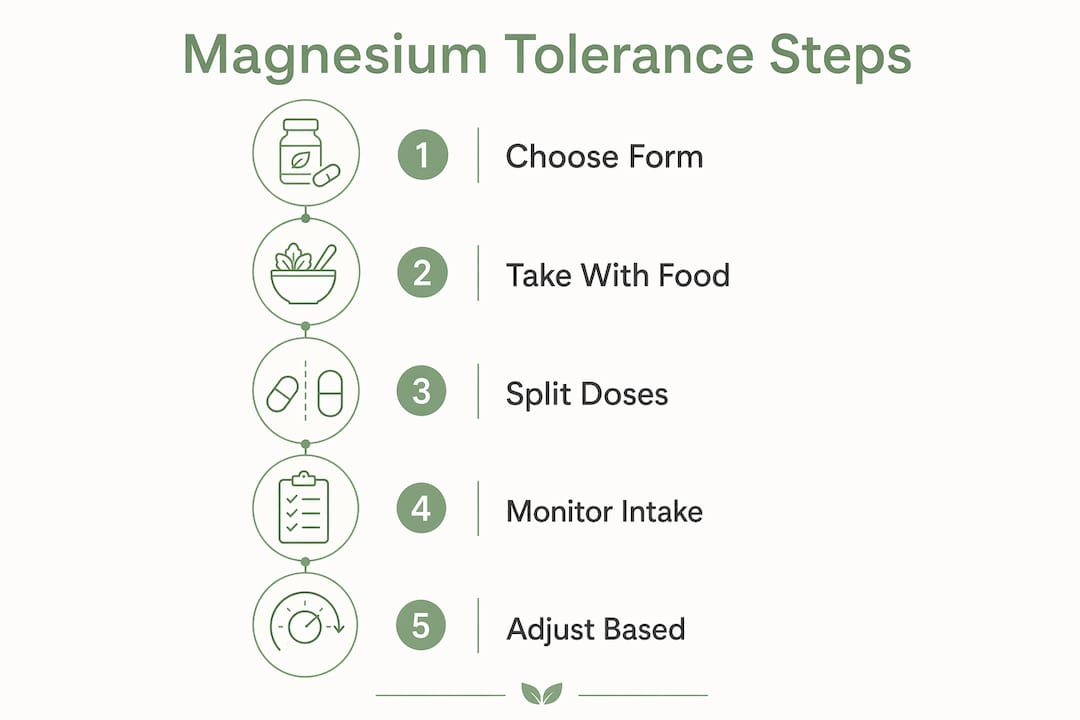
Magnesium bisglycinate sidesteps most of this problem by binding magnesium to two glycine molecules. The chelated structure reduces free ions in the gut and lowers the osmotic effect significantly. That is why bisglycinate is widely recognised as the best-tolerated form, and why it suits runners who need reliable, night-after-night supplementation without worrying about their next morning run.
| Measure | Men | Women |
|---|---|---|
| UK Reference Nutrient Intake (RNI) | 300 mg/day | 270 mg/day |
| NHS supplement upper guidance | ≤ 400 mg/day | ≤ 400 mg/day |
Staying within the recommended upper intake from supplements is unlikely to cause harm; the main risk above that threshold is diarrhoea, not toxicity.
What magnesium bisglycinate realistically does for runners
Magnesium supports energy production, protein synthesis and muscle recovery — three processes that matter on every run and in every recovery window afterwards. Glycine, the carrier molecule in bisglycinate, also has mild calming properties that can support sleep onset. For runners logging consistent mileage, that combination is genuinely useful.

What it will not do is compensate for poor sleep hygiene, under-fuelling, or overtraining. Nutrition professionals are clear that magnesium supplements are often oversold for sleep and recovery; foundational habits come first. Think of bisglycinate as a support layer, not a shortcut.
Realistic outcomes for runners who are low in dietary magnesium:
- Reduced post-run muscle stiffness after a few weeks of consistent use.
- Small but noticeable improvement in sleep quality when combined with good sleep hygiene.
- Fewer nocturnal cramps, particularly during high-mileage training blocks.
- Steadier energy levels during longer runs, linked to magnesium’s role in ATP production.
Runners most likely to benefit are those with low dietary intake or heavy training loads. If your diet already includes plenty of magnesium-rich foods — spinach, nuts, wholemeal bread, seeds — the marginal gain from supplementing is smaller. For a deeper look at how this plays out overnight, Runcomplete’s guide on magnesium for runners’ sleep covers the recovery mechanics in detail.
When to take magnesium and how much to start with
Pick a time you will actually stick to. For sleep benefits, taking bisglycinate 30–60 minutes before bed on a relatively empty stomach may improve acute relaxation. If your stomach is sensitive, prioritise taking it with your evening meal first and adjust once you know how you respond.
Starter dosing framework:
- Begin at a moderate elemental magnesium dose from bisglycinate.
- Hold that dose for a week before increasing.
- A moderate starting supplement dose from glycinate or bisglycinate is commonly recommended, keeping total daily intake (food plus supplements) within 320–400 mg depending on sex and training needs.
- If loose stools appear, halve the dose before escalating again.
| Form | Approximate bioavailability | Digestive tolerance |
|---|---|---|
| Magnesium oxide | ~4% | Poor — high osmotic effect |
| Magnesium citrate | ~25–30% | Moderate |
| Magnesium bisglycinate | ~30% | Good — chelated, low osmotic effect |
Splitting the dose (morning and evening) is a practical tolerance strategy. It keeps the amount hitting your gut at any one time lower, which reduces the laxative risk without sacrificing total daily intake.
Pro Tip: If you are aiming for sleep benefits but find evening doses cause mild nausea, try taking your capsule with a small carbohydrate-containing snack rather than on a completely empty stomach.
How to fit magnesium into your daily routine as a runner
The simplest approach is to attach your supplement to a meal you already eat reliably. Here are three routines that work for different runner schedules:
- Breakfast routine — suits morning runners who train fasted and eat afterwards. Take bisglycinate with your post-run breakfast. Food is already there; no extra planning needed.
- Post-lunch routine — works for runners who train at lunchtime or early evening. A small meal with some fat or carbohydrate buffers the mineral well.
- Evening with dinner — the most popular choice for runners targeting sleep quality. Take your capsule with your main meal, then wind down as normal.
What to avoid pairing with your dose: high-calcium foods (dairy-heavy meals) can compete for absorption pathways, so spacing your supplement away from a large glass of milk or a calcium-fortified drink is worth doing when practical. You do not need to be rigid about it, but it is an easy win.
Race week checklist:
- Do not trial a new dose or form for the first time in race week.
- Stick to the routine you have already tested on ordinary training nights.
- If you are travelling, pack your supplement in your hand luggage so the routine does not break.
Pro Tip: Start your trial on a Monday or Tuesday — an easy training night with no race pressure. Record how you sleep and how your legs feel the next morning. Two weeks of consistent notes tells you far more than one night.
For broader race-week supplement planning, Runcomplete’s half marathon recovery guide covers what to prioritise and what to leave out.
Side effects, drug interactions, and when to see a GP
The most reliable signal that your dose is too high is loose stools. Reduce intake immediately or split the total daily dose if that happens — it is the body’s clearest feedback and the simplest fix.
Common side effects at higher doses: diarrhoea, bloating, stomach cramps. These are dose-dependent and almost always resolve when you drop back.
Key drug interactions to know:
- Fluoroquinolone and tetracycline antibiotics — magnesium binds to these in the gut and reduces their effectiveness. Space doses by at least two hours.
- Bisphosphonates (for bone density) — take magnesium at least two hours apart.
- Levothyroxine — spacing is advised; check with your pharmacist for the specific gap.
The BNF lists approximately 26 interactions for magnesium, with specific spacing guidance for several common medicines. If you take any regular prescription medication, a quick conversation with your pharmacist before starting is the sensible move.
When to consult a GP or pharmacist:
- Kidney disease or impaired renal function — magnesium clearance is reduced and toxicity risk rises.
- Pregnancy or breastfeeding.
- Taking any of the medicines listed above.
Keep your total daily elemental magnesium (from food and supplements combined) within the NHS guidance of up to 400 mg/day unless a clinician advises otherwise.
This article is general information, not medical advice. Confirm current guidance with a pharmacist or GP for your own situation.
Runcomplete’s recommended trial method for runners
A 14–21 day structured trial gives you enough signal to know whether bisglycinate is working for you. Here is the protocol:
- Baseline week (days 1–7): No supplement. Log your sleep quality (1–10), perceived muscle soreness the morning after runs, and stool consistency. This is your reference point.
- Start low (days 8–14): Take 100–200 mg elemental magnesium from bisglycinate with dinner on normal training nights. Continue logging the same three metrics.
- Review at day 14: Compare your logged scores. If sleep quality has improved and digestion is fine, hold the dose. If loose stools appeared, halve the dose for the next week.
- Optional escalation (days 15–21): If tolerating well and seeking more benefit, increase cautiously toward the 320–400 mg total daily target, accounting for dietary intake.
| Metric | How to track | What to look for |
|---|---|---|
| Sleep quality | Score 1–10 each morning | Upward trend over 14 days |
| Muscle soreness | Score 1–10 post-run | Lower scores after comparable efforts |
| Stool consistency | Note any changes | Loose stools = reduce dose |
Pro Tip: A simple notes app works fine for tracking. The goal is pattern recognition over two weeks, not clinical precision. Even rough daily scores reveal a trend.
Runcomplete’s Ready is UK-made, free of fillers, and comes with a 30-day guarantee — so the trial carries no financial risk. Tim at Runcomplete developed this approach specifically for everyday runners who want a practical, low-fuss way to evaluate whether supplementing is worth continuing.
Key takeaways
Taking magnesium bisglycinate with food is the most reliable starting point for runners: it reduces digestive upset, supports consistent dosing, and lets you build a habit that actually sticks.
| Point | Details |
|---|---|
| Take with food | UK pharmacy guidance supports taking magnesium with or after meals to reduce diarrhoea risk. |
| Start at 100–200 mg elemental magnesium | Begin low, hold for a week, then increase cautiously toward a 320–400 mg daily total (including food and supplements). |
| Evening timing for sleep | Take 30–60 minutes before bed, with food if sensitive, for best sleep-support results. |
| Loose stools = reduce dose | Diarrhoea is the clearest sign your dose exceeds current tolerance; halve it immediately. |
| Runcomplete Ready | UK-made bisglycinate capsules with a 30-day guarantee; follow the 14-day trial protocol above. |
Why bisglycinate tolerability matters more than most guides admit
Most magnesium content focuses on which form absorbs best. That misses the real issue for runners: the supplement you actually take every night beats the one you abandon after three days of loose stools.
Bisglycinate’s tolerability advantage is not marketing. The chelated structure genuinely reduces the osmotic load on the gut, and the glycine carrier adds a mild calming effect that complements the sleep goal. But the form only works if the dose is right and the habit is consistent. A runner taking 400 mg of bisglycinate erratically will see less benefit than one taking 150 mg reliably with dinner every night.
The other thing guides understate: dietary magnesium matters. Spinach, pumpkin seeds, almonds, and wholemeal bread are all solid food sources of magnesium, and if you are already eating well, your supplement dose can be modest. Supplementing on top of a magnesium-rich diet is not harmful at sensible doses, but it is also not dramatically more effective than fixing the diet first.
The 30-day trial approach exists precisely because individual response varies. Some runners notice better sleep within a week; others take three weeks to register a difference. The tracking protocol cuts through that noise and gives you a personal answer rather than a population average.
Ready: Runcomplete’s magnesium bisglycinate for runners
Runners who have worked through the trial protocol and want a reliable, no-fuss source of bisglycinate will find exactly that in Runcomplete’s Ready.

Ready contains magnesium bisglycinate in capsule form, with no fillers, and is suitable for vegetarians and vegans. It is made in the UK and available as a one-time purchase or monthly subscription. The 30-day guarantee means you can complete the full trial protocol without financial risk. Take one or two capsules with your evening meal, log your sleep and recovery, and reassess at two weeks.
Useful sources and further reading
- NHS — Vitamins and minerals: magnesium — UK reference intakes, upper limits, and food sources of magnesium.
- Doncaster and Bassetlaw Teaching Hospitals NHS Foundation Trust — Magnesium guidance — NHS pharmacy guidance on oral magnesium, tolerability, and dosing; adapted from SPS by Consultant Pharmacist Lee Wilson.
- BNF/NICE — Magnesium interactions — Full list of drug interactions and spacing recommendations.
- Runner’s World UK — Magnesium benefits for runners — Practical overview of magnesium’s role in running performance and recovery.
- Marathon Handbook — Magnesium for runners — Dosing guidance, bioavailability comparisons, and runner-specific advice.
- Capsure UK — Best time to take magnesium — UK-focused guide on timing, tolerability, and bisglycinate.
- SwiLab — Magnesium bisglycinate — Detailed explanation of bisglycinate’s chelated structure and digestive tolerance mechanism.
- Runcomplete blog — magnesium for runners’ sleep — Deeper reading on overnight recovery and sleep quality for runners.
- Runcomplete blog — gentle magnesium for runners — Practical tolerability and dosing strategies.
Consult a pharmacist or GP before starting magnesium supplements if you take regular prescription medication, have kidney disease, or are pregnant. They can check interactions and confirm the right dose for your situation.
Recommended
- Magnesium for Runners’ Sleep: Unlocking Overnight Muscle Recovery – Run Complete
- Gentle Magnesium for Runners: Recovery Without the Stomach Upset – Run Complete
- When to Take Magnesium for Running: Timing Your Dose for Better Recove – Run Complete
- Magnesium Bisglycinate for Runners: The Secret to Heavy Leg Recovery a – Run Complete

