
For everyday UK runners, Runcomplete Ready is the standout choice. It uses magnesium bisglycinate (also called magnesium glycinate), the form with the highest bioavailability and the gentlest stomach profile, formulated specifically for recovery and sleep. It is made in the UK, free from unnecessary fillers, suitable for vegetarians and vegans, and backed by a 30-day money-back guarantee.
Three reasons it earns the top spot:
- Form: Bisglycinate chelates magnesium to glycine, improving absorption compared with inorganic salts and reducing the digestive side effects common with cheaper forms.
- Transparency: The label shows clear elemental magnesium per serving, with no bulking agents obscuring the active dose.
- Low risk to try: A 30-day guarantee means you can assess whether it genuinely helps your recovery and sleep before committing.
Ready to try it? Visit Runcomplete to order or start a subscription.
Table of Contents
- What does magnesium bisglycinate actually do for runners?
- Who should try it, and what are the safety considerations?
- How do you pick a quality magnesium supplement in the UK?
- How and when should you take magnesium bisglycinate?
- How long before you notice a difference?
- Key takeaways
- Why everyday runners deserve a simpler approach to supplementation
- Runcomplete Ready: what it contains and how to buy it
- Useful sources and further reading
What does magnesium bisglycinate actually do for runners?
Magnesium bisglycinate supports recovery and sleep through two overlapping mechanisms: better absorption than most other forms, and the calming effect of glycine itself.
Magnesium is involved in over 300 enzymatic reactions, including muscle contraction, protein synthesis, and energy metabolism. After a hard run, your muscles need it to relax and repair. Low dietary magnesium is also associated with elevated cortisol, which keeps you in that familiar “tired but wired” state long after your evening run. Sports nutrition experts note that bisglycinate modulates cortisol and supports GABA receptors, shifting the body towards more restorative sleep.
Glycine, the amino acid magnesium is bound to in this form, is itself a calming neurotransmitter. It supports melatonin production and reduces core body temperature slightly at night, both of which help sleep onset. For runners, that overnight window is when most of the real recovery happens.
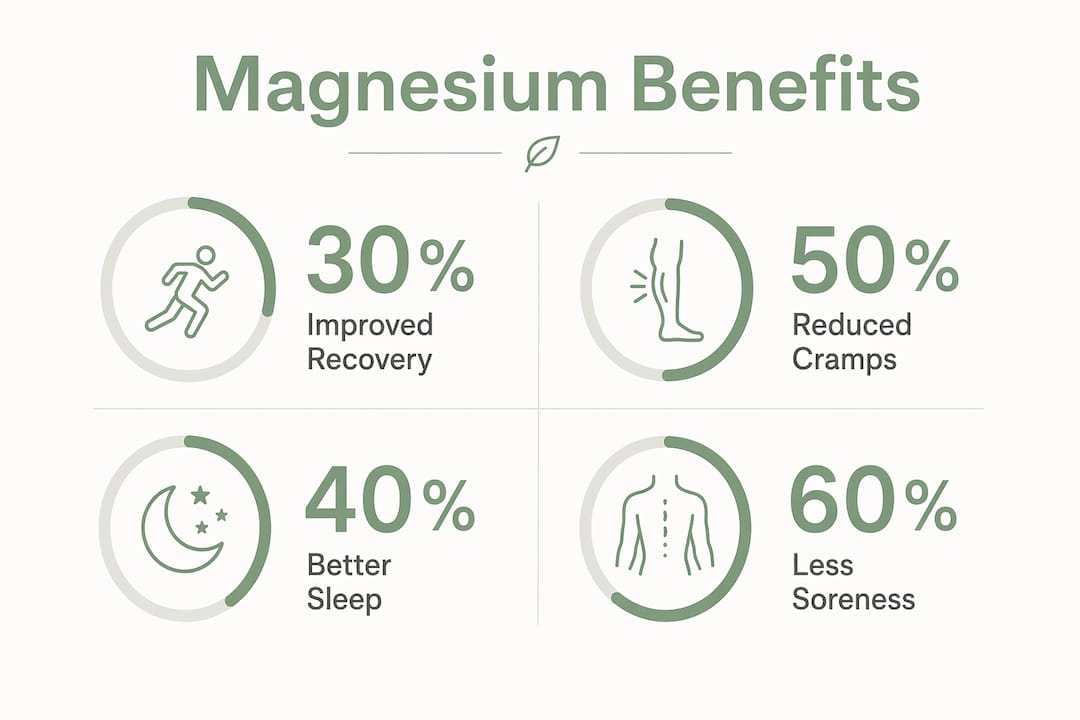
What the evidence shows: A randomised trial cited by NobleNature found magnesium glycinate produced a 28% reduction in Insomnia Severity Index scores over 28 days, compared with an 18% reduction for placebo. A separate 2022 study using 350mg magnesium glycinate daily for 10 days found significantly reduced muscle soreness at 24, 36, and 48 hours post-exercise.
The practical benefits for runners: reduced next-day soreness, fewer cramp episodes when deficiency is a factor, and faster sleep onset. These are real but not guaranteed. Bisglycinate corrects a deficiency and supports recovery conditions; it does not replace adequate training load management or sleep hygiene. If your magnesium levels are already optimal, the gains will be modest. For runners who train consistently and sleep poorly, the difference tends to be more noticeable. You can read more about the recovery and sleep connection on the Runcomplete blog.
Who should try it, and what are the safety considerations?
Magnesium bisglycinate suits everyday runners who carry a consistent training load, struggle with sleep quality, or suspect their diet is low in magnesium-rich foods (leafy greens, nuts, seeds, wholegrains). It is also worth considering if you experience regular leg cramps after longer runs.
Side effects to know about:
- Loose stools or mild GI discomfort, usually at higher doses or when taken on an empty stomach.
- Occasional drowsiness, which is actually useful if you take it before bed but worth knowing if you dose mid-afternoon.
- Rarely, nausea at doses above individual tolerance.
Interactions to check:
- Bisphosphonates (used for bone density): separate by at least 3–4 hours.
- Certain antibiotics, including tetracyclines and fluoroquinolones: take magnesium 2–3 hours apart.
- Diuretics and proton pump inhibitors can deplete magnesium; supplementing may be particularly relevant but check with your GP or pharmacist first.
- Digoxin users should seek medical advice before supplementing.
Which? experts advise staying under 400mg elemental magnesium per day from supplements without medical supervision. The NHS sets adult daily requirements at around 300mg for men and 270mg for women from all dietary sources combined.
Check with your GP first if you are pregnant, have kidney disease, take prescribed medications that affect magnesium levels, or are unsure whether symptoms (cramps, fatigue, poor sleep) have a different underlying cause.
How do you pick a quality magnesium supplement in the UK?
Start with the form. Bisglycinate and glycinate are the same compound; both terms on a label indicate a chelated form with better absorption than inorganic salts such as oxide or sulphate.
Six-point label checklist:
- Form: Magnesium bisglycinate or glycinate listed as the active ingredient.
- Elemental magnesium per serving: This is the actual usable amount, not the total compound weight. A product listing “500mg magnesium bisglycinate” may contain only around 50–100mg elemental magnesium.
- Dose per capsule vs per serving: Check whether the stated dose requires two or four capsules; some products obscure a low per-capsule dose behind a multi-capsule serving.
- Filler and additive list: Which? notes that bulking agents such as talc and PVA are common in UK supplements and reduce the proportion of active ingredient per capsule.
- Vegetarian and vegan suitability: Relevant if you follow a plant-based diet; capsule shells are often gelatine-based unless stated otherwise.
- Third-party testing and UK manufacturing: These signal quality control beyond the manufacturer’s own claims.
“The best supplement is the one you will actually take consistently. Prioritise well-absorbed, simple formulations over expensive novel blends unless you have a targeted need.” — Helvy, citing practitioner guidance
Pro Tip: Compare elemental magnesium per serving across products, not the total compound weight. A product with fewer capsules per serving and a higher elemental Mg figure usually indicates better concentration and fewer fillers.

How and when should you take magnesium bisglycinate?
The common starter range for active adults is 200–350mg elemental magnesium per day from a supplement. The NHS recommends around 300mg for men and 270mg for women from all sources; the EU Nutrient Reference Value (NRV) is 375mg. Stay under 400mg per day from supplements without medical advice.
| Goal | Elemental Mg per day | Timing |
|---|---|---|
| Sleep support | 200–300mg | 1–2 hours before bed |
| Recovery (post-run) | 200–350mg | Evening or split: post-run + bedtime |
| Starter tolerance check | 100mg | Evening, with food |
| Safe upper limit (supplements) | 400mg | Do not exceed without GP guidance |
Timing guidance:
- For sleep: take 1–2 hours before bed to allow glycine’s calming effect to build before you lie down.
- For recovery: split the dose between post-run and bedtime, or take the full dose in the evening if you run in the morning.
- Avoid taking a large dose immediately before a hard session; the small risk of digestive discomfort is not worth it.
Avoid taking magnesium at the same time as calcium-heavy meals or the antibiotics listed above. A 2–3 hour gap is usually sufficient. For more detail on timing your dose around your training schedule, the Runcomplete guide on when to take magnesium for running covers this in depth.
How long before you notice a difference?
Allow at least 10–14 days before expecting meaningful change. Practitioners observe that most people need consistent daily dosing for this period before sleep quality or muscle soreness improvements become noticeable.
A simple trial timetable:
- Days 1–7: Tolerance phase. Start at the lower end of the dose range. Note any GI effects; if loose stools occur, reduce the dose and take with food.
- Days 8–21: Watch for shifts in sleep onset time, how rested you feel in the morning, and next-day soreness after harder sessions.
- Week 4 onwards: Consistent patterns should be visible. Track cramp frequency and how your legs feel 24–48 hours after long runs.
Track four things simply: sleep onset time, a 1–10 morning freshness score, next-day soreness rating, and cramp frequency per week. You do not need an app; a notes page on your phone works fine. If GI side effects persist beyond the first week, reduce the dose rather than stopping entirely. Consult your GP if adverse effects continue or if you see no benefit after a full four-week trial at an appropriate dose.
Key takeaways
Magnesium bisglycinate is the best-absorbed, most gut-friendly magnesium form for UK runners, and consistent daily dosing for at least two weeks is what separates results from disappointment.
| Point | Details |
|---|---|
| Best form for runners | Choose magnesium bisglycinate or glycinate; better absorbed than oxide or citrate, gentler on the stomach. |
| Starter dose | Begin at 200mg elemental magnesium per day; build to 200–350mg; stay under 400mg without GP advice. |
| Timing | Take 1–2 hours before bed for sleep; split post-run and bedtime for recovery focus. |
| Safety check | Consult your GP if you take prescribed medications, have kidney disease, or are pregnant before starting. |
| Runcomplete Ready | UK-made, filler-free bisglycinate with a 30-day guarantee; a low-risk way to run a proper trial. |
Why everyday runners deserve a simpler approach to supplementation
The supplement market is full of products aimed at elite athletes or gym-goers chasing marginal gains. Most everyday runners just want to feel less wrecked the day after a long run and sleep through the night without waking at 3am with tight calves.
That gap is exactly what Runcomplete was built around. The formulation choices behind Ready reflect a deliberate set of priorities: bisglycinate over cheaper oxide forms, a transparent elemental magnesium figure on the label, no bulking agents, and UK manufacturing so the supply chain is traceable. These are not marketing points; they are the things that actually determine whether a supplement does what it claims.
The subscription option matters too. Consistency is what drives results with magnesium, and a monthly supply removes the friction of remembering to reorder. For runners who already manage training plans, nutrition, and recovery, one less decision is genuinely useful.
Runcomplete Ready: what it contains and how to buy it
Runcomplete Ready is formulated specifically for runners and meets every point on the checklist above: magnesium bisglycinate form, clear elemental magnesium per serving, no unnecessary fillers, vegetarian and vegan capsules, UK-made, and backed by a 30-day money-back guarantee.

You can buy Ready as a one-off purchase or on a monthly subscription, whichever suits your routine. The subscription removes the reorder friction and keeps your supply consistent, which matters because the benefits build over weeks rather than days. If it does not work for you within 30 days, the guarantee means you are not out of pocket.
For runners just starting out with nutrition and supplementation, the beginner runner nutrition guide on the Runcomplete site gives useful context on where magnesium fits within a broader fuelling plan.
This article is general information, not medical advice. Confirm current guidelines with the NHS or a qualified healthcare professional for your individual situation.
Useful sources and further reading
- Magnesium glycinate for sleep and muscle recovery: what the evidence actually shows — NobleNature: trial data on ISI scores, soreness reduction, and timing protocols.
- I’m a magnesium supplement expert, here are five things I’d never do when buying — Which?: label-check advice, filler identification, and dose guidance.
- Best magnesium supplements: reviewed by nutrition experts — Which?: independent UK supplement reviews including bioavailability and tolerability comparisons.
- Which magnesium should I take? — Helvy: practitioner-led guidance on form selection and starting doses.
- Is magnesium glycinate good for runners? — Cymbiotika: explanation of chelation and bioavailability.
- Magnesium glycinate: benefits, side effects and best time to take — Evopure: UK-focused overview of dosing and tolerability.
- NHS dietary reference values for magnesium: the NHS sets adult requirements at 300mg/day for men and 270mg/day for women; the EU NRV is 375mg. For personalised advice, speak to your GP or a registered dietitian.
- Sports massage for recovery: if you are exploring complementary recovery methods alongside supplementation, sports massage addresses soft-tissue fatigue that supplements alone cannot resolve.
Recommended
- Gentle Magnesium for Runners: Recovery Without the Stomach Upset – Run Complete
- Magnesium Bisglycinate for Runners: The Secret to Heavy Leg Recovery a – Run Complete
- When to Take Magnesium for Running: Timing Your Dose for Better Recove – Run Complete
- Magnesium for Runners’ Sleep: Unlocking Overnight Muscle Recovery – Run Complete

