
Standard hard capsule sizes run from the largest to the smallest. For most supplement formulas, start with size 00 or 0 and work outward only if your target dose and powder density demand it.
Three rules to keep in your back pocket before reading further:
- Convert mg to mL first. Divide your target dose in mg by your powder’s bulk density (g/mL) × 1,000. That gives you the minimum capsule volume you need.
- Prefer 00 or 0 for single-capsule concepts. These sizes cover the majority of common supplement doses and are the most widely accepted by consumers.
- Use elongated shells (00E or 0E) before jumping a full size. If you are only slightly over capacity, an elongated variant adds volume without the swallowability penalty of a larger diameter.
The full specification table and worked calculations are in the sections below.
Key takeaways
Choosing the right capsule size comes down to one calculation: convert your target dose to mL using measured bulk density, then match that volume to the standard size chart, starting at 00 or 0.
| Point | Details |
|---|---|
| Start with size 00 or 0 | These cover most supplement doses and offer the best balance of capacity and swallowability. |
| Use the density formula | Fill weight (mg) = capsule volume (mL) × bulk density (g/mL) × 1,000; measure density yourself before ordering. |
| Try elongated shells first | If you are slightly over capacity, 00E or 0E adds volume without increasing diameter or swallowing difficulty. |
| Pilot fill before production | Hand-fill 10 capsules and weigh them; if average fill exceeds 90% of theoretical volume, move up a size. |
| Runcomplete Ready capsule | A size 00 magnesium bisglycinate capsule, UK-made, vegan-friendly, and designed for single-serving ease. |
Table of Contents
- What are the standard supplement capsule sizes and dimensions?
- How to read a capsule size chart correctly
- How many milligrams fit in each capsule size?
- Practical factors to weigh when choosing a capsule size
- How capsule shell material affects capacity and dietary suitability
- Worked examples: which size fits common supplement doses?
- How to measure bulk density and estimate fill weight at home
- Choosing capsule sizes: what actually matters in practice
- Runcomplete: magnesium bisglycinate in a capsule built for runners
- Sources
What are the standard supplement capsule sizes and dimensions?
The table below draws on manufacturer specification data from Torpac, which publishes volume, locked length and diameter for each standard hard capsule size. Use these as planning figures; confirm exact values with your chosen supplier before production.
They are not always listed in basic charts, so ask your supplier specifically.
Printing tip: LFA Capsule Fillers’ interactive chart includes printable actual-size outlines. Always print with “fit to page” switched off, then check the printed scale against a ruler before using the outline to assess swallowability.
Tolerances on locked length and diameter are typically ±0.3 mm and ±0.05 mm respectively for standard gelatin shells, though HPMC shells can run slightly tighter or looser depending on the manufacturer. Capsuline UK’s size chart lists empty weights and volumes for both gelatin and vegetarian shells, which is useful when comparing shell types side by side.
How to read a capsule size chart correctly
The numbers on a capsule size chart are easy to misread if you do not know which dimension refers to what. Here is what each term actually means:
- Locked (closed) length: the total length of the assembled capsule once the cap and body are joined. This is the dimension that matters for swallowability and bottle fill count.
- Body vs cap: the body is the longer, narrower tube that holds the fill; the cap is the shorter, slightly wider piece that slides over it. Volume figures refer to the combined internal space of both.
- Theoretical volume: the maximum internal fill space in mL. In practice, you will rarely fill beyond 85–90% of this figure without risking poor closure or weight variation.
- External diameter: the widest point of the assembled capsule. Larger diameters are harder to swallow and require wider tooling bores on filling machines.
- Empty weight: the weight of the shell alone, before filling. This matters when calculating total capsule weight for label claims.
- Tolerance: the acceptable manufacturing variation on any given dimension. Always confirm tolerance bands with your supplier, as they affect both filling machine settings and label weight declarations.
Elongated (E) variants such as 00E and 0E use the same cap diameter as the standard size but extend the body length. They are worth considering when your calculated fill volume sits between two standard sizes, because they avoid the jump to a larger diameter. Prosafe Nutra’s sizing guide recommends shortlisting 00 or 0 first and reaching for elongated shells before committing to 000.
Before confirming a size with your supplier, check:
- Whether their tolerance bands match your filling machine’s specifications
- Whether they stock the elongated variant in your preferred shell material
- How they measure locked length (some measure to the rim, others to the tip of the dome)
- Whether their empty weight figures are for gelatin or HPMC shells
How many milligrams fit in each capsule size?
Fill weight depends on powder bulk density, particle size, moisture content and how the powder is packed. The formula is straightforward:
Required volume (mL) = target dose (mg) ÷ (bulk density (g/mL) × 1,000)
Rearranged to find maximum fill weight: fill weight (mg) = capsule volume (mL) × bulk density (g/mL) × 1,000
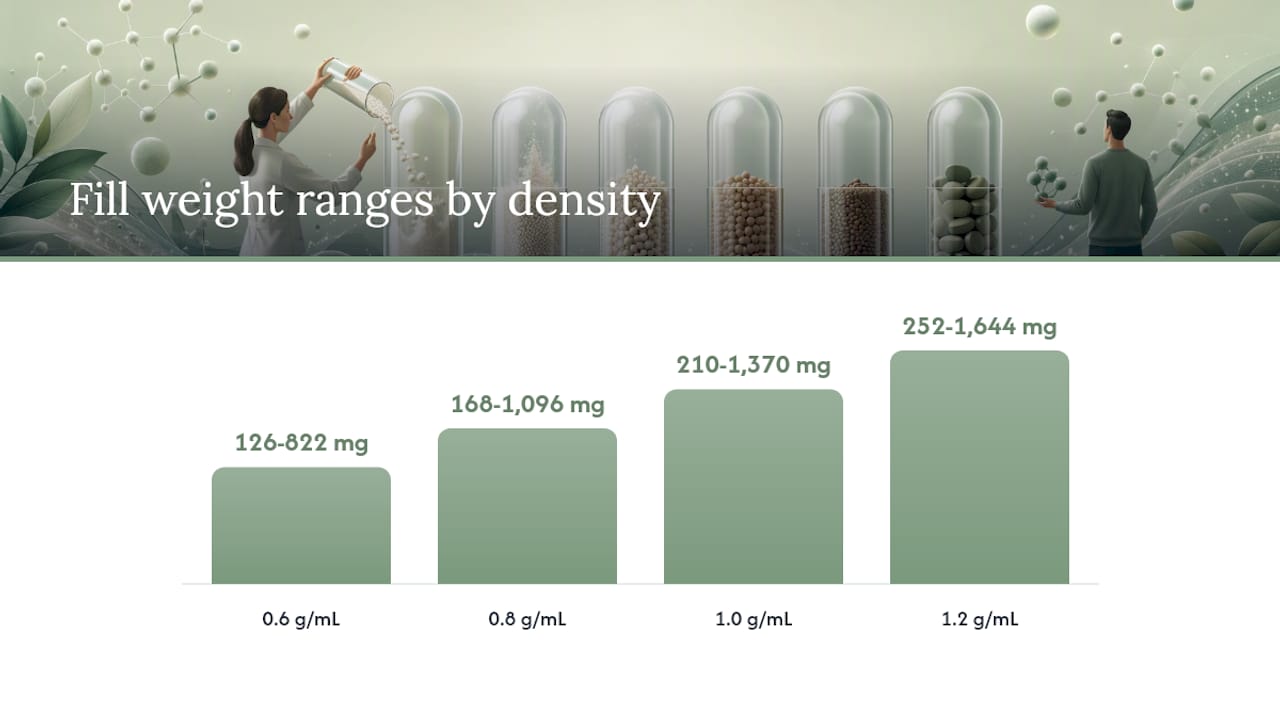
Capsulesizes provides density-based fill weight estimates across the standard size range. The table below uses those planning figures for four common bulk densities.
| Size | 0.6 g/mL (mg) | 0.8 g/mL (mg) | 1.0 g/mL (mg) | 1.2 g/mL (mg) |
|---|---|---|---|---|
| 000 | 822 | 1,096 | 1,370 | 1,644 |
| 00 | 570 | 760 | 950 | 1,140 |
| 0 | 408 | 544 | 680 | 816 |
| 1 | 300 | 400 | 500 | 600 |
| 2 | 222 | 296 | 370 | 444 |
| 3 | 162 | 216 | 270 | 324 |
| 4 | 126 | 168 | 210 | 252 |
| 5 | 78 | 104 | 130 | 156 |
Worked example 1: 400 mg magnesium bisglycinate
Magnesium bisglycinate powder typically has a bulk density of around 0.6–0.7 g/mL. At 0.65 g/mL:
- Required volume = 400 ÷ (0.65 × 1,000) = 0.615 mL
- A size 0 capsule offers 0.68 mL theoretical volume. At 90% utilisation that is 0.61 mL — borderline.
- Recommendation: size 00 (0.95 mL) gives comfortable headroom. If swallowability is the priority and the formula is stable at 90% fill, a size 0 with a pilot fill is worth testing first.
Worked example 2: 800 mg mineral blend
A denser mineral blend at 1.0 g/mL:
- Required volume = 800 ÷ (1.0 × 1,000) = 0.80 mL
- A size 00 offers 0.95 mL, giving 84% utilisation — well within the safe range.
- Recommendation: size 00 is the clear first choice. If the blend is slightly less dense (0.8 g/mL), required volume rises to 1.0 mL, which exceeds size 00. At that point, consider a 00E elongated shell or a two-capsule serving before moving to 000.
Overfilled capsules can fail to lock cleanly, leading to weight variation and potential leakage on the production line. Essencefield’s dosage capacity guide recommends sample fills as a standard step before committing to a production run.
Practical factors to weigh when choosing a capsule size
Dose and density get you to a shortlist. These factors determine which size you actually commit to:
- Desired dose per serving. A single-capsule serving is almost always preferable from a consumer compliance standpoint. If your target dose fits in a 00 or 0, keep it there.
- Powder bulk density. Measure it yourself (see the method section below) rather than relying on a supplier’s generic figure, which may not match your finished blend.
- Swallowability. Size 00 (8.53 mm diameter, 23.3 mm long) is near the upper limit of comfortable swallowing for many adults. Size 000 is noticeably harder and should carry a clear “take with water” instruction.
- Capsules per serving. Two capsules per serving is widely accepted, but three or more can deter compliance. If your formula needs three capsules, reconsider the dose or the delivery format.
- Machine and tooling compatibility. Urmachine’s industrial capsule guide notes that size 000 may require special tooling and runs slower on standard high-speed filling machines, while very small sizes (4, 5) need good powder flowability to maintain dosing accuracy. Confirm tooling availability before finalising size.
- Bottle count and packaging. A larger capsule means fewer fit per bottle at a given serving count, which affects packaging cost and shelf footprint.
- UK regulatory labelling. The Food Supplements (England) Regulations 2003 (and their devolved equivalents) require that label claims for nutrient content are accurate per stated serving. Your capsule size directly determines what “per serving” means, so lock the size before drafting label copy.
- Moisture and hygroscopic actives. Some powders absorb moisture readily, which changes bulk density over time and can cause capsule shells to soften. This is especially relevant for magnesium salts and botanical extracts.
Questions to ask your supplier before locking in a size:
- What is your recommended fill efficiency (% of theoretical volume) for this shell type?
- What are your tolerance bands on locked length and empty weight?
- Do you stock 00E or 0E elongated shells in HPMC?
- What tooling change lead time should I allow if I switch sizes after a trial?
Pro Tip: Position a one-capsule serving as a brand feature, not just a convenience. “One capsule, no fuss” is a meaningful differentiator in a category where two-to-four capsule servings are common. If your formula is borderline between 0 and 00, the brand messaging case for staying at 00 is often stronger than the cost saving from dropping to 0.
How capsule shell material affects capacity and dietary suitability
Shell material is not just a dietary preference question. It changes empty weight, disintegration time and, in some cases, closure tolerances.

| Material | Dietary status | Typical empty weight vs gelatin | Disintegration tendency | Key consideration |
|---|---|---|---|---|
| Gelatin | Not vegetarian/vegan | Baseline | Fast (5–15 min in gastric fluid) | Most widely available; lowest cost |
| HPMC | Vegetarian and vegan | Slightly heavier (+5–10%) | Slower (15–30 min); more variable | Required for vegan labelling in UK |
| Pullulan | Vegetarian and vegan | Similar to HPMC | Moderate; low oxygen permeability | Higher cost; good for oxygen-sensitive actives |
For UK supplement labelling, a “suitable for vegetarians” or “suitable for vegans” claim requires the shell to be certified as such by the supplier. Ask for written confirmation and a certificate of conformity, not just a verbal assurance.
HPMC shells can be slightly more sensitive to humidity during filling, and pullulan shells are notably hygroscopic in high-humidity environments. Both factors can affect closure integrity and shell weight, so run a humidity-controlled pilot fill if your facility is not climate-controlled.
Disintegration time matters for efficacy. A gelatin capsule typically disintegrates within 5–15 minutes in gastric fluid, while HPMC can take 15–30 minutes or longer. For most mineral and botanical supplements this difference is not clinically significant, but for time-sensitive actives it is worth discussing with your formulation chemist.
Worked examples: which size fits common supplement doses?
The magnesium bisglycinate row reflects the kind of formulation Runcomplete uses in its Ready magnesium capsules: a chelated form with a relatively low bulk density that sits comfortably in a size 00 shell, keeping the capsule easy to swallow without needing a second capsule per serving.
For the high-dose B-complex, a two-capsule serving of size 00 is often preferable to a single 000 capsule on swallowability grounds, even though the 000 technically fits the dose. The production trade-off is that 000 tooling may not be standard on your contract manufacturer’s line.
Running a quick pilot fill: request a small sample of your target shell size from your supplier (most UK capsule suppliers will send a sample pack of 100–500 shells). Fill by hand using a small scoop or spatula, weigh each filled capsule, and calculate the average fill weight and standard deviation.
How to measure bulk density and estimate fill weight at home
You do not need a laboratory to get a usable bulk density figure. A 10 mL graduated cylinder and a precise scale (0.01 g resolution) are sufficient for planning purposes.
- Tare the graduated cylinder on your scale and record the weight.
- Spoon your powder loosely into the cylinder up to the 10 mL mark. Do not tap or compress.
- Weigh the filled cylinder and subtract the tare weight. The result is the mass of 10 mL of powder in grams.
- Divide by 10 to get bulk density in g/mL. For example: 7.8 g in 10 mL = 0.78 g/mL.
- Apply the formula: fill weight (mg) = capsule volume (mL) × 0.78 × 1,000. For a size 00 (0.95 mL): 0.95 × 0.78 × 1,000 = 741 mg estimated fill weight.
- Run a hand-fill pilot with 10 capsules, weigh each, and compare to your calculated estimate. A consistent result within ±5% of the calculated figure gives you confidence to proceed to a supplier trial.
This method gives you a loose bulk density figure. Tapped bulk density (after vibration or tapping) will be higher and is what filling machines tend to achieve. For a conservative estimate, use the loose figure; for a tighter estimate, tap the cylinder 20 times on a hard surface before reading the volume.
Safety and QA note: home measurements are indicative only. Before committing to a production run, have your contract manufacturer or a third-party testing laboratory validate fill weight under production conditions. For products making nutrient content claims, USP verification provides an independent quality benchmark worth considering.
Choosing capsule sizes: what actually matters in practice
The sizing charts and formulas in this article give you the framework, but the real decisions are simpler than they look. Most supplement formulas land in a size 00 or 0, and the choice between them usually comes down to one question: can you hit your target dose at a comfortable fill level, or are you pushing the capsule to its limit?
Swallowability is underweighted in most formulation discussions. A capsule that is technically correct but uncomfortable to take daily will quietly erode compliance, and compliance is the only metric that actually matters for a supplement’s effectiveness. If a formula sits right at the edge of a size 0, the modest cost saving over a size 00 is rarely worth the consumer experience trade-off.
The other thing formulators underestimate is how much bulk density varies between batches, especially for botanical powders and chelated minerals. A density figure from a supplier’s data sheet is a starting point, not a guarantee. Running your own measurement, as described above, and then doing a pilot fill before placing a production order is the single most effective way to avoid expensive surprises.
For runners specifically, the practical priority is a capsule that is easy to take on a training day, ideally with a single capsule per serving. Runcomplete’s approach with its magnesium bisglycinate formulation reflects exactly that thinking: a size 00 shell, no fillers, and a dose that fits cleanly without requiring two capsules.
Runcomplete: magnesium bisglycinate in a capsule built for runners
Recovery after a run depends on more than stretching. Magnesium bisglycinate is one of the best chelated magnesium forms available, and the difference between a supplement you actually take and one that sits in a drawer often comes down to how easy it is to swallow.

Runcomplete’s Ready magnesium capsules are made in the UK, free of fillers, and suitable for vegetarians and vegans. The formulation fits a single size 00 capsule per serving, so there is no counting out a handful of tablets after a long run. One capsule, taken before bed, supports muscle recovery, reduces cramps and promotes deeper sleep. Available on a monthly subscription or as a one-time purchase, with a 30-day guarantee. If you are looking for an easy to swallow magnesium supplement designed specifically for runners, this is where to start.
Sources
These are the primary specification and guidance pages used to build this article. Download or bookmark them before approaching a capsule supplier or contract manufacturer.
- TORPAC CAPSULES Empty Hard Gelatin Capsule Physical Specifications
- Capsule Size Chart: Volume, Length & Fill Weight (000-5)
- Capsule Size Chart: 000-5 Volume, Length & Fill Weight
- Industrial Capsule Size Chart & Tooling Guide (2026) | Urmachine
When requesting tooling or mould numbers from a filling machine supplier, bring the Torpac PDF and confirm that the mould bore matches the external diameter of your chosen shell size and material.

