
For everyday UK runners, Runcomplete Ready is the standout choice: unbuffered magnesium bisglycinate, made in the UK, with a 30-day guarantee and no unnecessary fillers. If you want the short answer, that is it.
- What to take: Runcomplete Ready, an unbuffered magnesium bisglycinate capsule
- Why bisglycinate: higher absorption than oxide or citrate, far gentler on the stomach
- How much: a typical supplemental range for runners falls within a moderate amount. The NHS recommends general daily intake levels for men and women respectively as a dietary baseline
- UK trust signals: UK-made, third-party tested, 30-day money-back guarantee
Table of Contents
- Why magnesium bisglycinate works better for runners
- How much magnesium should UK runners actually take?
- Which runners actually need to supplement?
- What to check before you buy magnesium bisglycinate
- How to time magnesium for recovery and sleep
- Side effects, interactions, and when to see your GP
- Why Runcomplete Ready suits everyday runners
- Key takeaways
- A runner-centred view on magnesium supplementation
- Runcomplete Ready: low-risk way to try magnesium bisglycinate
- Useful sources and further reading
Why magnesium bisglycinate works better for runners
Magnesium bisglycinate is a chelated form of magnesium: the mineral is bound to two glycine molecules, which protects it through the digestive tract and improves how much your body actually absorbs. That chelation is the key practical difference from cheaper forms.
The tolerability gap is real. Chelation prevents free magnesium ions accumulating in the gut, which is precisely what causes the laxative effect common with citrate or oxide. For runners who have ditched magnesium after one bad experience with loose stools, bisglycinate is usually the form that finally works.
For runners specifically, the practical benefits are muscle relaxation after hard efforts, support for nervous-system recovery, and improved sleep quality. The evidence on sleep is reasonably strong: a randomised controlled trial found magnesium bisglycinate produced a statistically significant reduction in insomnia severity scores over 28 days, with most improvement appearing within the first two weeks. The evidence on exercise-induced cramping is more mixed: magnesium supports muscle function but is not a substitute for electrolyte balance or hydration when cramps are the primary problem.
Common magnesium forms at a glance:
- Oxide: poorly absorbed (~4% bioavailability), frequently causes diarrhoea
- Citrate: moderate absorption (~25–30%), mildly laxative for some
- Bisglycinate/glycinate: good absorption (~30%), gentlest on the gut, calming effect from glycine
The “bis” simply means two glycine molecules are attached; the theoretical absorption advantage over standard glycinate is marginal. What matters more in practice is product purity.
How much magnesium should UK runners actually take?
The NHS/DHSC recommended daily intake provides guideline amounts for men and women (aged 19–64). These figures cover total intake from food and supplements combined, not supplementation alone.
| Magnesium form | Approx. bioavailability | GI tolerance |
|---|---|---|
| Oxide | ~4% | Poor (laxative) |
| Citrate | ~25–30% | Moderate |
| Bisglycinate | ~30% | Good |
Safety threshold: Taking high doses of supplemental magnesium can cause diarrhoea. The NHS advises caution not to exceed recommended amounts from supplements alone.
Runners training regularly often need more than a sedentary person. A supplemental dose of 160–400 mg/day is the practical range, depending on your dietary intake and training load. Divide doses to reduce any GI risk: 100–200 mg with an evening meal, and another 100–200 mg before bed works well for most runners.
Example dosing plans:
- Easy run day: 200 mg with dinner
- Long run day: 200 mg post-run with food, 200 mg before bed
- Rest day: 200 mg in the evening
Always take magnesium with or after food. An empty stomach increases the chance of nausea, even with bisglycinate.
Which runners actually need to supplement?
Not everyone does. Runners with diets rich in leafy greens, nuts and wholegrains may already meet their baseline needs from food alone. Supplementation is most valuable when diet or training pushes needs beyond what food reliably supplies.
Signs supplementation may help you:
- High weekly mileage (above 30–40 miles) or intense training blocks
- Diet low in magnesium-rich foods (few nuts, seeds, wholegrains, or dark leafy greens)
- Frequent muscle cramps not explained by dehydration or sodium loss
- Poor sleep quality, particularly difficulty staying asleep after hard training days
- Restricted diet (vegan, calorie-restricted, or gut-health conditions limiting absorption)
Signs you probably don’t need it:
- Balanced whole-food diet with regular nuts, seeds, and greens
- Low mileage (fewer than 15 miles per week) with no signs of deficiency
- No sleep disruption or cramping issues
Pro Tip: If you suspect deficiency, the most reliable check is a serum magnesium blood test via your GP. At-home signals like persistent leg cramps, poor sleep, and fatigue after easy runs are worth noting, but they overlap with many other causes. A blood test removes the guesswork.
What to check before you buy magnesium bisglycinate
Label-reading matters more than most runners realise. Some products marketed as magnesium bisglycinate are buffered with magnesium oxide, which reduces bioavailability and reintroduces the GI problems bisglycinate is supposed to avoid.

| Feature | What to look for |
|---|---|
| Form | “Bisglycinate” or “TRAACS bisglycinate” on the label |
| Purity | “Unbuffered” — no magnesium oxide listed in ingredients |
| Elemental magnesium | Stated clearly per capsule (not just total compound weight) |
| Third-party testing | Certificate of Analysis (COA) available on request |
| Suitability | Vegetarian/vegan capsule shell |
| Origin | UK-made for supply chain confidence |
Quick buying flow:
- Decide your target elemental dose (typically 160–400 mg supplemental)
- Check elemental magnesium per capsule, not just “magnesium bisglycinate” compound weight
- Confirm the form is unbuffered and free of oxide fillers
- Look for third-party testing or a COA
- Choose subscription for ongoing training support, or one-off purchase to trial
Bioavailability and purity are the decisive factors. A cheaper product with oxide filler will deliver less magnesium and more GI discomfort.
How to time magnesium for recovery and sleep
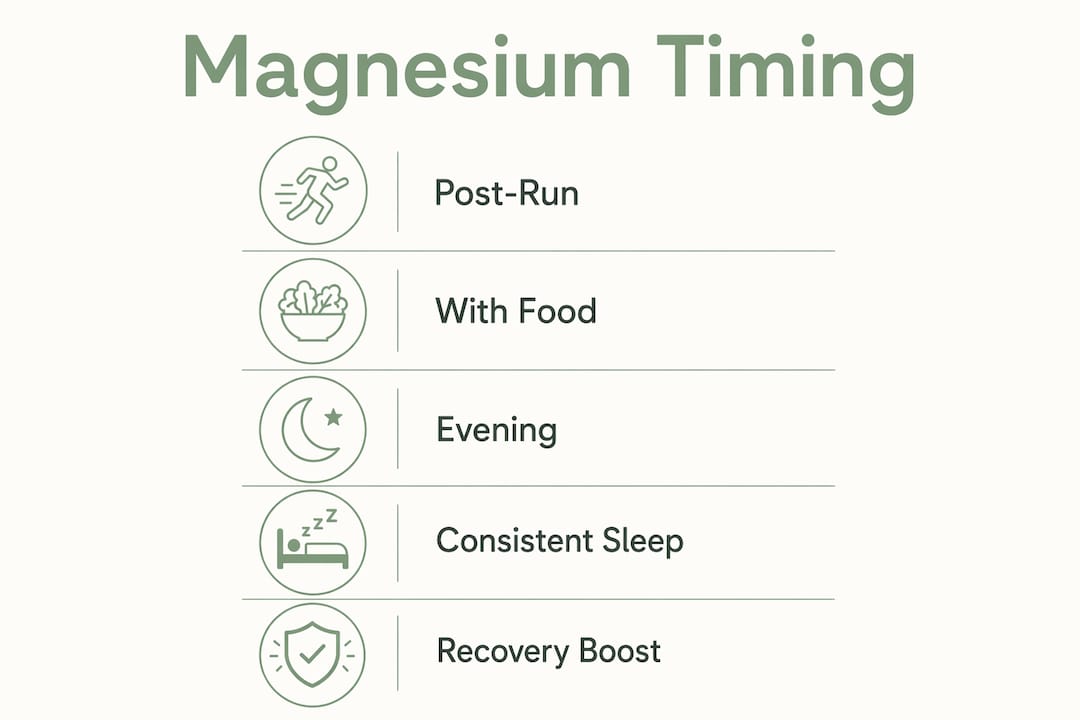
Evening dosing, 30–60 minutes before bed, captures both the sleep and nervous-system recovery benefits. Post-workout dosing after an afternoon or evening run works well too. Avoid large doses immediately before a run: magnesium can stimulate gut motility, which is the last thing you want mid-effort.
Timing by training day:
- Easy run day: single dose (200 mg) with dinner or 30 minutes before bed
- Long run day: split dose — 200 mg post-run with food, 200 mg before bed
- Rest day: single evening dose to support overnight muscle repair
What to expect and when:
- Days 1–7: some runners notice improved sleep quality within the first week
- Weeks 2–4: the randomised trial data shows most sleep improvement occurs in the first 14 days
- Weeks 4+: sustained benefit; combine with good sleep hygiene for runners for best results
Pair magnesium with consistent sleep timing and post-run nutrition for compounding recovery gains. It is a support tool, not a standalone fix.
Side effects, interactions, and when to see your GP
Magnesium bisglycinate is well tolerated at recommended doses, but it is not risk-free at high amounts.
Common side effects to watch for:
- Loose stools or diarrhoea at doses above 400 mg supplemental per day
- Mild nausea if taken on an empty stomach
- Rarely, lethargy at very high doses
Drug interactions: Magnesium can reduce the absorption of certain antibiotics (particularly tetracyclines and fluoroquinolones), bisphosphonates (used for bone density), and some diuretics. If you take any prescription medication, check with your GP or pharmacist before starting supplementation.
Reduce your dose if loose stools appear — that is the clearest signal you have exceeded your personal tolerance. Long-term safety data for high supplemental doses is limited, so staying within the 400 mg/day supplemental ceiling is sensible. See your GP if you suspect genuine deficiency, experience persistent muscle weakness, or have a condition affecting magnesium absorption.
This article is general information, not medical advice. Confirm current guidance with your GP or a qualified healthcare professional for your own situation.
Why Runcomplete Ready suits everyday runners
Runcomplete Ready is built around unbuffered magnesium bisglycinate: no oxide fillers, no unnecessary additives, and a vegetarian/vegan-friendly capsule. It is made in the UK, which matters for supply chain transparency, and comes with third-party testing and a certificate of analysis available on request.
What makes Ready practical for runners:
- Unbuffered bisglycinate: no oxide dilution, so you get what the label says
- Vegetarian and vegan capsule shell, free of common fillers
- UK-made with third-party lab testing
- 30-day money-back guarantee — low risk to trial
- Available as a one-time purchase or monthly subscription
For magnesium bisglycinate timing, Ready fits the dosing schedules above: one or two capsules in the evening, with food, on both training and rest days. Check the elemental magnesium per capsule on the label to confirm your dose aligns with your target intake.
Pro Tip: Always check the elemental magnesium figure, not just the compound weight. A capsule listed as “500 mg magnesium bisglycinate” typically contains around 100 mg of elemental magnesium — the number that actually matters for dosing.
Key takeaways
Magnesium bisglycinate is the best-tolerated form for runners, and product purity matters more than the brand name on the front of the pack.
| Point | Details |
|---|---|
| Top recommendation | Runcomplete Ready: unbuffered bisglycinate, UK-made, 30-day guarantee |
| UK dosing baseline | NHS recommends 300 mg/day (men) and 270 mg/day (women) from all sources combined; typical supplemental doses for runners are in the 160–400 mg/day range |
| Safe supplemental ceiling | Keep supplemental doses at or below 400 mg/day to avoid diarrhoea |
| Best timing for runners | Evening dose 30–60 minutes before bed; split doses on long run days |
| Label check | Confirm “unbuffered bisglycinate”, elemental magnesium per capsule, and a COA |
A runner-centred view on magnesium supplementation
Most magnesium articles are written for a general health audience, then awkwardly retrofitted with a running angle. The practical priorities for runners are actually quite specific: tolerability matters more than theoretical bioavailability percentages, because a supplement that causes GI distress during a training block simply gets abandoned. Sleep quality after hard efforts is where the evidence is clearest and where everyday runners feel the difference fastest.
What gets underestimated is how much the form and purity of a product affect real-world results. Two products both labelled “magnesium bisglycinate” can perform very differently if one is buffered with oxide. That is not a minor formulation detail; it is the difference between a supplement that works and one that does not. For runners who are not elite athletes with sports dietitians on hand, the practical shortcut is to look for “unbuffered” on the label, check that elemental magnesium is stated clearly, and buy from a brand that publishes its test results. The rest is noise.
Runcomplete Ready: low-risk way to try magnesium bisglycinate
Runners who want to trial magnesium bisglycinate without committing to a large upfront purchase have a straightforward option with Runcomplete Ready. It is available as a one-time purchase or a monthly subscription, both backed by a 30-day guarantee. Buy directly from the Runcomplete site to access the certificate of analysis and confirm you are getting the UK-made, unbuffered product.

Runcomplete Ready is the practical, no-filler choice for everyday runners who want gentle magnesium for recovery without the guesswork of decoding supplement labels. Visit the Runcomplete Ready product page to check the current options and start your 30-day trial.
Useful sources and further reading
- NHS: Vitamins and minerals — magnesium — official UK recommended daily intake figures
- PMC: Magnesium bisglycinate supplementation and sleep quality RCT — randomised trial on insomnia severity
- Marathon Handbook: Magnesium for runners — practical runner-focused overview including timing and cramping evidence
- Runner’s World UK: Magnesium benefits for runners — food-first guidance and supplementation context
- Pharmacist Tested: Magnesium glycinate vs bisglycinate — label-reading and form comparison
- Runcomplete: Magnesium bisglycinate for runners — recovery and sleep timing guide
- Runcomplete: When to take magnesium for running — practical dosing schedules
For label interpretation and COA guidance, the Runcomplete product page links directly to third-party test results.
Recommended
- Magnesium Bisglycinate for Runners: The Secret to Heavy Leg Recovery a – Run Complete
- Magnesium for Runners’ Sleep: Unlocking Overnight Muscle Recovery – Run Complete
- Gentle Magnesium for Runners: Recovery Without the Stomach Upset – Run Complete
- When to Take Magnesium for Running: Timing Your Dose for Better Recove – Run Complete

