
Magnesium is an electrolyte your body cannot function without, yet it rarely gets mentioned alongside sodium and potassium in hydration advice. It governs muscle relaxation, nerve signalling and recovery, and works in constant partnership with potassium and calcium. Deficiency can worsen cramps and fatigue, but supplementation only helps when it’s targeted, not blanket dosing.
TL;DR:
- Magnesium mainly functions at the cellular level as an intracellular ion, influencing over 300 enzymatic reactions vital for energy and muscle function.
- Blood tests often underestimate magnesium deficiency because less than 1% of total body magnesium circulates in serum, requiring symptom-based diagnosis.
- Magnesium deficiency can cause hypocalcaemia and hypokalaemia, which are resistant to supplementation unless magnesium levels are corrected first.
- A magnesium intake of 310 to 420 milligrams daily can be met through foods like nuts, spinach, and seeds, but supplements like bisglycinate are useful if diet alone is insufficient.
- For active runners, magnesium supplements may reduce cramp rates and support recovery, especially when combined with sodium-rich hydration, but proper medical consultation is advised for severe or chronic deficiencies.
Table of Contents
- What is magnesium’s physiological role among the electrolytes?
- How does magnesium interact with potassium and calcium?
- What are the signs and risk factors for magnesium deficiency?
- How much magnesium do you need and where does it come from?
- Which magnesium supplement form works best and is it safe?
- Does magnesium help hydration and exercise recovery?
- How is magnesium status actually tested and diagnosed?
- What role does magnesium play in kidney function and acid-base balance?
- How does magnesium interact with sodium and chloride?
- How is magnesium deficiency treated in different clinical situations?
- Runcomplete’s take: what runners actually need to know
- Where to read more about magnesium and electrolyte health
- The overlooked mineral deserves less hype, not more
- Runcomplete’s Ready: built for exactly this gap
- Sources
What is magnesium’s physiological role among the electrolytes?
Most of the magnesium in your body isn’t floating around in your bloodstream at all. Most of the magnesium sits in bone and muscle with only a very small fraction circulating in blood serum. That last fraction is the bit doctors measure, which is precisely why blood tests can be misleading, something covered in more detail later.
Inside cells, magnesium is one of the major positively charged ions, sitting alongside potassium as the dominant intracellular cations. Sodium and calcium, by contrast, do most of their work outside cells. This distinction matters because magnesium’s influence happens largely at the cellular level, quietly enabling processes rather than driving the dramatic swings you feel with sodium loss during a long run.
The scale of magnesium’s job in the body is easy to underestimate. It acts as a cofactor for more than 300 enzymatic reactions, including nearly every step involved in producing and using ATP, the molecule that powers muscle contraction. Reviews on magnesium’s biochemistry describe it as frequently overlooked as an electrolyte despite this central role in cellular electrophysiology, enzyme activity and energy metabolism. Without adequate magnesium, the machinery that turns food into usable energy simply runs less efficiently.
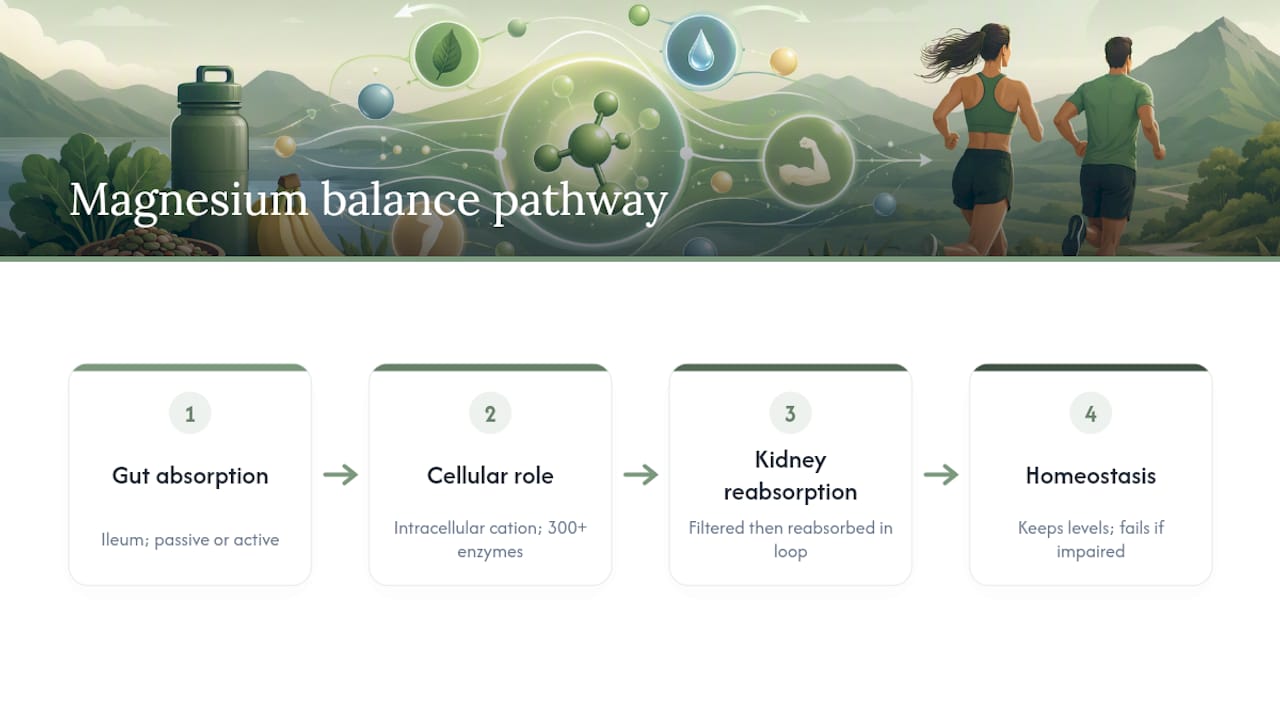
Getting magnesium into the body and keeping it there involves two separate systems working in tandem. Absorption happens mainly in the small intestine, particularly the ileum, through a mix of passive diffusion when intake is high and active transport when intake is lower. Absorption efficiency isn’t fixed. It rises when the body is running low and falls when magnesium is plentiful, a self-regulating mechanism that helps protect against toxicity from food sources alone.
The kidneys handle the other half of the equation. They filter a large amount of magnesium daily and then reabsorb most of it, primarily in the loop of Henle, adjusting the amount excreted in urine based on what the body needs. This renal reabsorption is what makes certain diuretics and kidney conditions so disruptive to magnesium balance. When that reabsorption mechanism is impaired, either by medication or disease, magnesium leaks out in urine faster than diet can replace it, setting the stage for the kind of deficiency discussed further down.
Gut and kidney regulation together mean a healthy person eating a reasonably varied diet rarely runs into serious trouble. Problems tend to arise when one of these two control points breaks down, whether through chronic diarrhoea, certain medications, or reduced kidney function.
How does magnesium interact with potassium and calcium?
Magnesium doesn’t operate in isolation. It’s deeply intertwined with two other electrolytes, and correcting one without the others often fails outright.
Take calcium first. Magnesium is required for the normal secretion of parathyroid hormone (PTH), the hormone responsible for raising blood calcium when it dips too low. When magnesium is significantly depleted, PTH secretion becomes impaired and peripheral tissues also become resistant to the PTH that is released. The result is a paradox: low magnesium can cause low calcium (hypocalcaemia) even though the parathyroid glands are perfectly healthy. A recent clinical review on magnesium homeostasis notes that magnesium deficiency is commonly accompanied by both hypokalaemia and hypocalcaemia, and that treating the magnesium is often necessary before the calcium abnormality will resolve at all. Giving calcium alone in this situation is treating the symptom while ignoring the cause.
Potassium tells a similar story through a different mechanism. Magnesium is needed to keep potassium inside cells, largely through its role in regulating the ROMK potassium channels in the kidney’s distal tubule. When magnesium is low, these channels leak more potassium into the urine, driving up renal potassium wasting regardless of how much potassium is consumed. This is why hypokalaemia caused by magnesium deficiency is notoriously resistant to potassium supplementation on its own; the kidneys keep dumping potassium until magnesium is corrected.
The cardiac and neuromuscular consequences of this triple interaction are where things get serious. Low magnesium, low potassium and low calcium each independently affect the electrical stability of heart muscle and nerve conduction, and having two or three occurring together raises the risk of arrhythmia considerably more than any single deficiency alone. Neuromuscular symptoms, tremor, spasm, hyperreflexia, often reflect this combined disturbance rather than a single mineral shortfall. It’s one of the clearest arguments for viewing electrolyte balance as a system rather than three separate numbers on a blood panel.
What are the signs and risk factors for magnesium deficiency?
Hypomagnesemia rarely announces itself with a single obvious symptom, which is part of why it goes unrecognised so often. Early signs tend to be vague: fatigue, loss of appetite, mild nausea. As deficiency deepens, more specific neuromuscular signs appear.
The clinical picture that clinicians watch for includes:
- Muscle cramps, tremor and generalised weakness
- Numbness or tingling, particularly in the extremities
- Increased reflex responses (hyperreflexia)
- Personality changes, irritability or, in severe cases, confusion
- Cardiac arrhythmias, which represent the most dangerous end of the spectrum
Clinical reviews describe hypomagnesemia as being associated with exactly this cluster of neuromuscular and cardiovascular symptoms, with severity broadly tracking how low serum magnesium falls and how quickly it dropped.
The causes split roughly into three categories. Gastrointestinal losses come from chronic diarrhoea, malabsorption conditions such as Crohn’s disease, or prolonged vomiting, since a meaningful amount of magnesium is normally reabsorbed in the gut. Renal losses happen when the kidney’s reabsorption mechanism is disrupted, whether by genetic tubular disorders or, far more commonly, by medications. Loop and thiazide diuretics, proton pump inhibitors (PPIs) taken long term, and certain chemotherapy agents all increase urinary magnesium loss. Chronic alcohol use contributes through several routes at once: poor dietary intake, direct renal wasting, and gastrointestinal effects.
Some groups carry meaningfully higher risk. Older adults absorb magnesium less efficiently from the gut and are more likely to be on long-term PPIs or diuretics. Endurance athletes lose magnesium through sweat and urine during prolonged exertion, on top of diets that may not fully replace it. People with poorly controlled diabetes lose magnesium through osmotic diuresis linked to high blood glucose. If you fall into more than one of these categories, a look at your dietary intake is worth more attention than most give it.
How much magnesium do you need and where does it come from?
Adults need between roughly 310 and 420 milligrams of magnesium per day, with the higher end generally applying to men and the lower end to women. The range exists because requirements shift with body size, muscle mass and life stage. Pregnancy nudges the requirement upward too.
Hitting that target through food is entirely achievable, and a look at ordinary portions makes the point better than any supplement marketing does:
- A 30g handful of almonds provides roughly 80mg
- A cup of cooked spinach provides around 155mg
- 30g of pumpkin seeds provides close to 150mg
- A cup of cooked black beans provides around 120mg
- A slice of wholegrain bread provides roughly 25 to 30mg
Pro Tip: Pair magnesium-rich foods with something acidic, like a squeeze of lemon on spinach, since some research suggests certain organic acids may support mineral absorption slightly better than eating the food alone.
Stack a couple of those together across a day, spinach with dinner, almonds as a snack, wholegrain toast at breakfast, and you’re within striking distance of the recommended range without any supplement at all. The trouble is that most people don’t eat that way consistently. Diets heavy in refined grains and processed food, which strip out much of the magnesium naturally present in whole grains, are common enough that mild shortfalls are widespread rather than rare.

This is where supplementation earns a place, not as a substitute for real food, but as a sensible backstop for people whose diet, training load or medical situation makes the gap harder to close through meals alone, as explained in detail in this magnesium for sleep guide. If cramps, poor sleep or persistent fatigue coincide with a diet that’s genuinely light on the foods above, that’s a reasonable trigger to consider a supplement rather than guessing.
Which magnesium supplement form works best and is it safe?
Not all magnesium supplements behave the same way once they hit your gut, and the differences explain a lot of the mixed reviews you’ll see online.
Magnesium oxide has the highest elemental magnesium content by weight, which looks appealing on a label, but it’s also the most poorly absorbed form and the most likely to cause diarrhoea, since much of it stays in the gut and pulls water in with it.
Magnesium citrate absorbs considerably better than oxide and is a common choice, but it still carries a real risk of loose stools at higher doses, which is precisely why it doubles as a laxative in higher-strength formulations.
Magnesium bisglycinate (also called glycinate), where magnesium is bound to the amino acid glycine, tends to be absorbed more efficiently and tolerated with markedly less gastrointestinal upset than oxide. The chelation process, binding the mineral to an amino acid carrier, appears to shield it from some of the digestive interactions that cause other forms to cause loose stools. That’s a large part of why Runcomplete builds its Ready formula around bisglycinate rather than a cheaper, higher-dose oxide capsule; a form that stays in your system rather than moving through it undigested doesn’t do much for recovery. If you want a deeper look at how bisglycinate specifically supports sleep and recovery, Runcomplete’s magnesium glycinate benefits piece covers the mechanism in more depth.
On dosing, most over-the-counter supplements sit between 200 and 400mg of elemental magnesium daily, and side effects, mainly gastrointestinal, become more likely as doses climb, particularly with citrate or oxide. Excess magnesium from supplements can also cause hypotension and muscle weakness, so more is not automatically better. For context, severe hypomagnesemia diagnosed in hospital is treated very differently: IV magnesium sulphate dosing there is calculated against renal function and monitored closely, a world away from a daily oral capsule, and not something to attempt at home.
A few safety notes worth taking seriously:
- People with reduced kidney function should check with a clinician before supplementing, since impaired renal clearance raises the risk of magnesium building up to unsafe levels
- Certain anti-epileptic medications, lamotrigine among them, can interact with magnesium supplements, so anyone on regular prescription medication should ask a pharmacist or GP before starting
- Diarrhoea that appears shortly after starting a new magnesium supplement is usually a sign the form or dose doesn’t suit you, not something to push through
If you’re still deciding between formats, Runcomplete’s comparison of magnesium glycinate versus citrate walks through the tolerability differences in more detail.
Does magnesium help hydration and exercise recovery?
The sports nutrition world has spent decades obsessing over sodium and, more recently, potassium, while treating magnesium as an afterthought. The evidence suggests that’s a mistake, albeit a nuanced one.
The most relevant piece of research here is the MAGNAK study, which surveyed runners across two half-marathon events using a magnesium-rich electrolyte hydration mix. Runners who used the magnesium-rich mix reported cramps at a noticeably lower rate than those who drank water alone, roughly 21% compared with 46%, a statistically significant difference. That’s a meaningful signal, but it comes from an open survey design rather than a blinded controlled trial, so it points towards a real effect without proving it conclusively for every runner in every condition.
There’s also a timing wrinkle worth knowing about. Athletes often show a temporary dip in blood magnesium immediately after exercise that typically corrects itself within a few hours. Anyone drawing conclusions from a blood test taken right after a hard session risks mistaking a normal, temporary shift for genuine deficiency.
So where does magnesium actually fit into a runner’s hydration plan? Sodium remains the priority for in-run fluid replacement, since sweat losses of sodium are large and directly tied to cramp risk and fluid balance during exertion. Magnesium plays a supportive role rather than a leading one:
- Before a run: dietary magnesium intake over the preceding days matters more than anything taken minutes before you set off
- During a run: sodium-focused electrolyte drinks should still lead; a magnesium-containing mix is a reasonable addition for longer efforts, not a replacement for sodium
- After a run: this is where magnesium’s role in muscle relaxation and recovery becomes more relevant, supporting the return to baseline rather than the effort itself
For runners training consistently rather than chasing a single race, Runcomplete’s guide to how long magnesium takes to work is worth reading before assuming a single dose will fix a cramp problem overnight.
How is magnesium status actually tested and diagnosed?
Blood tests for magnesium are more limited than most people assume, and understanding why changes how you should read your own results.
Clinically, hypomagnesemia is generally defined as a serum magnesium level below roughly 0.75 mmol/L, with severity graded further as the number drops. Below around 0.5 mmol/L, symptoms including tetany and arrhythmia become more likely, which is the threshold at which hospital treatment usually becomes necessary.
The core limitation is that serum magnesium represents less than 1% of total body magnesium, so a normal blood result doesn’t rule out a meaningful shortfall in bone and muscle stores. Clinical guidance on evaluating magnesium status is explicit that diagnosis shouldn’t rest on a single serum value; clinicians weigh symptoms, medication history (particularly diuretics and PPIs), and related electrolyte markers like potassium and calcium together, since disturbances in those minerals often point towards an underlying magnesium problem even when the magnesium number itself looks borderline.
Timing matters too, tying back to the post-exercise dip mentioned earlier. Repeated measurements over time, rather than one snapshot, give a far more reliable picture, particularly for anyone who trains heavily.
Once a genuine deficiency is confirmed, the treatment path depends on severity. Mild to moderate cases are typically managed with oral supplementation and dietary changes, followed by a repeat test some weeks later to check progress. Severe or symptomatic cases, particularly with cardiac involvement, are treated with intravenous magnesium sulphate in hospital, dosed and monitored against kidney function, since the kidneys are what ultimately clear any excess.
What role does magnesium play in kidney function and acid-base balance?
The kidneys aren’t just where magnesium gets filtered and reabsorbed. They’re also central to a much broader balancing act involving acid-base status, and magnesium sits right in the middle of it.
Magnesium influences the activity of several ion transporters in the kidney’s tubules, including ones that also handle hydrogen and bicarbonate ions, the two main currencies of acid-base regulation. When magnesium is depleted, some of these transport pathways become less efficient, and there’s a recognised link between chronic magnesium deficiency and mild metabolic disturbances involving both potassium and acid-base handling.
There’s a two-way relationship worth understanding too. Chronic metabolic acidosis, seen in conditions like chronic kidney disease, tends to increase urinary magnesium losses, compounding any dietary shortfall. This creates a cycle in people with reduced kidney function: impaired filtration disrupts magnesium handling, magnesium deficiency then affects the tubular transporters that help manage acid-base balance, and the acid-base disturbance itself further drives magnesium loss.
This is one of the clearer reasons clinicians treat magnesium and kidney health as connected rather than separate topics. Someone with declining kidney function can swing either way: reduced filtration sometimes causes magnesium to build up (hypermagnesemia), while impaired reabsorption in certain kidney disorders causes it to be lost too readily. Neither extreme is something to try to self-diagnose or self-correct with over-the-counter supplements, which is exactly why the safety caution about renal impairment and magnesium supplementation, mentioned earlier, applies here with particular force.
How does magnesium interact with sodium and chloride?
Sodium and chloride get most of the attention in hydration conversations, largely because their losses through sweat are large and their effects on fluid balance are immediate and obvious. Magnesium’s relationship with both is quieter but still clinically relevant.
Magnesium and sodium share space on the same renal transport pathways in parts of the kidney’s tubule system. Certain diuretics that block sodium reabsorption, loop diuretics in particular, disrupt the mechanisms magnesium relies on for reabsorption at the same time, which is precisely why long-term diuretic use is one of the most common drivers of magnesium deficiency seen in clinical practice. The two losses tend to travel together rather than independently.
Chloride’s link to magnesium is less direct but shows up through acid-base balance again. Chloride is the main negatively charged ion balancing sodium and potassium in extracellular fluid, and shifts in chloride handling can influence the acid-base environment that, as covered above, also affects how efficiently the kidney manages magnesium.
The clinical takeaway is straightforward even if the biochemistry isn’t: an electrolyte panel showing abnormal sodium or chloride, particularly in someone on diuretics, long-term PPIs, or with gastrointestinal illness causing fluid loss, is a reasonable prompt to check magnesium as well rather than treating it as an unrelated afterthought. This is part of why isolated correction, fixing sodium without checking magnesium, so often produces disappointing results in practice.
How is magnesium deficiency treated in different clinical situations?
Repletion strategy depends heavily on how severe the deficiency is and what’s driving it, which is why a one-size-fits-all approach to “topping up magnesium” rarely works well.
For mild, asymptomatic deficiency picked up incidentally, dietary improvement is usually the first step, sometimes paired with a modest oral supplement in the 200 to 400mg range. Follow-up testing a few weeks later confirms whether levels have recovered, bearing in mind the diagnostic limitations covered earlier around serum readings.
Moderate deficiency with symptoms, cramping, tremor, fatigue, generally warrants oral supplementation at a more consistent dose, often alongside addressing the underlying cause. If a diuretic or PPI is driving ongoing losses, correcting magnesium without reviewing that medication tends to be a losing battle; the deficiency simply recurs.
Severe deficiency, particularly with cardiac symptoms or very low serum readings, is a hospital matter. IV magnesium sulphate is given under close monitoring, with dosing adjusted against kidney function since impaired renal clearance raises the risk of overcorrection. Oral repletion afterwards is deliberately slower, reflecting the reality that refilling depleted intracellular and bone stores takes considerably longer than normalising the blood level alone.
Across every scenario, the same principle holds: repletion works best when it addresses the cause, not just the number on a blood test.
Runcomplete’s take: what runners actually need to know
Runcomplete built its Ready formula around magnesium bisglycinate specifically because casual runners have different needs to elite athletes chasing marginal gains. You’re not managing a sports science team’s electrolyte protocol; you’re trying to sleep properly, avoid a 3am calf cramp, and recover well enough to run again in two days.
What this means practically:
- If your diet is reasonably varied and you’re not on medications that deplete magnesium, food alone likely covers your needs
- If you’re training consistently, sleeping poorly, or notice recurring cramps despite decent hydration, a targeted bisglycinate supplement addresses a plausible gap without the digestive downsides of cheaper forms
- If symptoms are severe, persistent, or you have kidney issues or take diuretics, PPIs, or anti-epileptic medication, see a GP for proper testing before self-supplementing
Runcomplete’s best magnesium bisglycinate for runners guide goes deeper on why this form, made in the UK with a 30-day guarantee, tends to suit recreational runners specifically better than generic sports supplements built for gym-goers. The goal isn’t to replace a varied diet. It’s to close the gap when training load and modern eating patterns make that diet harder to maintain consistently.
Where to read more about magnesium and electrolyte health
For readers who want to go straight to primary sources rather than take any article’s word for it, four references anchor most of the claims here. The NHS’s guidance on vitamins and minerals covers recommended intake ranges in plain terms. The StatPearls hypomagnesemia review on NCBI Bookshelf is the clearest clinical reference for symptoms, thresholds and treatment. The PMC review “Magnesium: the forgotten electrolyte” is the best single explainer of the biochemistry. And the MAGNAK study on magnesium-rich hydration mixes is the most relevant sports-specific evidence currently available.
If you have persistent symptoms, kidney concerns, or take regular medication, a conversation with a GP beats any amount of independent reading.
The overlooked mineral deserves less hype, not more
The conventional wisdom on electrolytes has a blind spot, and it’s not that magnesium is unimportant, it’s that everyone treats it as an afterthought until something goes wrong. Sports drinks lead with sodium because sodium losses are large and visible. Magnesium’s effects are quieter: a cramp that doesn’t quite go away, sleep that never feels fully restorative, recovery that drags a day longer than it should.
Where the advice usually falls short is in treating supplementation as a blanket fix rather than a targeted one. The evidence doesn’t support magnesium as a cure-all, and it doesn’t support ignoring it either. What it supports is a specific, unglamorous priority order: eat the foods that supply it consistently, notice the patterns that suggest a shortfall, and reach for a well-absorbed supplement like bisglycinate when diet genuinely isn’t closing the gap. Testing has real limits, so context matters more than a single number.
If there’s one thing worth doing differently after reading this, it’s paying attention to the pattern of symptoms over weeks rather than chasing a single blood result or a single bad night’s sleep.
— Tim
Runcomplete’s Ready: built for exactly this gap
Runcomplete exists for runners who’ve read everything above and landed on the same conclusion: diet should do most of the work, but a well-formulated supplement earns its place when training load, poor sleep or recurring cramps suggest a genuine shortfall. Ready uses magnesium bisglycinate specifically because it’s absorbed efficiently without the digestive complaints that come with cheaper oxide or high-dose citrate formulas, and it’s made in the UK with a 30-day guarantee so trying it carries no real risk.

Unlike generic sports supplements built around elite training protocols, Ready is formulated for the runner training three or four times a week who wants better recovery and deeper sleep without adding another complicated routine. There are no fillers, and it works whether you buy once or set up a monthly subscription to match your training cycle. If the symptoms and dietary gaps described earlier sound familiar, visit Runcomplete to check whether Ready fits your routine, and start with a single month before deciding whether to subscribe.
This article is general information, not a substitute for advice from a qualified doctor. Consult a qualified healthcare professional about your own circumstances before acting on anything here.
Sources
- NHS — Vitamins and minerals: others (magnesium)
- Hypomagnesemia - StatPearls / NCBI Bookshelf
- Magnesium: the forgotten electrolyte — review (PMC)
- A magnesium-rich electrolyte hydration mix reduces exercise associated muscle cramps in half-marathon runners (MAGNAK)

