
Magnesium bisglycinate is the best form for sleep. It absorbs well, sits gently on the stomach, and the glycine carrier amino acid has its own modest evidence for reducing sleep latency. For runners and active adults in the UK, Ready — Magnesium for Runners (RunComplete) is the first-choice pick: UK-made bisglycinate capsules with clear elemental labelling and a 30-day guarantee.
Before you scroll to the full shortlist, here is what to look for on any label:
- Elemental magnesium per serving: aim for 100–200 mg for sleep support
- Form: bisglycinate or glycinate as the primary salt
- Timing: take 30–60 minutes before bed
- Format: capsule or powder for reliable dosing; gummies and topicals for convenience
| Product | Form | Best for | Format | Vegan-friendly |
|---|---|---|---|---|
| Ready — Magnesium for Runners (RunComplete) | Bisglycinate | Runners: sleep + recovery | Capsule | Yes |
| Viridian Magnesium bisglycinate | Bisglycinate | Sleep-focused daily use | Capsule | Yes |
| Holland & Barrett Magnesium bisglycinate | Bisglycinate | Easy high-street purchase | Capsule | Yes |
| Dr Vegan Magnesium glycinate 1500 mg | Glycinate | Higher-dose needs | Capsule | Yes |
| Heights Magnesium+ | Glycinate blend | Multi-nutrient sleep support | Capsule | Yes |
| TRIP Wild Berry Magnesium Gummies | Citrate/glycinate | Palatability and convenience | Gummy | Yes |
Table of Contents
- Does magnesium actually help you sleep?
- Which magnesium form is best for sleep?
- How to choose the right magnesium supplement in the UK
- Best magnesium supplements for sleep in the UK
- How we picked and tested these supplements
- Safety, side effects and UK guidance for magnesium supplements
- Key takeaways
- Why I think most people overthink this
- Runcomplete Ready: a clean option for runners who want better sleep
- Useful sources and further reading
Does magnesium actually help you sleep?
The honest answer: probably, but the effect is modest and most pronounced when your intake is already low.
Magnesium has three biologically plausible routes to better sleep. It activates GABA receptors, which quieten nervous system activity before bed. It supports melatonin synthesis by acting as a cofactor in the enzymatic pathway that converts serotonin to melatonin. And it contributes to muscle relaxation by competing with calcium at neuromuscular junctions, which matters if cramps or restless legs are disrupting your nights.

The clinical picture is encouraging but not dramatic. A systematic review of trials on magnesium for sleep and anxiety found mostly modest, positive effects across studies, with the caveat that sample sizes were small and dosing varied considerably between trials. RCTs in older adults with insomnia reported improvements in sleep efficiency, total sleep time, and melatonin levels, though the heterogeneity in dose and duration makes it hard to draw firm conclusions. A 2026 expert commentary published by MedicalXpress put it plainly: the mechanisms are plausible, but high-quality clinical evidence remains limited.
Who is most likely to benefit?
- People whose dietary magnesium intake is below the NHS recommended levels of approximately 300 mg/day for men and 270 mg/day for women
- Older adults, who tend to absorb less magnesium from food
- Runners and active people, who may need roughly 10–20% more magnesium than sedentary individuals due to sweat losses
- People experiencing restless legs, night cramps, or stress-related sleep disruption
Statistic callout: The systematic review found that the majority of included trials reported positive effects on at least one sleep outcome, but the authors called for larger, better-designed trials before firm clinical recommendations can be made.
If your diet is already rich in magnesium from leafy greens, nuts, seeds, and wholegrains, the uplift from supplementation will likely be smaller. That does not make supplementation pointless, but it does mean expectations should be calibrated.
Which magnesium form is best for sleep?
Glycinate and bisglycinate are the same compound described two ways: bisglycinate simply means the magnesium ion is chelated to two glycine molecules. Both terms refer to the same sleep-friendly form. Chelated organic forms like glycinate absorb better and are gentler on the gut than inorganic salts such as oxide, and the glycine carrier adds a modest independent benefit for sleep quality.
How to choose the right magnesium supplement in the UK
The single most important thing to check is the elemental magnesium per serving, not the total salt weight. A label saying “500 mg magnesium glycinate” is not the same as 500 mg of actual magnesium. Aim for 100–200 mg elemental magnesium per serving for sleep support, staying within the NHS/DHSC guidance that supplemental doses above approximately 400 mg per day can cause diarrhoea.
Red flags to avoid
- Elemental magnesium amount missing from the label
- Magnesium oxide as the sole or primary form
- Proprietary blends that obscure the active magnesium dose
- Added stimulants (caffeine, guarana) in a product marketed for sleep
- Excessive fillers, artificial colours, or undisclosed excipients
For runners specifically, magnesium needs alongside food and training are worth understanding before you settle on a dose, since sweat losses can push requirements above the standard dietary reference value.
Best magnesium supplements for sleep in the UK
Products were selected on four criteria: bisglycinate or glycinate as the primary form, clear elemental magnesium labelling, UK availability, and evidence of tolerability or third-party testing. Price-per-day estimates are based on standard retail pricing at time of review (2026); check current listings as prices change.
| Product | Form | Elemental Mg/serving | Best for | Format | Vegan | Third-party testing | Side effects |
|---|---|---|---|---|---|---|---|
| Ready — Magnesium for Runners (RunComplete) | Bisglycinate | Clearly labelled | Runners: sleep + recovery | Capsule | Yes | UK-made; 30-day guarantee | Low laxative risk |
| Viridian Magnesium bisglycinate | Bisglycinate | Clearly labelled | Sleep-focused daily use | Capsule | Yes | Widely stocked; retailer-verified | Low laxative risk |
| ZipVit Magnesium glycinate | Glycinate | Clearly labelled | Sensitive guts; nightly use | Capsule | Yes | Not publicly listed | Low laxative risk |
| Nutrition Geeks Magnesium glycinate | Glycinate | Clearly labelled | Flexible dosing | Capsule/Powder | Yes | Not publicly listed | Low laxative risk |
| Ancient & Brave True Magnesium | Mixed/topical | Varies by format | Topical or mixed-format users | Tablet/Topical | Yes | Not publicly listed | Low (oral); none (topical) |
| Simple Science Magnesium Complex | Multi-form blend | Clearly labelled | Combined-form coverage | Capsule | Yes | Not publicly listed | Moderate (citrate component) |
| Nutrition Geeks Magnesium Glycinate 3-in-1 | Glycinate blend | Clearly labelled | All-in-one supplement | Capsule | Yes | Not publicly listed | Low laxative risk |
| Vitabright Magnesium glycinate | Glycinate | Clearly labelled | Simple nightly dosing | Capsule | Yes | Not publicly listed | Low laxative risk |
| Dr Vegan Magnesium glycinate 1500 mg | Glycinate | High per serving | Higher-dose needs | Capsule | Yes | Not publicly listed | Low laxative risk |
| Heights Magnesium+ | Glycinate blend | Clearly labelled | Multi-nutrient sleep support | Capsule | Yes | Not publicly listed | Low laxative risk |
| New Leaf Magnesium glycinate | Glycinate | Clearly labelled | Tolerability-focused nightly use | Capsule | Yes | Not publicly listed | Low laxative risk |
| Sweet Bee Organic Magnesium Butter | Topical | N/A (transdermal) | Topical application | Topical | Yes | Not publicly listed | None (GI) |
| TRIP Pomegranate Orange Blossom Magnesium Powder | Mixed salts + botanicals | Varies | Flavoured powder preference | Powder | Yes | Not publicly listed | Moderate (citrate component) |
| THIS WORKS Deep Sleep Body Whip | Topical | N/A (transdermal) | Bedtime relaxation ritual | Topical | Check label | Not publicly listed | None (GI) |
| TRIP Wild Berry Magnesium Gummies | Citrate/glycinate | Varies | Palatability; convenience | Gummy | Yes | Not publicly listed | Moderate (citrate component) |
| Holland & Barrett Magnesium bisglycinate | Bisglycinate | Clearly labelled | High-street accessibility | Capsule | Yes | Retailer-verified | Low laxative risk |
| HABI Magnesium citrate Red Apple Gummies | Citrate | Varies | Gummy preference; mild laxative effect | Gummy | Yes | Not publicly listed | Moderate laxative risk |
| Ancient & Brave True Magnesium Tablets | Bisglycinate/mixed | Clearly labelled | Tablet preference | Tablet | Yes | Not publicly listed | Low laxative risk |
Ready — Magnesium for Runners (RunComplete) is the standout pick for everyday runners. The bisglycinate form keeps gut disruption low, which matters when you are training regularly and cannot afford a bad night caused by a laxative effect. UK manufacture and a 30-day guarantee add a layer of accountability that many supplement brands do not offer. For a deeper look at why bisglycinate suits runners specifically, the Runcomplete guide to magnesium glycinate benefits is worth reading alongside this article.
Viridian Magnesium bisglycinate is a solid alternative for anyone who wants a chelated bisglycinate product from a brand with long-standing UK health-retailer distribution. It is widely stocked in independent health shops and online.
Holland & Barrett Magnesium bisglycinate is the easiest high-street option. The bisglycinate form is the right choice and the price is accessible, though batch-testing transparency is limited compared to specialist brands.
Dr Vegan Magnesium glycinate 1500 mg suits people who want a higher labelled strength per serving. The 1500 mg figure refers to the salt weight, not elemental magnesium, so check the elemental figure on the label before assuming it delivers more active magnesium than other products.
Heights Magnesium+ combines magnesium with other sleep-support nutrients. Useful if you want a single capsule to cover multiple bases, though the per-nutrient dose of each ingredient will be lower than a standalone product.
Topical options (Sweet Bee Organic Magnesium Butter, THIS WORKS Deep Sleep Body Whip) work best as part of a wind-down routine rather than as primary magnesium sources. The evidence for transdermal magnesium absorption is limited; treat them as complementary rather than equivalent to oral supplementation.
Gummy formats (TRIP Wild Berry Magnesium Gummies, HABI Magnesium Citrate Red Apple Gummies) are convenient and palatable, but citrate-based gummies carry a moderate laxative risk at higher doses. HABI’s citrate formula is the more likely culprit; TRIP’s blend is gentler.
How we picked and tested these supplements
Products were shortlisted by checking three things first: the magnesium salt used (glycinate or bisglycinate as the primary form), whether elemental magnesium per serving was stated clearly on the label, and whether the product was available to buy in the UK at time of review (2026).
Scoring criteria:
- Form and absorption potential (glycinate/bisglycinate scored highest; oxide scored lowest)
- Elemental magnesium transparency (clearly labelled vs. salt weight only)
- Tolerability profile (laxative risk based on form and dose)
- Third-party or batch testing evidence (where publicly available)
- Price per day (calculated from standard retail price divided by number of servings per pack)
- Format suitability for sleep use (capsule/tablet/powder preferred over gummies for dosing precision)
- Vegan and allergen status
Trust signals used:
- UK manufacture: reduces supply-chain risk and supports label accuracy
- Third-party batch testing: confirms the product contains what the label states
- Clear elemental labelling: the single most important transparency marker for a magnesium supplement
- Money-back guarantee: signals manufacturer confidence in the product
Conflict of interest note: Runcomplete’s own product, Ready, appears in this list. It was assessed against the same criteria as every other entrant. Its inclusion reflects that it meets the selection criteria on form, labelling, UK manufacture, and guarantee; readers should weigh that context accordingly.
Safety, side effects and UK guidance for magnesium supplements
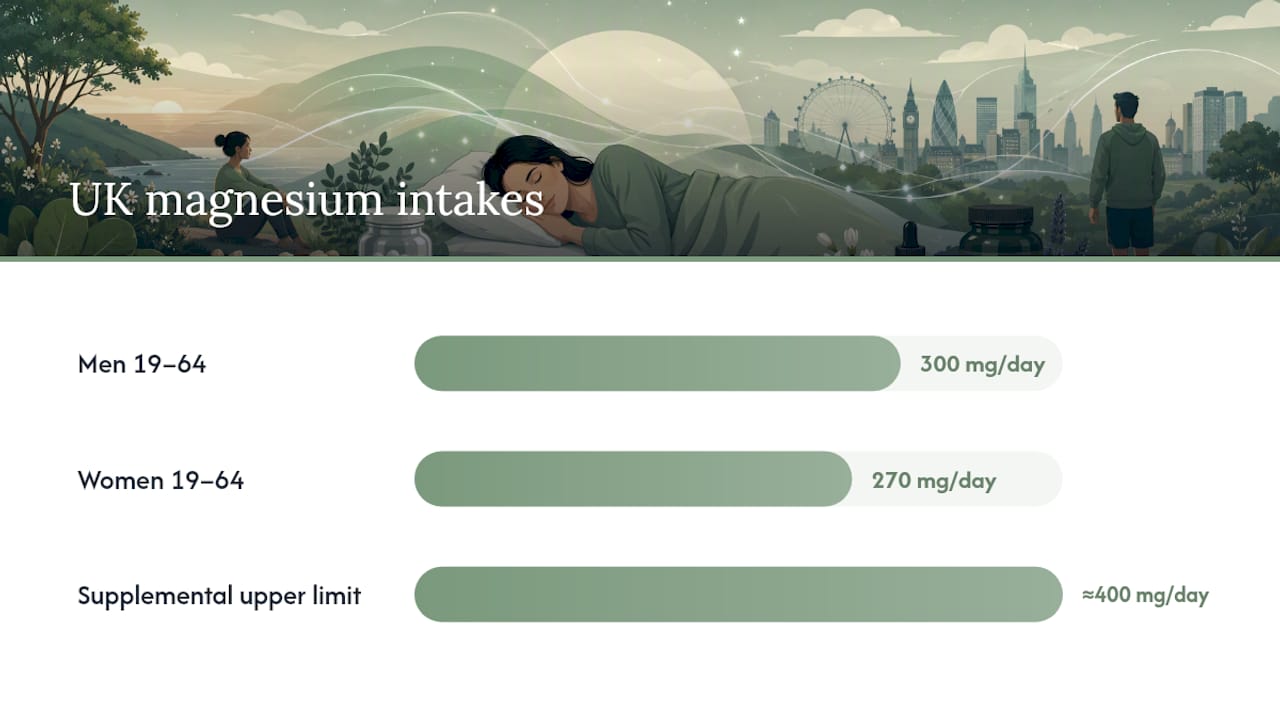
The NHS recommends approximately 300 mg/day for men and 270 mg/day for women aged 19–64, and cautions that taking more than about 400 mg of supplemental magnesium per day in the short term can cause diarrhoea. That 400 mg figure refers to supplemental magnesium on top of dietary intake, not total magnesium from all sources.
Common side effects:
- Loose stools or diarrhoea, particularly with citrate, oxide, or high doses of any form
- Mild nausea if taken on an empty stomach
- Rarely, stomach cramping at doses above the tolerable upper level
Who should take extra care:
- People with kidney disease: the kidneys regulate magnesium excretion; impaired function can lead to accumulation
- Pregnant or breastfeeding women: discuss with a GP or midwife before starting
- Anyone taking prescription medicines, particularly antibiotics (tetracyclines, fluoroquinolones), bisphosphonates, or diuretics, where magnesium can affect absorption or interact with the drug’s mechanism
For a full breakdown of magnesium side effects and how to reduce them, including practical steps for runners, the Runcomplete blog covers this in detail.
Starting safely:
- Begin with half the recommended serving for the first week
- Take with food if you notice any nausea
- Observe gut response before increasing to a full dose
- Allow 2–12 weeks to assess sleep changes, depending on your baseline magnesium status
UK guidance callout: The NIH/NCBI clinical monograph on magnesium notes that interactions with certain medicines are clinically significant. If you take any regular prescription medication, check with your pharmacist before adding a magnesium supplement.
The timeline for sleep improvement varies. People with low baseline magnesium may notice changes within two to four weeks. Those with adequate dietary intake may see a smaller or slower effect. Larger, well-designed trials are still needed to pin down the optimal dose and form for insomnia, so patience and realistic expectations are both warranted.
Key takeaways
Magnesium bisglycinate is the best single form for sleep support in the UK: well absorbed, gentle on the gut, and the glycine carrier adds its own modest sleep benefit.
| Point | Details |
|---|---|
| Best form for sleep | Bisglycinate (glycinate) absorbs well and is gentle on the gut; avoid oxide as the primary salt. |
| Elemental dose target | Aim for 100–200 mg elemental magnesium per serving for sleep support; stay within the NHS supplemental limits of approximately 400 mg per day to avoid diarrhoea. |
| Who benefits most | People with low dietary magnesium intake, older adults, and runners or active individuals who may need roughly 10–20% more magnesium due to sweat losses benefit most. |
| Timeline to improvement | Allow 2–12 weeks depending on baseline status; effects are modest if dietary intake is already adequate. |
| Runcomplete Ready | UK-made bisglycinate capsules with clear elemental labelling and a 30-day guarantee; the first-choice pick for everyday runners. |
Why I think most people overthink this
The supplement market has turned magnesium into something far more complicated than it needs to be. Threonate for brain penetration, taurate for GABA, oxide for budget buyers — the proliferation of forms gives the impression that choosing the wrong one will cost you weeks of sleep. It probably will not.
The honest picture from the research is simpler: most people who benefit from magnesium supplementation do so because their dietary intake was already borderline low, and any well-absorbed form will help. Bisglycinate earns its recommendation not because it is dramatically superior to citrate on sleep outcomes, but because it is gentle enough to take every night without worrying about a laxative effect the morning before a run. That practical advantage matters more than the marginal differences between organic forms.
What I would push back on is the idea that topical magnesium is a meaningful alternative to oral dosing for sleep. The transdermal absorption evidence is genuinely weak. A magnesium body butter might be a pleasant part of a wind-down routine, and there is nothing wrong with that, but it is not delivering a reliable dose to your bloodstream. If you are buying it as your primary magnesium source, you are likely wasting money.
For runners specifically, the case for supplementation is stronger than for the general population. Sweat losses are real, training increases demand, and poor sleep compounds recovery problems in a way that affects the next session. Starting with a conservative dose of bisglycinate 30 minutes before bed is low-risk, low-cost, and worth trying for at least four weeks before drawing conclusions.
*— Tim
Runcomplete Ready: a clean option for runners who want better sleep
Runners who train regularly and want a no-fuss magnesium supplement that actually fits their recovery needs have a straightforward option in Ready — Magnesium for Runners from Runcomplete. It delivers magnesium bisglycinate in capsule form, with elemental magnesium clearly stated on the label, no unnecessary fillers, and suitability for vegetarians and vegans.

What separates it from the generic high-street options is the combination of UK manufacture and a 30-day guarantee. You are not committing to a product you cannot return if it does not suit you, and you know exactly where it was made. For everyday runners who want sleep and recovery support without the noise of a sports supplement brand, it is a practical, evidence-aligned starting point. If you are also building your running base from scratch, Runcomplete’s beginner runner nutrition guide covers the broader dietary picture alongside supplementation.
Useful sources and further reading
The following sources were used in preparing this article. They are worth bookmarking if you want to verify specific claims or read the primary research.
- Vitamins and minerals - Others - NHS
- Systematic review of magnesium for anxiety and sleep disorders (PMC11136869)
- Magnesium requirements and losses in active populations (PMC11227245)
- Magnesium’s role and limits as a supplement (MedicalXpress, 2026)
- Comparative absorption and effects of magnesium forms (PubMed 23969766)
- Randomised trials showing sleep improvements with magnesium (PMC7352515)
- NIH/NCBI monograph on magnesium: dosing, interactions and clinical considerations (NBK554553)

