
For sleep and muscle recovery, magnesium glycinate is generally the stronger pick. For blood pressure and heart palpitations, magnesium taurate has the better evidence behind it. Most healthy adults see a difference within several weeks of consistent daily use.
There’s one caveat that matters more than the rest: if you have reduced kidney function or take regular prescription medicines, speak to a GP before starting either form. Magnesium clears through the kidneys, and impaired filtration lets it build up to unsafe levels.
- Sleep, recovery, muscle tension: magnesium glycinate (bisglycinate)
- Blood pressure, cardiac rhythm support: magnesium taurate
- Both goals at once: a split schedule, covered later in this article
A quick note on the numbers: cohort and trial data link higher magnesium intake to modest gains in sleep quality and duration, typically visible after three to eight weeks of steady supplementation, not overnight.
Key Takeaways
Magnesium glycinate supports sleep and recovery through glycine’s calming action, while magnesium taurate supports cardiovascular health through taurine’s effects on cardiac and vascular tissue.
| Point | Details |
|---|---|
| Match the carrier to your goal | Choose glycinate for sleep, recovery and muscle cramps; choose taurate for blood pressure and cardiac concerns. |
| Expect gradual results | Most benefits appear within three to eight weeks of consistent daily use, not immediately. |
| Stay within the supplemental limit | Keep elemental magnesium under 350mg per day from supplements, per NIH guidance. |
| Time your dose to your goal | Take glycinate in the evening for sleep; take taurate in the morning for cardiovascular support. |
| Check kidney function first | Anyone with reduced kidney function or complex medication should consult a GP before starting either form. |
| Runcomplete’s Ready supports the sleep case | Ready is a UK-made magnesium bisglycinate formulated for runners’ evening recovery and sleep, backed by a 30-day guarantee. |
Table of Contents
- Magnesium taurate vs glycinate: a quick comparison
- How do glycinate and taurate actually work differently?
- What does the clinical evidence actually show?
- How much magnesium glycinate or taurate should you take?
- When’s the best time to take glycinate or taurate?
- Which magnesium form is better for your specific goal?
- Who benefits most from each form beyond sleep and heart health?
- Is it safe to take magnesium glycinate or taurate long-term?
- What the research keeps getting glossed over
- Why Runcomplete’s Ready fits the sleep and recovery case
- Frequently asked questions
- Sources
Magnesium taurate vs glycinate: a quick comparison
Both are chelated forms, meaning the magnesium is bound to an amino acid rather than a mineral salt like oxide or citrate. That bond is precisely why glycinate and taurate behave so differently once inside your body.
Magnesium glycinate pairs magnesium with glycine, an amino acid that doubles as an inhibitory neurotransmitter in the brain. Magnesium taurate pairs it with taurine, which plays a direct role in cardiac muscle function and blood vessel tone. The magnesium itself is identical in both. The carrier is what shifts the emphasis.
- Glycinate: favoured for sleep, relaxation, muscle cramps and general nervous-system calming.
- Taurate: favoured for blood pressure support, heart rhythm concerns and vascular health.
- Elemental yield and tolerability: both chelates are absorbed considerably better than magnesium oxide, and the difference between glycinate and taurate in absorption is small enough that it rarely decides which one you should choose.
- Combined use: reasonable if you have both a sleep problem and a cardiovascular concern, provided total elemental magnesium stays within safe daily limits.
Where people go wrong is assuming one form is simply “better” than the other across the board. It isn’t a strength contest. It’s a matching exercise between the carrier’s own biological role and what you’re actually trying to fix.
How do glycinate and taurate actually work differently?
Chelation, the process of binding magnesium to an amino acid, changes how your gut absorbs the mineral. Free magnesium salts like oxide rely on passive diffusion and often overwhelm the intestine, causing loose stools before much magnesium is actually absorbed. Bisglycinate instead hitches a ride on amino-acid transporters in the gut wall, which is one reason chelated forms are gentler and better tolerated than cheaper mineral salts.
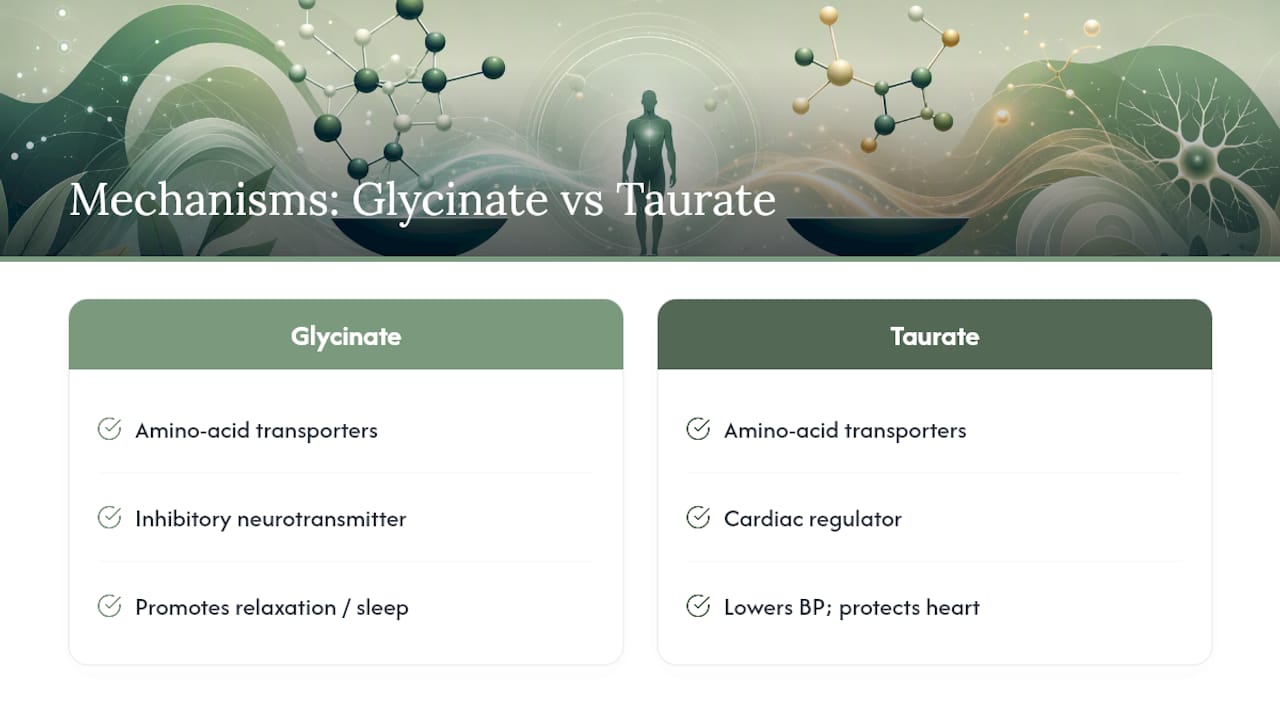
Glycine’s own job description matters here too. It’s one of the central inhibitory neurotransmitters in the spinal cord and brainstem, and it plays a documented role in lowering core body temperature before sleep onset, one of the physiological triggers your body uses to signal it’s time to wind down. Combine that with magnesium’s own effect on GABA receptor activity, and you get a supplement whose carrier and mineral are pulling in the same direction: toward relaxation.

Taurine works on a different system entirely. It helps regulate calcium flow in and out of heart muscle cells, supports how blood vessel linings respond to pressure changes, and has documented antioxidant activity in cardiac tissue. Research on magnesium taurate specifically has shown reduced blood pressure and measurable cardiac protection in hypertensive animal models, with the taurine and magnesium appearing to work through complementary rather than overlapping mechanisms.

Pro Tip: Don’t choose a form based on absorption percentages alone; the carrier amino acid’s own job in the body is usually the more important factor.
What does the clinical evidence actually show?
The evidence for glycinate and sleep is real but modest—not dramatic. A randomised, placebo-controlled trial using 250mg of elemental magnesium as bisglycinate over four weeks found a small but statistically significant improvement in insomnia scores compared with placebo. That’s consistent with broader cohort data linking higher magnesium intake to better sleep quality and more normal sleep duration, particularly in people who started out with low baseline magnesium.
For taurate, the strongest data still comes from animal and mechanistic studies rather than large human trials. One peer-reviewed study found magnesium taurate attenuated hypertension progression and reduced cardiotoxicity in a hypertensive rat model, with measurable blood pressure reductions emerging within several weeks. Separately, small human interventions using taurine or magnesium supplementation have shown increases in endothelial repair markers and reductions in oxidative stress, which supports the plausibility of taurate’s cardiovascular case even though large-scale human RCTs specifically on magnesium taurate are still thin on the ground.
What’s missing across the whole field is head-to-head data. No major trial has put glycinate and taurate side by side on the same sleep or cardiovascular outcome, so most of what you’re reading, including this article, is built from separate evidence streams pointed at separate goals. That’s an honest limitation worth sitting with.
- Glycinate: human RCT and cohort evidence, modest effect sizes, 3 to 8 week timeframe.
- Taurate: strong mechanistic and animal evidence, smaller human trials, 3 to 4 week timeframe for BP changes.
- NIH’s Office of Dietary Supplements is the most authoritative reference point for safe dosing across both forms.
How much magnesium glycinate or taurate should you take?
Most trials and clinical guidance converge on 200 to 400mg of elemental magnesium per day, regardless of which chelate you choose. The NIH’s Office of Dietary Supplements sets a tolerable upper intake level of 350mg per day for magnesium from supplements specifically, separate from the magnesium you already get through food, which isn’t capped the same way.
A few practical points worth knowing before you start:
- Start at the lower end. Many people begin around 200mg elemental and increase after a week or two if tolerated.
- Expect a gut adjustment period. Even chelated forms can cause mild loosening of stools in the first week; this is far less common than with magnesium oxide or citrate.
- Watch for signs of excess. Nausea, drowsiness, or an irregular heartbeat at higher doses warrant cutting back and checking with a GP.
- Avoid supplementing unsupervised if you have significant kidney impairment. Reduced filtration means magnesium can accumulate to dangerous levels.
- Space doses away from certain medicines. Tetracycline and fluoroquinolone antibiotics, plus bisphosphonates, bind to magnesium and lose effectiveness if taken too close together.
Magnesium bisglycinate specifically tends to cause fewer GI side effects than oxide or citrate forms, which is part of why it’s become the default recommendation for anyone who’s tried magnesium before and given up because of stomach upset.
When’s the best time to take glycinate or taurate?
Timing isn’t cosmetic here, it changes what you get out of the supplement. Take magnesium glycinate in the evening, roughly 30 to 60 minutes before bed, so glycine’s calming and thermoregulatory effects line up with your natural wind-down window. Taking it in the morning doesn’t cause harm, but you’re wasting the part of its effect that’s most useful to you.
Taurate works better earlier in the day if your goal is blood pressure or palpitation support, since you want steady coverage through your most active hours rather than a slow-release effect while you sleep.
- Morning: magnesium taurate, taken with breakfast.
- Evening: magnesium glycinate, taken 30 to 60 minutes before bed.
- Combined schedule: split doses across the day, keeping total elemental magnesium within the 350mg supplemental ceiling.
- Medicines: separate any dose from tetracyclines, fluoroquinolones, or bisphosphonates by two to four hours.
Pro Tip: Take magnesium with a meal rather than on an empty stomach; it noticeably reduces the chance of GI discomfort without affecting absorption in any meaningful way.
For runners specifically, taking magnesium with food around training days tends to smooth out tolerability even further, and getting the timing right relative to your run can make the recovery benefit more noticeable.
Which magnesium form is better for your specific goal?
Before picking a form, run through four questions honestly: what’s your primary goal, how’s your kidney function, what medicines are you currently on, and are you pregnant or planning to be? The answers narrow the decision fast.
- Sleep, recovery or muscle cramps as the priority: choose magnesium glycinate. It’s the better-evidenced option for nervous-system calming and has the gentlest GI profile of the common chelates.
- Blood pressure or heart palpitations as the priority: choose magnesium taurate. The cardiovascular mechanism data is more specific to this form.
- Both goals genuinely apply: consider the split schedule outlined earlier, provided total elemental intake stays under the supplemental ceiling.
- Any kidney impairment, complex medication list, or pregnancy: don’t self-prescribe. Get bloodwork or a GP conversation before starting either form.
If you’re still unsure which chelate fits your situation, a comparison against other common forms like citrate can help clarify why glycinate keeps winning out for tolerability specifically.
Who benefits most from each form beyond sleep and heart health?
Glycinate’s calming profile extends well past sleep. People dealing with generalised anxiety, tension headaches, or the kind of restless, wired feeling that shows up after a stressful day often notice a difference with glycinate specifically, likely tied to glycine’s role as an inhibitory neurotransmitter rather than the magnesium alone. Runners and anyone doing regular resistance training tend to reach for it too, since nighttime leg cramps and post-exercise muscle tension respond well to evening dosing.
Taurate’s audience is narrower but distinct. Beyond blood pressure, people managing occasional heart palpitations unrelated to a diagnosed arrhythmia, or those with a family history of cardiovascular issues who want a preventative angle, are the ones most likely to see taurate recommended. It’s less commonly suggested for anxiety or cramping specifically, since taurine’s mechanisms centre on vascular and cardiac tissue rather than the central nervous system.
There’s a middle group worth mentioning: people managing both stress-related sleep trouble and mild blood pressure concerns. Rather than picking one form and hoping it covers both, the split-dosing approach mentioned earlier tends to serve this group better than forcing a single-form compromise. It’s a genuinely common overlap, not an edge case.
Is it safe to take magnesium glycinate or taurate long-term?
Long-term data on either form specifically is thinner than you’d expect given how widely both are used. Most safety information comes from general magnesium supplementation research rather than trials that ran for years using glycinate or taurate by name, which means the honest answer is that long-term safety looks good but isn’t as exhaustively documented as, say, vitamin D.
What is well established is the underlying principle: healthy kidneys clear excess magnesium efficiently, so cumulative build-up isn’t a meaningful concern for most adults staying within the 350mg supplemental upper limit. The risk profile changes considerably for people with reduced kidney function, where magnesium clearance slows and levels can climb gradually over months, sometimes without obvious symptoms until they’re significant.
There’s no strong evidence that either chelate becomes less effective over time or requires cycling on and off. Some people do report that the initial sleep or calming effect becomes less noticeable after several months, though whether that reflects genuine tolerance or simply the body reaching a stable, corrected magnesium level isn’t something the current research settles cleanly. If you’ve been on either form for six months or more, an annual check of kidney function and magnesium levels is a reasonable habit rather than a strict necessity, particularly if you’re also taking other supplements or medications that affect mineral balance.
What the research keeps getting glossed over
Most articles on this topic treat glycinate and taurate like competing products in the same aisle, one destined to “win.” That framing misses the actual point: the carrier amino acid is doing real physiological work of its own, and picking between them should follow your goal, not a vague sense that one is more premium or better absorbed.
The conventional advice also underplays how modest the sleep evidence really is. A 250mg dose over four weeks produced a small, statistically significant effect, not a dramatic one. That’s still worth taking seriously, but it’s not a sedative, and treating it as one sets people up to quit after a rough night thinking it “doesn’t work.”
If you’re a runner dealing with heavy legs, restless nights, or both, my honest read of the evidence is that glycinate deserves the first trial, taken consistently, in the evening, for at least three weeks before judging it. Cardiovascular concerns are a different conversation entirely, one that belongs with a GP rather than a supplement aisle decision.
Why Runcomplete’s Ready fits the sleep and recovery case
If glycinate is the form your evenings need, the harder question is which product actually delivers it without fillers, binders, or a dose too low to matter. Ready, from Runcomplete, is magnesium bisglycinate formulated specifically around what everyday runners need after a hard session: a clean, capsule-based dose designed to support muscle recovery and deeper sleep without the bulk-supplement extras most sports products bundle in.
Ready is made in the UK and backed by a 30-day guarantee, so you can trial the evening-dosing routine covered earlier in this article without committing long-term. It’s suitable for vegetarians and vegans, and available as a one-time purchase or monthly subscription depending on how you like to plan your recovery stack. If you’re managing kidney disease or a complex prescription list, talk to a clinician before adding it, same as with any magnesium supplement. For most casual runners chasing better sleep and fewer heavy-leg mornings, Ready is worth starting tonight.
Frequently asked questions
Is magnesium glycinate or taurate better for anxiety? Glycinate tends to be the better-suited option, since glycine functions as an inhibitory neurotransmitter with a documented calming effect on the nervous system. Taurate’s mechanisms centre more on cardiovascular tissue than mood.
Can you take magnesium glycinate and taurate together? Yes, provided total elemental magnesium from both stays within the 350mg supplemental upper limit and kidney function is normal. A common approach is taurate in the morning and glycinate in the evening.
How long does it take for magnesium glycinate to help with sleep? Clinical trials show measurable improvements in insomnia scores after around four weeks of consistent daily use, with broader cohort data suggesting benefits can appear anywhere from three to eight weeks in.
Does magnesium taurate lower blood pressure quickly? Animal studies show measurable blood pressure reductions within three to four weeks of consistent supplementation, though large-scale human trials on magnesium taurate specifically remain limited.
Which magnesium form has fewer side effects? Bisglycinate is generally regarded as the gentlest chelated form on the gut, causing fewer digestive side effects than magnesium oxide, citrate, or even taurate for some people, though individual tolerance varies.
Who should avoid magnesium supplements altogether? Anyone with significantly reduced kidney function should avoid unsupervised magnesium supplementation, since impaired clearance allows the mineral to accumulate to unsafe levels. Speak to a GP first if you’re on regular prescription medication.
This article is general information, not a substitute for advice from a qualified doctor. Consult a qualified healthcare professional about your own circumstances before acting on anything here.
Sources
- Association between magnesium intake and sleep quality/duration — PMC
- Magnesium — Office of Dietary Supplements (NIH)
- The science of magnesium | Metagenics Institute
- Magnesium Glycinate: Evidence, Uses, Safety, Dosage — NutriStack

