
Magnesium glycinate is the better choice for daily supplementation, sleep, muscle recovery, and anyone with a sensitive stomach. Magnesium oxide is better suited to relieving constipation or acting as a short-term antacid. The difference comes down to one thing: how much magnesium your body actually absorbs from each form.
- Sleep and recovery: Choose glycinate (bisglycinate). Higher absorption, gentler on the gut, and the glycine component may support relaxation.
- Correcting a deficiency: Choose glycinate or another organic salt. Oxide’s low fractional absorption makes it a poor vehicle for raising magnesium levels.
- Relieving constipation: Oxide works well here. Its osmotic action in the colon is precisely why it still appears in many over-the-counter laxatives.
- Antacid use: Oxide is the standard choice for short-term acid relief, not ongoing supplementation.
Label tip: The number on the front of a bottle is usually the compound weight, not the elemental magnesium your body can use. Always find the “elemental magnesium” figure in the nutrition panel before comparing products.
Key takeaways
Magnesium glycinate (bisglycinate) delivers more absorbed magnesium per dose than oxide and is the better choice for daily supplementation, sleep, and recovery, while oxide remains useful for constipation and short-term antacid purposes.
| Point | Details |
|---|---|
| Absorption is what counts | Oxide’s ~60% elemental content is offset by low fractional absorption (~4–10%); bisglycinate absorbs at a materially higher rate. |
| Read the elemental figure | Always check the nutrition panel for elemental magnesium, not the compound weight on the front of the bottle. |
| Match form to goal | Bisglycinate for supplementation, sleep, and recovery; oxide for constipation or antacid use only. |
| Safety caution | High elemental doses can cause diarrhoea; anyone with kidney disease should consult a clinician before supplementing. |
| Runcomplete’s approach | Runcomplete’s Ready capsules use bisglycinate specifically for runners: UK-made, filler-free, and backed by a 30-day guarantee. |
Table of Contents
- Magnesium glycinate vs oxide: a side-by-side comparison
- Why elemental magnesium matters more than the number on the label
- What the clinical evidence says about absorption
- Common uses: matching the right form to your goal
- Side effects, safety, and when to avoid each form
- How to choose between glycinate and oxide
- Dosing, timing, and combining forms
- Runcomplete’s perspective: why bisglycinate suits everyday runners
- The case for stopping at “absorbed dose”
- Runcomplete: magnesium bisglycinate built for runners
- Sources
Magnesium glycinate vs oxide: a side-by-side comparison
The table below covers the six dimensions that matter most when choosing between these two forms.
| Dimension | Magnesium glycinate (bisglycinate) | Magnesium oxide |
|---|---|---|
| Bioavailability / absorption | Higher fractional absorption via chelation | Low fractional absorption (~4–10% in human studies) |
| Elemental magnesium per gram | ~14% | ~60% |
| Typical uses | Daily supplementation, sleep, muscle recovery, GI-sensitive users | Laxative, antacid, low-cost short-term use |
| Onset of effect | Gradual; builds over days to weeks of consistent use | Rapid osmotic laxative effect within 30 minutes to 6 hours |
| GI side effects | Low at standard doses; well tolerated | Higher risk of loose stools and diarrhoea, especially above 400 mg elemental |
| Dosing shape | Capsules or powder; split doses improve tolerability further | Tablets, capsules, liquid suspension |
The single biggest practical takeaway: oxide’s impressive-looking elemental percentage is largely irrelevant if the body absorbs only a fraction of it. Glycinate delivers less magnesium per gram on paper, but more where it counts.
Why elemental magnesium matters more than the number on the label
Most supplement bottles lead with the compound weight, which is the total mass of the magnesium salt, not the magnesium itself. Understanding the difference can save you from buying a product that looks potent but delivers very little.
Compound weight vs elemental magnesium
Magnesium oxide is roughly 60% magnesium by weight, so a 500 mg oxide capsule contains about 300 mg of elemental magnesium. Magnesium bisglycinate is only around 14% magnesium by weight, so a 500 mg bisglycinate capsule contains roughly 70 mg of elemental magnesium. On paper, oxide looks dramatically stronger. The problem is what happens next.
The absorbed dose is what actually matters
Fractional absorption for oxide sits in the region of 4–10% in human studies. That 300 mg of elemental magnesium in the oxide capsule may yield only 12–30 mg absorbed. Bisglycinate’s fractional absorption is substantially higher, meaning that 70 mg of elemental magnesium can deliver a meaningfully larger absorbed dose despite the lower starting number.
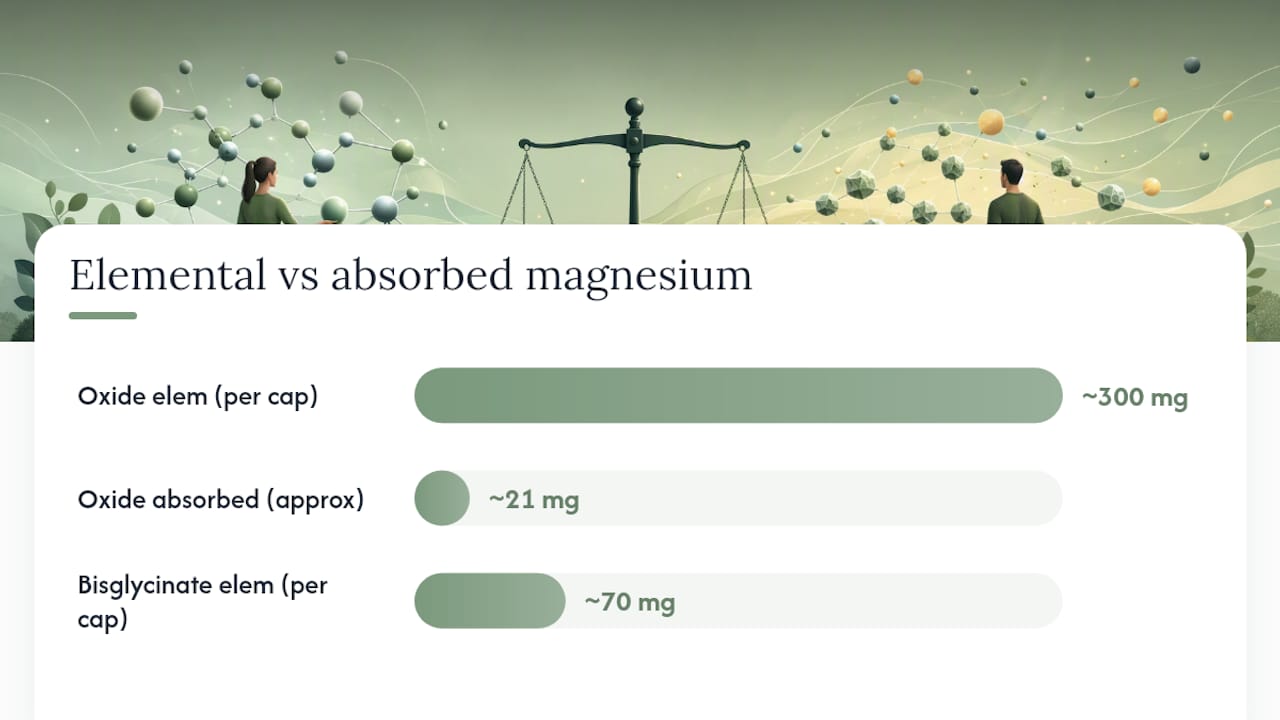
A worked example makes this concrete:
| Form | Capsule size | Elemental Mg | Fractional absorption | Approximate absorbed Mg |
|---|---|---|---|---|
| Magnesium oxide | 500 mg | ~300 mg | ~4–10% | ~12–30 mg |
| Magnesium bisglycinate | 500 mg | ~70 mg | Substantially higher | Materially more |
Three labelling pitfalls to watch for:
- A bottle stating “500 mg magnesium” without specifying elemental vs compound is almost always quoting compound weight.
- “High-strength” claims based on compound weight alone are misleading when the form has low bioavailability.
- Some products list elemental magnesium in small print in the nutrition panel; always find that figure before comparing doses across brands.
What the clinical evidence says about absorption

Organic magnesium salts, including citrate, gluconate, and glycinate, consistently show higher fractional absorption than magnesium oxide across both animal and human studies. A 2017 review published in PMC summarised this evidence, noting that while absolute differences vary by study design and measurement method, oxide sits substantially below most organic salts on urinary excretion metrics.
The measurement methods matter here. Researchers typically assess absorption either by urinary magnesium excretion after a loading dose or by serum area under the curve (AUC). Both approaches have limitations: urinary excretion reflects net retention rather than true absorption, and serum AUC can be influenced by renal clearance. Walker et al. (2003) and similar small trials reported higher urinary and serum responses for citrate and chelated forms compared with oxide in both acute and 60-day supplementation arms, though sample sizes were modest.
Absorption signal: Human studies place fractional absorption for magnesium oxide at roughly 4–10%, while organic salts and chelates typically perform materially better on the same metrics.
A practical note on special populations: people with impaired gut absorption, such as those who have had an ileal resection or who have conditions affecting small-intestine function, tend to benefit most from chelated forms. Oxide’s already-low absorption drops further when the absorptive surface is compromised.
Common uses: matching the right form to your goal
The Harvard T.H. Chan School of Public Health notes that supplements are commonly used when dietary intake falls short, but the form you choose should reflect what you are actually trying to achieve.
Where glycinate (bisglycinate) performs well:
- Daily supplementation and deficiency correction. Higher net absorbed magnesium makes it the practical choice for raising and maintaining magnesium status over time.
- Sleep and recovery. Practitioners often recommend bisglycinate at 200–400 mg elemental taken 60–90 minutes before bed. The glycine component may support calming effects, and the form’s tolerability means it is unlikely to disrupt sleep with GI discomfort. For a deeper look at magnesium glycinate benefits for recovery, Runcomplete’s guide covers the evidence in detail.
- Muscle cramps and post-exercise recovery. Runners and active individuals tend to favour bisglycinate because it supports muscle function without the laxative risk that comes with oxide at comparable elemental doses.
- GI-sensitive users. Anyone who has experienced loose stools from other magnesium forms will usually tolerate bisglycinate well at standard doses.
Where oxide has a genuine role:
- Constipation relief. Oxide’s osmotic action draws water into the colon, producing a laxative effect within 30 minutes to 6 hours. This is a feature, not a flaw, when that is the goal.
- Short-term antacid use. Oxide neutralises stomach acid quickly and cheaply, which is why it appears in many over-the-counter antacid products.
- Low-cost, short-term use. If the goal is a brief course and tolerability is not a concern, oxide’s lower price per tablet can make sense.
Where the evidence is thinner: sleep-specific randomised controlled trials vary considerably by salt, dose, and population. The signal for bisglycinate is plausible and consistent with its tolerability profile, but large, well-controlled RCTs comparing glycinate directly with oxide for sleep outcomes specifically remain limited.
Side effects, safety, and when to avoid each form
The most common side effects of magnesium supplements are gastrointestinal, and they are dose-dependent. NHS guidance is clear that loose stools, diarrhoea, nausea, and abdominal cramping are more likely with poorly absorbed forms, because unabsorbed magnesium draws water into the bowel. Oxide, with its low fractional absorption, carries a higher risk than bisglycinate at equivalent elemental doses.
High short-term doses above a certain amount can cause diarrhoea in most people regardless of form, and at very high doses there is a risk of fluid and electrolyte loss. MedlinePlus provides detailed safety and interaction guidance for magnesium-containing medicines, and it is worth checking if you take other medications.
Contraindications and interactions to know:
- Reduced kidney function. The kidneys regulate magnesium excretion; impaired renal function raises the risk of hypermagnesaemia (magnesium toxicity). Anyone with chronic kidney disease should not supplement without medical supervision.
- Drug interactions. Magnesium can reduce the absorption of certain antibiotics (tetracyclines, fluoroquinolones) and bisphosphonates. It may also interact with diuretics and proton pump inhibitors.
- Laxative overuse. Using oxide as a laxative regularly without clinical guidance can lead to electrolyte imbalance.
- Symptoms requiring urgent attention. Muscle weakness, irregular heartbeat, difficulty breathing, or confusion after taking magnesium supplements warrant immediate medical advice.
Pro Tip: If you experience loose stools on your current magnesium supplement, switching to bisglycinate and splitting the dose across morning and evening often resolves the problem without reducing your total intake. More on gentle magnesium options for sensitive stomachs.
How to choose between glycinate and oxide
One rule covers most decisions: favour organic chelates like bisglycinate for systemic supplementation; use oxide when you specifically need a laxative or antacid effect.
Decision checklist:
- Define your goal. Sleep, recovery, and deficiency correction point to bisglycinate. Constipation or acid relief point to oxide.
- Check elemental magnesium, not compound weight. Find the elemental figure in the nutrition panel and use that for dose comparisons.
- Assess your tolerability. A history of GI sensitivity to supplements is a strong reason to choose bisglycinate from the start.
- Consider price in context. Oxide is cheaper per tablet, but if absorption is low, the cost-per-absorbed-milligram may not be as favourable as it appears.
- Check for special conditions. Kidney disease, pregnancy, or a long medication list all warrant a conversation with a clinician before starting any magnesium supplement.
Three red flags that mean see a clinician first:
- Diagnosed or suspected kidney disease at any stage.
- Persistent GI symptoms (chronic diarrhoea, unexplained cramping) that could indicate an underlying condition.
- Symptoms of hypermagnesaemia: muscle weakness, very low blood pressure, slowed breathing, or confusion.
Dosing, timing, and combining forms
Work from elemental magnesium targets and your own tolerability, not from the compound weight on the label.
Those bisglycinate compound doses look large because the elemental percentage is only around 14%. In practice, most bisglycinate capsules are formulated at 500–1,000 mg compound per capsule, so two to four capsules covers the typical supplementation range.
Timing tips:
- For sleep and recovery, take bisglycinate 60–90 minutes before bed. The magnesium glycinate sleep guide from Runcomplete covers timing and dose examples for runners specifically.
- Split doses across two meals if you are taking higher elemental amounts, as this reduces the GI load at any one time.
- Avoid taking magnesium at the same time as tetracycline or fluoroquinolone antibiotics; space them by at least two hours.
- Combining bisglycinate and oxide in the same day is generally unnecessary. If you want a laxative effect and ongoing supplementation, use oxide for the former and bisglycinate for the latter on separate occasions.
Runcomplete’s perspective: why bisglycinate suits everyday runners
Runcomplete positions magnesium bisglycinate as the default form for everyday runners because it combines reliable absorption with the tolerability that matters when you are training consistently. Oxide’s laxative risk at supplementation-relevant doses is a real practical problem for runners, not a theoretical one.
The case for bisglycinate in a running context rests on three things:
- Steady absorption supports consistent magnesium status rather than a spike-and-purge cycle.
- GI tolerability means you can take it the night before a run without worrying about the consequences.
- Glycine is an inhibitory neurotransmitter precursor that may support sleep quality, which is where most recovery actually happens.
Runcomplete’s Ready capsules are UK-made, free of fillers, and suitable for vegetarians and vegans. They come with a 30-day guarantee, which removes the risk of trying a new supplement. For runners who want a broader picture of choosing the best magnesium bisglycinate in the UK market, Runcomplete’s buying guide covers what to look for on the label.
Pro Tip: If you are new to magnesium supplementation, start at the lower end of the elemental range (around 200 mg) for the first week. This lets your gut adjust and makes it easier to identify the dose that works for you before increasing.
The case for stopping at “absorbed dose”
Most of the confusion around magnesium supplements comes from a single mistake: treating the number on the front of the bottle as the number that matters. It does not. The compound weight is a manufacturing figure. What matters is how much elemental magnesium the product contains, and then how much of that the gut actually absorbs.
Oxide’s 60% elemental content has made it the default “high-strength” option in budget supplements for decades. That framing is misleading. A product that delivers 300 mg of elemental magnesium but absorbs only 4–10% of it is not a high-strength supplement. It is a laxative with a branding problem.
The conventional advice to “just take more oxide to compensate” also falls apart in practice. Pushing the dose higher to compensate for poor absorption is exactly how you end up with diarrhoea, not better magnesium status. The research on organic salts does not suggest they are marginally better. For systemic supplementation, the gap is large enough that choosing oxide over bisglycinate or citrate is genuinely counterproductive.
What the evidence actually supports is straightforward: if your goal is to raise or maintain magnesium levels, support sleep, or aid muscle recovery, an organic chelate is the rational choice. Oxide earns its place in a medicine cabinet for constipation or heartburn. Putting it in a daily recovery stack because the label number looks impressive is the one mistake worth avoiding.
Runcomplete: magnesium bisglycinate built for runners
Runners who train regularly lose magnesium through sweat and face a specific recovery challenge that generic supplements are not designed for. Runcomplete’s Ready capsules close that gap with a clean bisglycinate formula that prioritises what actually gets absorbed, not what looks good on a label.

Ready is made in the UK, contains no fillers, and is suitable for vegetarians and vegans. The 30-day guarantee means you can try it without committing to a full subscription. For runners building a consistent training routine, the combination of reliable absorption and genuine GI tolerability makes bisglycinate the practical choice over oxide every time.
If you are starting out and want to understand how magnesium fits into a broader nutrition plan, Runcomplete’s beginner runner nutrition guide is a useful next step. To order Ready or start a monthly subscription, visit Runcomplete.
This article is general information, not a substitute for advice from a qualified doctor. Consult a qualified healthcare professional about your own circumstances before acting on anything here.
Sources
The following sources underpin the evidence and guidance in this article:

