
Yes, trace amounts of heavy metals turn up in a meaningful share of dietary supplements, but that fact alone shouldn’t put you off taking them. The real question is whether the level found poses a genuine risk, and for the overwhelming majority of products on UK shelves, it doesn’t. A 2021 Fera Science Ltd survey of turmeric supplements found 29 of 30 samples sat at concentrations of low concern, while peer-reviewed contamination surveys of herbal and nutraceutical products confirm the same pattern: problem products cluster in a minority, not across the board.
The risk that does exist is concentrated in a handful of ingredient types, mainly botanicals grown in contaminated soil, seaweed that concentrates metals from seawater, and occasionally protein powders made from plant sources. If you’re taking a straightforward mineral supplement like magnesium bisglycinate, the exposure pathway that worries toxicologists barely applies.
If you’re concerned about a specific product right now, do this immediately:
- Stop using it and check whether the brand publishes a Certificate of Analysis (CoA) with third-party lab results.
- If there’s no CoA, no batch number, and no accredited lab named on the packaging or website, treat that as a red flag until you can verify otherwise.
Fera’s 2021 survey found one turmeric sample with lead at roughly 2.25 mg/kg — far above the other 29 samples and consistent with deliberate adulteration rather than natural soil uptake. That single outlier is the kind of result that drives cumulative exposure concerns, and it’s exactly the sort of thing accredited testing is designed to catch before a product reaches your kitchen cupboard.
Key Takeaways
Heavy metals appear in a minority of supplement products, concentrated in botanicals and seaweed rather than refined minerals, and checking for third-party ICP-MS testing from a UKAS-accredited lab is the single most reliable safeguard available to shoppers.
| Point | Details |
|---|---|
| Contamination is patchy, not universal | A small subset of products, mostly turmeric, kelp, and some botanical blends, drives most of the measured risk. |
| Insist on real CoA detail | A trustworthy Certificate of Analysis names the lab, the method (ICP-MS), the accreditation, and the detection limits, not just a pass/fail line. |
| Watch the higher-risk categories | Turmeric, seaweed/kelp, herbal blends, and some plant protein powders warrant extra scrutiny before you buy. |
| Cumulative exposure matters most | One outlier batch taken daily for months adds up far more than a single dose, which is why regulators track chronic intake. |
| Choose refined minerals where possible | Runcomplete’s magnesium bisglycinate starts from a defined mineral compound, backed by UK manufacturing and a 30-day guarantee, avoiding the botanical contamination pathway entirely. |
Table of Contents
- Which heavy metals turn up in supplements and how do they get there?
- What do these metals actually do to the body?
- What do the regulatory limits and safety numbers actually mean?
- What do the surveys and peer-reviewed studies actually show?
- How are heavy metals actually measured in a lab?
- Which supplement types carry the highest heavy-metal risk?
- How do you choose a safer supplement brand?
- What should you do if you suspect a supplement has exposed you to heavy metals?
- What do UK-specific findings actually mean for you?
- A brand’s-eye view on testing and trust
- How Runcomplete builds safety into every batch of Ready
- Sources
Which heavy metals turn up in supplements and how do they get there?
Four metals dominate the conversation: lead, cadmium, inorganic arsenic, and mercury. Chromium and nickel show up occasionally in survey data, usually at lower concentrations and with less consistent health signal attached to them.
Each metal has a distinct route into a finished product, and understanding the route tells you a lot about which ingredients to watch.
- Lead most commonly enters through contaminated soil where botanicals are grown, or through deliberate adulteration such as lead chromate added to turmeric to brighten its colour.
- Cadmium accumulates in plants grown in cadmium-rich soils, particularly leafy greens, cocoa, and some root vegetables used in herbal blends.
- Inorganic arsenic is a marine and soil contaminant, which is why seaweed and kelp products carry disproportionate risk.
- Mercury appears mainly through marine bioaccumulation, again pointing to seaweed, kelp, and some fish-derived ingredients.
- Manufacturing cross-contact happens when shared processing equipment carries residue from one raw material into a different product line.
Picture the journey as four stages: raw material (soil or sea), processing (grinding, extraction, blending), the finished capsule or powder, and finally you. Contamination introduced at any of the first three stages carries straight through, because heavy metals aren’t destroyed by standard manufacturing heat or drying processes. That’s why the quality of raw-material sourcing matters more than almost anything printed on the label.
What do these metals actually do to the body?
Lead primarily damages the nervous system, and even low-level exposure over time is linked to reduced cognitive function, particularly in children whose brains are still developing. Supplements are rarely anyone’s sole source of lead exposure, but they can add meaningfully to a cumulative body burden that also includes old paint, contaminated water pipes, and certain imported cosmetics.

Cadmium accumulates in the kidneys and, once there, has a biological half-life measured in decades rather than days. This makes even small, repeated doses from daily supplement use a legitimate long-term concern, especially for anyone with existing kidney impairment.
Inorganic arsenic is classified as a carcinogen at chronic exposure levels, and its main entry route through supplements is seaweed and kelp rather than mineral or protein products. Diet, particularly rice and rice-based foods, usually contributes far more arsenic exposure than a daily supplement does.
Mercury targets the nervous system and, like lead, is especially damaging during foetal development. Pregnant women taking marine-derived supplements such as kelp or fish oil blends should pay closer attention to sourcing than most other supplement users.
Cadmium’s decades-long half-life in the kidney means daily low-dose exposure from a contaminated supplement, taken over years, behaves very differently to a single acute exposure. This is why regulators focus on chronic dietary intake rather than one-off spikes.
Vulnerable groups deserve a specific mention: pregnant women (neurodevelopmental risk to the foetus), young children (higher relative dose per body weight and developing brains), and people with kidney disease (reduced ability to clear cadmium and other metals). None of this means these groups should avoid supplements entirely, but it does mean sourcing and third-party testing matter more for them than for a healthy adult taking a well-characterised mineral formula.
What do the regulatory limits and safety numbers actually mean?
A measured concentration on its own tells you very little. What matters is how that number compares against a regulatory benchmark, and there are several benchmarks worth knowing.
Maximum Levels (MLs) are legal ceilings for contaminant concentration in a food or supplement, typically expressed in milligrams per kilogram (mg/kg) or micrograms per kilogram (µg/kg). The UK retains compositional and purity frameworks originally set under Directive 2002/46/EC, adapted into domestic regulation after leaving the EU.
Permitted Daily Exposure (PDE), Tolerable Daily Intake (TDI), and Acceptable Daily Intake (ADI) all describe how much of a substance a person can consume daily, usually for a lifetime, without appreciable health risk. The USPNF general chapter on elemental contaminants sets out PDE values for arsenic, cadmium, lead, and mercury, along with three compliance calculation routes manufacturers can use: the Dietary Supplement Analysis Option, the Individual Component Option, and the Summation Option.
Benchmark Dose Lower Limit (BMDL) is a statistical threshold derived from toxicology studies, marking the lowest dose at which a defined adverse effect becomes statistically detectable. Margin of Exposure (MOE) then compares your estimated real-world exposure against that BMDL. A larger MOE means a bigger safety buffer.
| Metal | Example regulatory reference point | Unit |
|---|---|---|
| Lead | ML for food supplements (botanical), commonly cited in low single-digit mg/kg range | mg/kg |
| Cadmium | ML for food supplements, typically well below 1 mg/kg | mg/kg |
| Inorganic arsenic | Assessed against PDE/TDI rather than a single food ML in most cases | µg/day |
| Mercury | Assessed via PDE for finished products under USP guidance | µg/day |
Here’s a worked example. Say a turmeric supplement measures 1.5 mg/kg of lead, and a daily serving is 2 grams (0.002 kg). Your daily lead intake from that product alone is 1.5 mg/kg × 0.002 kg = 0.003 mg, or 3 micrograms. Compare that against the relevant PDE, and you get a sense of how much of your daily “allowance” that one product is using. It’s simple arithmetic, but almost nobody does it, which is exactly why outlier products like Fera’s 2.25 mg/kg turmeric sample matter disproportionately.
What do the surveys and peer-reviewed studies actually show?
The honest synthesis is this: most tested samples fall below regulatory MLs, but a consistent minority don’t, and that minority drives almost all of the genuine risk in this category.
Fera’s turmeric survey is the headline UK data point, with nearly all samples showing concentrations of low concern and one badly out of line. Separately, a peer-reviewed survey of dietary supplements sold in Gulf markets found that a substantial minority of herbal and nutraceutical products contained lead, mercury, or arsenic at levels the authors flagged as potentially concerning, again concentrated in a small subset of products rather than spread evenly.
Protein powders get their own body of evidence. A risk assessment of protein powder consumers found detectable lead and cadmium across sampled products, with plant-based powders showing higher metal burdens than whey-based alternatives in some datasets. That’s a useful data point if you’re comparing protein sources, though it doesn’t mean every plant protein product is contaminated.
| Study/survey | Sample size | Headline finding |
|---|---|---|
| Fera turmeric survey | 30 samples | 29 low concern; 1 elevated lead (~2.25 mg/kg) |
| UAE market supplement survey | Multiple herbal/nutraceutical products | Minority contained concerning lead, mercury, or arsenic levels |
| Protein powder risk assessment | Multiple commercial powders | Detectable lead/cadmium; plant-based powders higher in some cases |
“Contamination is unevenly distributed” is the phrase that recurs across critical reviews of herbal and nutraceutical products, and it’s the single most useful sentence in this whole field of research. It’s not that supplements are dangerous. It’s that a small number of specific products are, and finding them requires actual testing, not guesswork.
The outlier cases matter because cumulative exposure is additive. One contaminated turmeric capsule taken daily for a year contributes far more lead than the same capsule taken once, which is exactly why regulators assess chronic daily intake rather than single doses.
How are heavy metals actually measured in a lab?
Look for ICP-MS (Inductively Coupled Plasma Mass Spectrometry) results from a UKAS-accredited laboratory on any Certificate of Analysis or third-party report you’re shown. That combination, method plus accreditation, is the closest thing to a gold standard in this field.
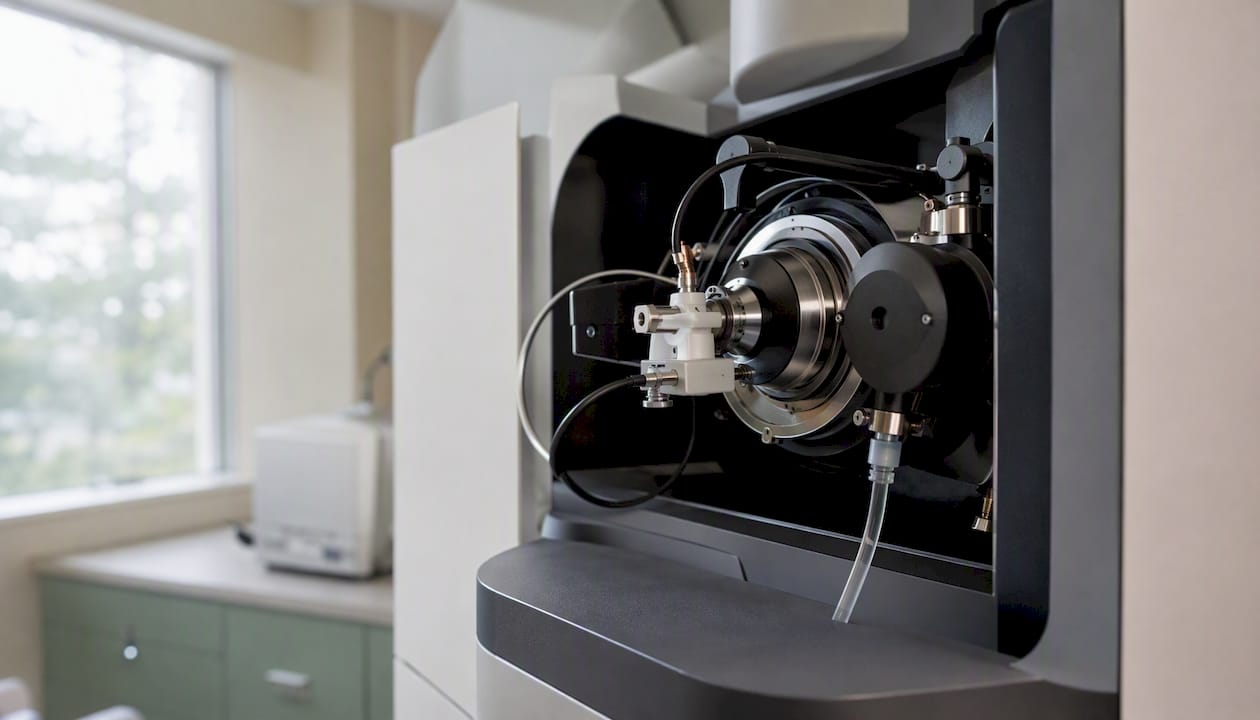
ICP-MS works by ionising a sample and measuring the mass-to-charge ratio of individual atoms, which lets a lab detect metals at parts-per-billion concentrations, far below what older methods could reliably catch. Eurofins’ UK testing division lists ICP-MS alongside LC-MS/MS and GC-MS among the ISO 17025 accredited methods commonly used for contaminant and nutritional analysis of supplements. For arsenic and mercury specifically, some labs run additional speciation analysis, because inorganic arsenic is considerably more toxic than the organic forms found in seafood, and a total-arsenic number without speciation can be misleading.
UKAS accreditation (the UK Accreditation Service) certifies that a lab meets ISO/IEC 17025, the international standard for testing and calibration competence. A lab operating under UKAS accreditation has been independently audited on its methods, equipment calibration, and staff competence, which is precisely why regulators and serious brands lean on it rather than taking a supplier’s word alone.
A genuinely useful CoA should show:
- The date of testing and the batch or lot number it corresponds to.
- Limits of detection (LOD) for each metal tested, not just a bare “pass” statement.
- The analytical method used (ICP-MS, ideally named explicitly).
- The testing laboratory’s accreditation status (UKAS or equivalent ISO 17025 body).
- A named signatory or lab reference, rather than an anonymous printout.
A CoA that reports results as “<LOD” without ever stating what that LOD value actually is lacks enough detail for anyone to independently judge the result. That single gap, an unstated detection limit, is one of the more common ways a CoA looks reassuring while actually telling you very little. Third-party verification that checks a supplier’s claims independently, rather than relying solely on vendor-issued paperwork, closes that gap.
Which supplement types carry the highest heavy-metal risk?
Four categories consistently show up in contamination surveys more than others, and knowing why each one is higher risk helps you judge products on their merits rather than by brand reputation alone.
- Turmeric, curcumin, and other root spices grow in soil that can naturally contain lead and cadmium, and turmeric’s bright colour has historically made it a target for deliberate lead chromate adulteration.
- Seaweed and kelp products concentrate arsenic and mercury from seawater simply by growing in it, making inorganic arsenic exposure a genuine consideration for anyone taking kelp-based iodine supplements.
- Multi-ingredient herbal blends aggregate exposure risk because each botanical component carries its own contamination profile, and few manufacturers test every individual ingredient before blending.
- Some plant-based protein powders draw from crops grown across varied and sometimes less-regulated soil conditions, which the PMC protein powder risk assessment links to higher measured cadmium and lead in certain products compared with dairy-derived alternatives.
None of this means every turmeric capsule or every plant protein tub on the shelf is contaminated. Risk here is product-specific and supply-chain dependent, tied directly to where the raw material was grown and how carefully the manufacturer tested it, not to the ingredient category as a whole. A refined mineral compound like magnesium bisglycinate, by contrast, starts from a chemically defined salt rather than a variable botanical harvest, which is one reason its contamination risk profile looks very different from turmeric’s.
How do you choose a safer supplement brand?
Run through this checklist before you buy anything in the higher-risk categories above, and honestly it’s worth doing for any supplement you take regularly.
- Ask whether the brand publishes third-party lab testing results or a Certificate of Analysis for the specific batch you’re buying.
- Check whether that CoA names an accredited laboratory (UKAS or ISO 17025) and the analytical method used (ICP-MS ideally stated explicitly).
- Favour products with simple, short ingredient lists over sprawling multi-botanical blends, since each added ingredient is another potential contamination source.
- Look for evidence of batch-level or supplier-lot testing rather than a single generic claim covering an entire product line.
- Treat supplier transparency, willingness to share sourcing information and test data on request, as a genuine signal rather than a nice-to-have.
Red flags worth walking away from: no CoA available on request, no named origin for the raw material, a suspiciously low price for an exotic botanical ingredient that’s expensive to source cleanly, and multi-ingredient blends with no per-ingredient testing breakdown.
Pro Tip: When a brand does publish a CoA, search it for the batch number and sample date first, not the results table. If the batch number on the document doesn’t match the one printed on your product’s packaging, the CoA you’re looking at proves nothing about the bottle in your hand.
What should you do if you suspect a supplement has exposed you to heavy metals?
- Stop taking the product immediately. Continued use only adds to cumulative exposure while you investigate.
- Keep the product, its packaging, and the batch number. You’ll need these details for both medical assessment and any regulatory report.
- Contact your GP if you have symptoms, particularly fatigue, abdominal pain, cognitive changes, or anything unusual that started after you began the product. Mention the specific supplement and batch by name.
- Ask about blood or urine testing if your GP recommends it. These are the standard diagnostic routes for suspected heavy metal exposure, and a GP or occupational health service typically orders them based on symptoms and exposure history.
- Report the product to the relevant authority. In the UK, that means your local authority’s Trading Standards or Environmental Health team, who can involve a Public Analyst laboratory, or the Food Standards Agency (FSA) directly for food supplement concerns.
- Save a physical sample where possible. A Public Analyst investigation needs actual product to test, not just a description of your symptoms.
What do UK-specific findings actually mean for you?
The headline takeaway from UK surveillance is reassuring with one caveat: most samples tested fall comfortably below Maximum Levels, but the small number of outliers that do appear can meaningfully shift someone’s cumulative exposure if that product becomes part of a daily routine.
Fera’s Committee on Toxicity (COT) assessment of turmeric and curcumin supplements tested 30 samples and found 29 sitting at concentrations of low concern for heavy metals. The one exception measured lead at roughly 2.25 mg/kg, a result the COT associated with likely lead chromate adulteration rather than natural soil uptake, and it’s precisely the kind of finding that regulatory sampling exists to catch.
UK food supplement regulation retains the compositional and purity framework originally established under Directive 2002/46/EC, adapted into domestic law after EU exit. In practice, this means the permitted vitamin and mineral lists, labelling rules, and purity criteria that applied under EU law largely continue to apply in Great Britain, giving UK consumers a reasonably consistent baseline to judge products against.
Only one sample in Fera’s 2021 turmeric survey exceeded safe concentration thresholds, yet that single result drove the entire regulatory conversation around cumulative exposure from botanicals. For you as a shopper, the practical lesson is straightforward: MLs and CoAs exist precisely to catch the rare bad batch before it reaches your cupboard, and checking for them takes about two minutes.
A brand’s-eye view on testing and trust
Runcomplete builds every batch of Ready around a simple principle: you shouldn’t have to become a toxicology expert to trust what’s in your capsule. Magnesium bisglycinate is a chemically defined mineral compound, not a variable botanical harvest, and that starting point already removes most of the soil-uptake and marine-bioaccumulation risk that drives contamination in turmeric or kelp products.
That said, “lower risk by ingredient type” isn’t the same as “no testing needed.” Runcomplete verifies raw material batches through supply-chain checks before manufacturing and backs finished product batches with testing documentation, following the same logic laid out in the CoA checklist covered earlier in this article: named method, stated detection limits, and a batch reference you can actually match against the product in your hand.
The honest position here is that no brand, including this one, should ask you to take safety on faith. Ask any supplement company for their batch documentation. If they can’t produce it, or the CoA has no accreditation, no LOD values, and no batch match, that tells you something worth knowing before you take another dose.
How Runcomplete builds safety into every batch of Ready
Runcomplete makes Ready, a magnesium bisglycinate capsule built specifically for the recovery and sleep needs of everyday runners, manufactured in the UK with no unnecessary fillers and no elite-athlete marketing dressing it up.

Because magnesium bisglycinate starts life as a refined mineral compound rather than a botanical harvest, it sidesteps the soil-uptake contamination pathway that drives most of the risk covered in this article. Runcomplete backs that inherent advantage with UK manufacturing oversight and a 30-day guarantee, so if Ready doesn’t fit your routine, you’re not locked into a subscription you regret. If you’re building a broader recovery routine and want to see how magnesium fits alongside your existing nutrition, the beginner nutrition guide for new runners is a sensible next stop, or you can go straight to Ready’s product page to check current batch information and place an order.
Sources
- Guidance notes on legislation implementing Directive 2002/46/EC on food supplements
- Heavy Metal contamination of Dietary Supplements products available in the UAE markets and the associated risk (PMC7606431)
- Elemental contaminants in dietary supplements (USPNF general chapter)
This article is general information, not a substitute for advice from a qualified doctor. Consult a qualified healthcare professional about your own circumstances before acting on anything here.

