
Yes, magnesium can improve HRV, but mainly if your levels are low or borderline to begin with. A 90-day randomised trial using 400 mg a day found measurable gains in parasympathetic activity and reduced sympathetic dominance, which is exactly the shift you want to see in your recovery scores. Don’t expect an overnight jump. Realistic change shows up over weeks, not hours, as your nervous system settles into a steadier rhythm.
Your next steps are straightforward:
- Check your diet and any risk factors (kidney function, medications) before starting.
- Choose a well-absorbed, gentle form rather than the cheapest tablet on the shelf.
- Track your HRV for four to twelve weeks against a proper baseline, not a single morning reading.
Pro Tip: If you run regularly, log your HRV alongside training load. A dip after a hard session is normal; a flat, unrecovering trend over several weeks is the pattern magnesium is more likely to help.
Key Takeaways
Magnesium supports HRV mainly by strengthening parasympathetic tone over weeks of consistent use, not through any single dose or overnight effect.
| Point | Details |
|---|---|
| Magnesium helps most when status is low | Benefits are clearest in people with marginal or low magnesium intake, not those already replete. |
| Expect weeks, not hours | The 90-day RCT showed HRV gains build gradually; single doses don’t produce an acute spike. |
| Bisglycinate suits nightly recovery | Better tolerability and absorption than oxide or citrate, with fewer digestive side effects. |
| Track trends, not single readings | Use a one to two week baseline, then four to twelve weeks of consistent intake before judging results. |
| Check kidney function and medications first | Renal impairment, diuretics, PPIs, and cardiac drugs all need a clinician’s input before starting. |
| Runcomplete’s Ready targets this exact use case | UK-made magnesium bisglycinate for everyday runners, with a 30-day guarantee and subscription option. |
Recommended reading on magnesium and HRV
- The 90-day RCT behind most of this article’s HRV claims.
- Serum magnesium and HRV in adult women, the key observational study.
- Magnesium’s broader cardiovascular role, a wider review of evidence and gaps.
- Official dosing and safety guidance from a health authority fact sheet.
Table of Contents
- How magnesium influences your nervous system and heart
- What HRV numbers are actually telling you
- What the human evidence actually shows
- Why bisglycinate beats oxide for sleep and recovery
- Running your own magnesium trial: dose, timing and tracking
- Safety, interactions and when to check with a clinician
- Try Runcomplete’s magnesium bisglycinate for your recovery trial
- Frequently asked questions
- Sources
How magnesium influences your nervous system and heart
Magnesium works inside your cells as a natural calcium antagonist, meaning it competes with calcium at the ion channels that control how tightly your heart muscle contracts and how excitable your nerve cells become. Too little magnesium and those channels tip toward overexcitation, the physiological signature of a body stuck in fight-or-flight.
That matters for HRV because your heart rate variability is largely a readout of vagal tone, the strength of your parasympathetic “rest and digest” signal relative to sympathetic drive. Magnesium supports that vagal side of the equation, and some research links adequate magnesium status to lower circulating cortisol, the stress hormone that keeps your system on alert.
- Regulates calcium flow into heart and nerve cells
- Supports vagal (parasympathetic) signalling
- Associated with lower stress-hormone activity in some studies
- Underpins normal cardiac excitation-contraction coupling
In the 90-day trial mentioned above, 400 mg daily increased pNN50 and reduced the LF/HF ratio, both markers pointing towards better autonomic balance. This is why magnesium tends to support recovery physiology, better sleep, calmer nights, less sympathetic drag, rather than acting like a stimulant that spikes your HRV the day you take it.
What HRV numbers are actually telling you
Your wearable probably shows RMSSD or SDNN, sometimes an LF/HF ratio. RMSSD reflects short-term, mostly parasympathetic fluctuation between heartbeats. SDNN captures overall variability across a longer window. LF/HF compares low-frequency and high-frequency signal power, a rougher proxy for the sympathetic-parasympathetic balance.
None of these numbers mean much in isolation. HRV is a trend metric, not a scoreboard, so one low morning after a bad night’s sleep or a few drinks tells you far less than a fortnight’s drift upward or downward.
- Compare your morning baseline week over week, not day over day.
- Watch for a sustained trend rather than a single reading.
- Note sleep, alcohol, and training load alongside every score.
Pro Tip: Take your reading at the same time and position each morning, ideally before coffee, since caffeine and posture both skew HRV independently of anything magnesium is doing.
What the human evidence actually shows
The strongest single piece of evidence is the randomised, controlled trial of 100 participants who took 400 mg of magnesium daily for 90 days. It found a clear rise in pNN50, a marker of parasympathetic input, alongside a drop in the LF/HF ratio, both consistent with better autonomic balance. That is a meaningfully long intervention window, which matters because it rules out a placebo blip and tells you this is a slow-build effect.

Observational data backs this up from a different angle. A cross-sectional study of 116 adult women found that higher serum magnesium tertiles correlated with lower resting heart rate and higher SDNN and RMSSD, with the heart-rate association reaching statistical significance. That is not proof supplementation causes the improvement, since it’s a snapshot, but it strengthens the case that magnesium status and HRV genuinely move together.
Broader reviews of magnesium’s cardiovascular role describe the same theme repeated across research: plausible mechanisms, encouraging associations, but a call for larger, better-powered trials before anyone calls this settled science. Worth separating clinical contexts too. Oral supplementation rarely shifts resting heart rate in a healthy person, while intravenous magnesium in hospital is used specifically to manage arrhythmias, a completely different intervention with a completely different risk profile.
- RCT (90 days, 400 mg/day): parasympathetic markers improved, sympathetic markers fell.
- Observational (116 women): higher serum magnesium linked to higher HRV indices.
- Review evidence: consistent direction, but small cohorts and varied dosing limit firm conclusions.
- Clinical IV use: relevant to arrhythmia management, not a model for daily supplementation.
The people most likely to see a change are those starting from low or marginal magnesium status, which describes a large slice of adults given how easily modern diets fall short.
Why bisglycinate beats oxide for sleep and recovery
Not all magnesium salts behave the same way in your gut, and that matters more than most people realise. Magnesium oxide is cheap and has poor absorption, so a large share of each dose stays in the intestine and draws water in, which is why it’s a common laxative and a common source of cramping. Citrate absorbs better but can still loosen the stool at higher doses. Magnesium sulfate belongs mainly in medical or bathing contexts, not daily capsules.
Magnesium glycinate and bisglycinate, magnesium bound to the amino acid glycine, tend to absorb more efficiently and cause far less gastrointestinal upset. That tolerability isn’t a minor comfort issue. Digestive stress itself is a physiological stressor that can suppress HRV, so a form that irritates your gut can partly cancel out the benefit you’re trying to get. Glycine also has its own mild calming, sleep-supportive effect, which pairs naturally with an evening dose.
- Oxide: cheap, poorly absorbed, common cause of loose stools.
- Citrate: moderate absorption, still gut-sensitive at higher doses.
- Glycinate/bisglycinate: better tolerated, supports overnight recovery.
Pro Tip: If a magnesium capsule leaves you running to the bathroom, it’s undermining the exact recovery effect you’re chasing, switch form before assuming magnesium doesn’t work for you.
Running your own magnesium trial: dose, timing and tracking
Most research supporting HRV benefits uses roughly 300 to 400 mg of elemental magnesium daily, within general safe supplemental limits for healthy adults. Start lower, around 200 mg, and increase gradually if your gut tolerates it well. Take it in the evening. Magnesium’s calming, sleep-supportive effect works best when it lines up with your wind-down routine, and dosing at the same time every night matters more than the exact hour you choose.
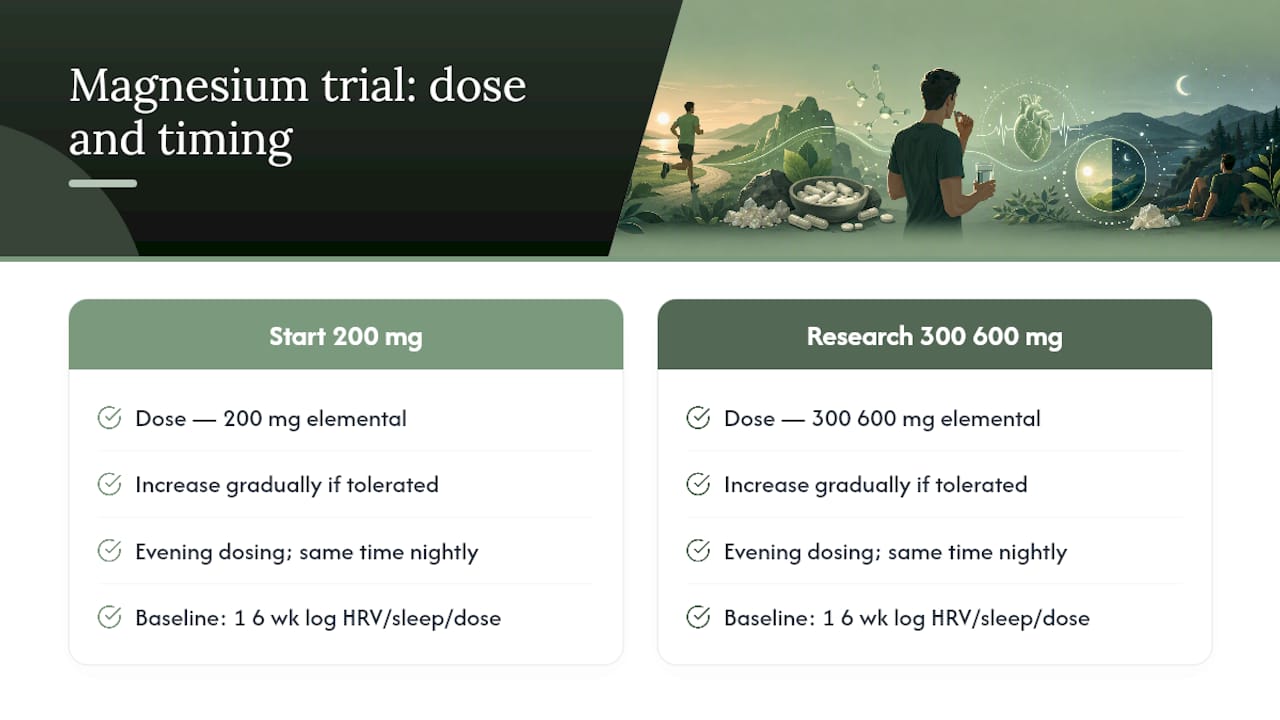
Run a proper baseline period first, one to two weeks logging HRV, sleep score and dose before you change anything. Then track four to twelve weeks of consistent intake, since single doses rarely produce an immediate spike. Control the obvious confounders: alcohol, heavy training days, and poor sleep will all mask what magnesium is doing.
Pro Tip: Pair your dose with five minutes of slow breathing or a short meditation before bed. The two together tend to produce a bigger parasympathetic lift than magnesium taken alone.

Safety, interactions and when to check with a clinician
Most healthy adults tolerate magnesium supplements well, though loose stools and cramping are the most common complaints, especially at higher doses or with poorly absorbed forms. The bigger concern is kidney function. If your kidneys can’t clear excess magnesium efficiently, it can build up to dangerous levels, so anyone with renal impairment should not self-supplement without medical guidance.
Certain medications interact meaningfully with magnesium: diuretics, proton pump inhibitors, some antibiotics, and cardiac drugs including digoxin. Seek urgent care for symptoms like an irregular or racing heartbeat, severe weakness, or breathing difficulty rather than assuming it’s a supplement side effect.
Anyone with kidney disease, anyone on diuretics, PPIs, certain antibiotics, or heart medication, and anyone pregnant or with an existing heart condition should check with a clinician before starting a magnesium supplement. This isn’t a box-ticking caveat; excess magnesium in someone with impaired kidney function can become genuinely dangerous.
- Diarrhoea or cramping: usually dose-related, often resolves by switching form.
- Kidney disease: seek medical advice before supplementing at all.
- On diuretics, PPIs, antibiotics, or cardiac medication: check for interactions first.
- New chest pain, palpitations, or breathlessness: treat as urgent, not supplement-related.
What runners should look for on a label
Gastrointestinal tolerability matters more for runners than most, since digestive upset the night before a long run can wreck both sleep and next-day HRV. Look for the elemental magnesium content per serving, not just the total compound weight, confirm the form is glycinate or bisglycinate, and check the ingredient list for unnecessary fillers or bulking agents.
- Elemental magnesium clearly stated per capsule
- Bisglycinate or glycinate as the primary form
- Vegetarian or vegan capsule shell if that matters to you
Pro Tip: A monthly subscription suits this better than one-off purchases, since the benefit depends on consistent nightly intake over months, not a single tub you forget to reorder.
A brief note on trialling this yourself
I’ve watched enough HRV data to know the pattern: people expect a dramatic jump and get a slow, steady drift instead. That’s the realistic version. Magnesium rewards patience and consistency far more than it rewards the “right” dose.
Try Runcomplete’s magnesium bisglycinate for your recovery trial
If you’ve read this far, you already know the form matters as much as the habit. Runcomplete’s Ready is a magnesium bisglycinate capsule made in the UK specifically for everyday runners, not elite athletes or gym-goers, with no unnecessary fillers and a formula suited to vegetarians and vegans.

It’s built around the exact pattern this article describes: consistent evening dosing that supports overnight recovery rather than a single big dose. You can buy it as a one-off or set up a monthly subscription so you’re never scrambling to reorder mid-trial, and every order comes with a 30-day guarantee if it doesn’t suit you. If you have a kidney condition, take diuretics or cardiac medication, or are otherwise under medical care, speak to your clinician before adding any magnesium supplement to your routine. Head to the Ready product page to start your own four-to-twelve-week HRV trial.
Frequently asked questions
Does magnesium really improve HRV, or is this overstated? The evidence is genuinely encouraging but not absolute. A 90-day RCT showed real gains in parasympathetic markers, and observational data links higher serum magnesium to better HRV indices, though larger trials are still needed to confirm effect sizes across different people.
How long before I see a change in my HRV after starting magnesium? Give it four to twelve weeks of consistent daily intake before judging results. Magnesium’s effect on HRV builds gradually through better sleep and lower sympathetic drive, not through an immediate physiological jolt.
Is magnesium glycinate better than magnesium oxide for HRV tracking? Yes, for most people. Glycinate and bisglycinate absorb more efficiently and cause far less digestive upset than oxide, and avoiding gut stress matters because digestive discomfort can itself lower HRV.
Can I take magnesium if I’m on blood pressure or heart medication? Check with your clinician first. Magnesium can interact with diuretics, certain antibiotics, and cardiac drugs, and your prescriber needs to confirm it’s safe alongside your specific treatment.
What’s a reasonable daily dose to start with? Many trials use around 300 to 400 mg of elemental magnesium daily, but starting around 200 mg and increasing gradually if well tolerated is a sensible approach for most healthy adults.
This article is general information, not a substitute for advice from a qualified doctor. Consult a qualified healthcare professional about your own circumstances before acting on anything here.
Sources
- Long-term HRV analysis shows stress reduction by magnesium intake - PubMed
- Magnesium deficiency and cardiometabolic disease - PMC
- Effects of serum calcium and magnesium on heart rate variability in adult women - PubMed
- Magnesium — Health Professional Fact Sheet (ODS)
Recommended
- Magnesium for Runners’ Sleep: Unlocking Overnight Muscle Recovery – Run Complete
- Magnesium Before or After Running: The Best Timing for Recovery – Run Complete
- When to Take Magnesium for Running: Timing Your Dose for Better Recove – Run Complete
- Magnesium with food for runners: sleep & recovery – Run Complete

