
“Third-party tested” shows independent verification of at least some test results — but it is only as useful as the test scope and the disclosure behind it. For runners choosing magnesium bisglycinate, three signals tell you whether a claim is real or marketing shorthand:
- Published batch Certificate of Analysis (CoA) that names the specific lot tested
- A UKAS-accredited or ISO 17025-recognised laboratory named on the document
- A batch number on the CoA that matches the batch number on your product
If any of those three are missing, the “third-party tested” badge tells you very little. Runcomplete’s Ready — Magnesium for Runners is built around these checks, with UK manufacturing, published CoAs, and a 30-day guarantee. The rest of this guide explains exactly what to look for and why it matters.
Table of Contents
- What do brands actually mean by “third-party tested”?
- Which laboratory tests actually matter for magnesium supplements?
- Why is magnesium bisglycinate often the best choice for runners?
- How do you verify a brand’s third-party testing claim?
- Dosage, timing, and safety for UK runners
- Does Runcomplete’s Ready meet the third-party testing checklist?
- What does third-party tested magnesium bisglycinate cost in the UK?
- Quick red flags and questions to ask before you buy
- Key takeaways
- Why transparency is the only honest starting point
- Try Runcomplete Ready with full CoA transparency
- Useful sources
What do brands actually mean by “third-party tested”?
The phrase gets used loosely. At its best, “third-party tested” means an independent laboratory with no financial stake in the outcome has analysed the finished product and issued a report. At its worst, it means a single raw-ingredient test was run years ago, and the brand has been printing the phrase ever since.
UK food supplements are regulated as foods, not medicines. Manufacturers are responsible for safety and labelling, but pre-market independent testing is not mandatory. That gap is precisely why voluntary transparency signals matter so much. A brand that publishes batch CoAs is choosing to be accountable in a way the law does not require.
The distinction between in-house and independent testing is critical. Manufacturers routinely run internal checks for process control, but only independent third-party testing gives you a result you can verify without trusting the maker. Watch for vague phrases like “quality checked,” “lab tested,” or “quality assured” with no lab name attached. Experts warn that “third-party tested” alone can obscure as much as it reveals — shoppers should demand the test scope and the lab identity rather than accept shorthand.
Pro Tip: Ask one specific question before buying: “Is the CoA for the finished capsule product, or for the raw ingredient before manufacturing?” Raw-ingredient CoAs are far more common and far less useful to you as a consumer.
Which laboratory tests actually matter for magnesium supplements?
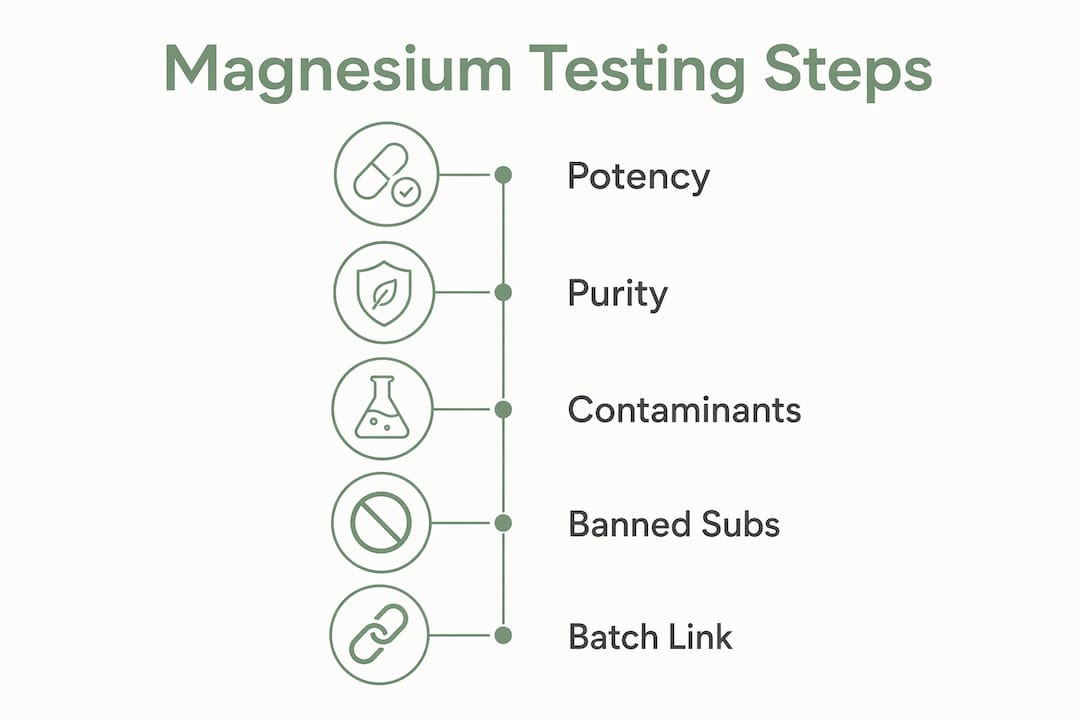
Not all CoAs are equal. A thorough one for magnesium bisglycinate should cover at least these four areas:
| Test type | What it confirms | Why it matters for runners |
|---|---|---|
| Potency / assay | Elemental magnesium content matches the label claim | You are getting the dose you paid for |
| Identity testing | Confirms the form is bisglycinate, not a cheaper oxide | Form determines absorption and GI tolerance |
| Heavy metals panel | Lead, cadmium, mercury, arsenic within safe limits | Chronic low-level exposure accumulates over months of daily use |
| Microbial testing | Total viable count, Salmonella, E. coli absent | Capsule hygiene, especially relevant for powder-based products |
Some CoAs also include residual solvents, pesticide screens (relevant when botanical excipients are used), and allergen declarations. These are worth having but are secondary to the four above for a straightforward mineral supplement.
The most important structural point: a CoA for a raw ingredient is not the same as a CoA for the finished product. Raw-material testing happens before blending, encapsulation, and packaging — all of which can introduce contamination or alter dose consistency. Finished-product testing is what actually reflects what is in the bottle you open.
Contaminant variability is real. A study cited by Phytality found total arsenic in algae supplements ranging from 0.053 to 57 mg/kg across samples — a more than 1,000-fold difference. Magnesium is lower-risk than algae, but the principle holds: without batch-level testing, you cannot know what is in your specific product.
Relevant UK and EU certification schemes include Informed-Sport (which screens for 270+ banned substances), BRCGS food safety standards, and voluntary GMP adherence. These are useful markers of facility quality but are distinct from a batch CoA — GMP certifies the process, not the product in your hand.
Why is magnesium bisglycinate often the best choice for runners?
Form matters as much as testing. Magnesium bisglycinate binds elemental magnesium to two glycine molecules, which improves intestinal absorption and is significantly gentler on the gut than magnesium oxide or sulphate. For runners who already deal with GI sensitivity during training, that tolerability difference is practical, not theoretical.

The bioavailability of the specific form and the absence of unnecessary fillers define quality as much as any lab result. Third-party testing confirms content and contaminants but does not measure functional absorption — a CoA cannot tell you how much magnesium your body actually uses. That is why choosing bisglycinate specifically, rather than a cheaper form, is a separate decision from verifying the test data.
For runners, the practical benefits cluster around three areas:
- Muscle recovery: magnesium supports protein synthesis and helps regulate the neuromuscular signalling that causes cramps
- Sleep quality: glycine has independent sleep-promoting properties, making bisglycinate particularly useful for the overnight repair window after long runs
- GI tolerance: recovery without the stomach upset that oxide forms can cause, which matters when you are already managing training load
Pro Tip: Check the label for elemental magnesium per dose, not total magnesium compound weight. A capsule of magnesium bisglycinate delivers a moderate amount of elemental magnesium, the number that actually counts. — the number that actually counts.
How do you verify a brand’s third-party testing claim?
Follow these steps before you buy:
- Request or locate the batch CoA. Reputable brands publish CoAs on their product page or provide them on request within 24 hours. If a brand cannot produce one, stop there.
- Match the batch number. The batch number on the CoA must match the number printed on your product packaging. A CoA validates only the specific batch tested — it does not guarantee every subsequent batch is identical.
- Check the lab name and accreditation. The CoA should name an independent, accredited laboratory — UKAS-accredited or ISO 17025-recognised. Verify the lab exists by searching its name independently.
- Confirm the test scope. Check which parameters were tested. Potency and heavy metals are the minimum for a mineral supplement; microbial testing adds meaningful assurance.
- Check detection limits and pass/fail status. A CoA that lists results without detection limits or without a clear pass/fail verdict is incomplete.
- Verify it is a finished-product test. The sample description on the CoA should reference the finished capsule or tablet, not a raw powder or ingredient.
Red flags to reject outright: no lab name anywhere on the document, a CoA with no batch reference, a test date more than two years old with no newer data, or a brand that only offers a summarised graphic rather than the full PDF.
Pro Tip: Always request the raw CoA PDF rather than a screenshot or summary image. PDFs carry the test methods, units, and detection limits that a cropped image can hide.
Dosage, timing, and safety for UK runners
Typical guidance for magnesium bisglycinate in a recovery context centres on elemental magnesium per dose. The NHS sets the recommended daily intake at 300 mg for men and 270 mg for women, though many runners supplement in the range of 150–300 mg of elemental magnesium per day from a bisglycinate source.
Key practical points:
- Evening dosing is the most common approach for sleep support; taking magnesium 30–60 minutes before bed aligns with its relaxation effects. For timing your dose around training, post-run intake also works well for acute recovery.
- Take with food to reduce any residual GI discomfort and support absorption.
- Allow several weeks before judging results. Most runners notice changes in sleep quality and cramp frequency after 3–6 weeks of consistent use, not after a few days.
- Safety cautions: magnesium supplements can interact with certain antibiotics, bisphosphonates, and diuretics. Anyone with kidney impairment should consult a GP before supplementing, as impaired kidneys cannot excrete excess magnesium efficiently.
The NHS upper tolerable intake level for supplemental magnesium is 400 mg per day for adults. Staying within that range from a bisglycinate source is straightforward, but always read the label for elemental magnesium content rather than total compound weight.
This article is general information, not medical advice. Confirm dosage and interactions with a pharmacist or GP for your own situation.
Does Runcomplete’s Ready meet the third-party testing checklist?
Ready — Magnesium for Runners is formulated specifically as magnesium bisglycinate, made in the UK, and designed for the recovery needs of everyday runners rather than elite athletes or gym-goers. The trust signals to verify on the product page include:
- Published batch-specific CoAs with lab accreditation details
- GMP-level manufacturing standards at the UK production facility
- Transparent ingredient list with no proprietary blends or hidden fillers
- Capsule format suitable for vegetarians and vegans
- 30-day money-back guarantee
- Customer reviews focused on runners’ sleep and recovery outcomes
Available as a one-time purchase or monthly subscription, Ready lets you match the batch number on your delivery to the CoA on the product page before you open the bottle. That is the verification step most brands skip.
What does third-party tested magnesium bisglycinate cost in the UK?
UK-made, independently tested magnesium bisglycinate typically sits at a higher price point than unverified alternatives, reflecting the real cost of batch testing. Third-party testing adds meaningful expense per batch, and brands that absorb that cost are making a deliberate quality commitment.
When comparing value, look at:
- Cost per effective elemental magnesium dose, not the headline capsule count
- Transparency signals — published CoAs, named lab, clear manufacturing origin
- Subscription savings where available, which reduce per-dose cost without compromising quality
Buying direct from a brand’s own website gives you the clearest access to CoA documentation and batch traceability. Specialist running retailers and reputable health stores can also stock third-party tested options, but always confirm they can provide batch CoA access before purchasing. Runcomplete’s Ready product page is the primary place to check current pricing, subscription options, and CoA documentation together.
Quick red flags and questions to ask before you buy
Before committing to any supplement, run through this list:
- No lab name on the website or CoA — reject immediately
- CoA without a batch number — it cannot be verified against your product
- “Lab tested” with no scope stated — could mean a single pH check
- Only raw-ingredient testing disclosed — not the same as finished-product assurance
- Vague terms like “quality checked” or “quality assured” with no data behind them
Exact questions worth asking customer support:
- “Which independent laboratory tested this batch?”
- “Is that lab UKAS-accredited or ISO 17025-recognised?”
- “Can I see the full CoA PDF for batch number X?”
- “Was the finished capsule product tested, or only the raw ingredient?”
If you cannot locate a CoA and a named accredited lab within a few minutes of searching the brand’s website, choose a brand that publishes this information openly. Transparency should not require detective work.
Key takeaways
Third-party tested supplements are only as trustworthy as the test scope, the lab’s accreditation, and the batch linkage — all three must be present for the claim to mean anything.
| Point | Details |
|---|---|
| Finished-product CoA required | The CoA must cover the finished capsule batch, not just raw ingredients, and match your product’s batch number. |
| Lab accreditation matters | Look for a UKAS-accredited or ISO 17025-recognised laboratory named on the document; verify it independently. |
| Test scope: potency and heavy metals minimum | A credible CoA for magnesium bisglycinate covers elemental magnesium assay, identity, heavy metals, and microbial testing. |
| Bisglycinate form is a separate decision | Third-party testing confirms content and contaminants; it does not measure absorption — choose bisglycinate for its bioavailability and GI tolerance. |
| Runcomplete Ready | UK-made magnesium bisglycinate with published batch CoAs, GMP manufacturing, and a 30-day guarantee for runners. |
Why transparency is the only honest starting point
The supplement industry’s testing gap is not a secret. UK law does not require pre-market testing, which means the brands that publish batch CoAs and name their labs are doing something genuinely voluntary. That choice is the signal worth paying attention to, not the badge on the front of the pack.
What frustrates me about most “third-party tested” marketing is that it conflates the existence of a test with the quality of a test. A single potency check on a raw ingredient, run once, tells you almost nothing about the capsule you are swallowing six months later. Runners deserve better than that, particularly when magnesium is something many take daily for months at a time.
The checklist in this guide is not complicated. A named accredited lab, a batch-specific CoA, and a finished-product test scope. If a brand cannot provide all three, the claim is incomplete. Runcomplete’s 30-day guarantee and UK manufacturing are meaningful, but they are most meaningful alongside the CoA transparency that lets you verify the product before you commit.
Try Runcomplete Ready with full CoA transparency
Runners who want magnesium bisglycinate without the guesswork around quality now have a straightforward option. Runcomplete Ready is UK-made, formulated specifically for everyday runners, and comes with batch-specific CoA documentation you can check before you open the bottle.

Choose a one-time purchase to try it first, or save with a monthly subscription — both options come with the same 30-day money-back guarantee. When your order arrives, match the batch number on the packaging to the CoA on the Ready product page before you start. That one step is what separates a verified supplement from a marketing claim.
Useful sources
Further reading for runners who want to check the evidence behind this guide:
- NHS Specialist Pharmacy Service — Understanding food supplements: The clearest UK regulatory overview of how food supplements are governed, why pre-market testing is not required, and what voluntary quality steps reputable manufacturers take.
- Phytality — The importance of third-party testing in the UK: Explains what a CoA is, why batch linkage matters, and includes real contamination data illustrating why independent testing is worth seeking out.
- Which? — Best magnesium supplements: Covers the practical differences between magnesium forms, including bioavailability and the role of fillers, from a consumer-focused perspective.
- SellHealth — How to read a supplement CoA in the UK: A practical walkthrough of what each section of a CoA means, including detection limits and accreditation markers.
- Nabo — How do you know if your vitamins are trustworthy?: Summarises UK certification schemes (Informed-Sport, BRCGS, GMP) and explains how they differ from batch CoA testing.
- HerbsDirect — Third-party tested supplements UK guide: Addresses common marketing traps and explains what questions to ask brands before accepting a “third-party tested” claim at face value.
Recommended
- Supplements for Overtraining Runners: A Realistic Recovery Guide – Run Complete
- Supplements for Half Marathon Recovery: A Guide for UK Runners – Run Complete
- Supplements for Running Injury Prevention: A UK Guide for Everyday Run – Run Complete
- Natural Sleep Aids for Runners: Rest Better and Run Stronger in 2026 – Run Complete

