
For sleep and relaxation, take magnesium glycinate 30 to 60 minutes before your target bedtime. That window gives glycine time to exert its calming effect and lets magnesium absorb before you actually need to be asleep.
- Timing window: 30–60 minutes before bed, taken consistently every night.
- Dose framing: most people use 200–350 mg of elemental magnesium, within the supplemental upper limit set by the ODS/NIH.
- Safety flag: leave at least two hours between magnesium and medicines like thyroid hormone or certain antibiotics.
A randomised, double-blind trial tested exactly this routine, and RunComplete’s Ready capsules are formulated with that same bedtime protocol in mind.
Table of Contents
- Why magnesium glycinate helps you sleep
- When should you actually take it: bedtime, morning, or split?
- How much elemental magnesium should you take, and when?
- Do any medicines or health conditions change the timing?
- How long before magnesium glycinate improves your sleep?
- Practical rules for making the timing stick
- RunComplete’s Ready: built around this exact timing
- What I’ve learned testing timing routines with runners
- Ready: RunComplete’s answer to better sleep and recovery
- Frequently asked questions
- Sources
Why magnesium glycinate helps you sleep
Glycine, the amino acid bonded to magnesium in this form, has its own calming effect on the nervous system. It’s involved in lowering core body temperature slightly before sleep onset, one of the physiological cues your brain uses to switch into rest mode. Magnesium itself supports GABA activity, the neurotransmitter system responsible for slowing down neural firing and easing muscle tension.
Glycinate (also called bisglycinate) binds magnesium to two glycine molecules, which makes it more bioavailable than magnesium oxide and gentler on digestion than magnesium citrate. That combination, calming amino acid plus a well-absorbed mineral, is why Sleep Foundation guidance singles it out as a sensible choice for sleep specifically, rather than magnesium in general.
A four-week randomised trial found that participants taking 250 mg of elemental magnesium bisglycinate nightly, 30 to 60 minutes before bed, saw a small but statistically significant drop in insomnia severity scores compared with placebo.
That’s not a dramatic effect. It’s a real one, and it matches how the ingredient is meant to work: gradually, not like a sedative.
When should you actually take it: bedtime, morning, or split?
Your goal decides your timing, not habit.
- Sleep support: take it 30–60 minutes before bed, every night, at roughly the same time.
- Daytime anxiety or general calm: a morning dose or a split dose (half at lunch, half in the evening) works better, since taking the full amount at night mainly targets sleep onset.
- Muscle cramps or post-run recovery: evening dosing suits nocturnal cramps, though some runners prefer taking it soon after an evening session while muscles are still primed for recovery.
- General repletion (low dietary intake): splitting the dose across the day reduces gastrointestinal load and keeps blood levels steadier than one large hit.
Picture three different people. A runner who trains at 7pm and eats late benefits from taking their dose right before winding down, letting recovery and sleep support overlap. A shift worker whose “bedtime” shifts weekly needs to anchor the dose to their own sleep window, not the clock. Someone on thyroid medication needs to work backwards from their medication schedule first, then fit the magnesium dose around it.
In the trial mentioned above, most of the improvement in sleep scores showed up within the first two weeks, with the full effect measured at the four-week mark.
Pro Tip: If you’re not sure which scenario fits you, start with the sleep protocol. It’s the best-tested timing and the easiest one to stick to consistently.
How much elemental magnesium should you take, and when?
Supplement labels rarely say “200 mg of magnesium” in plain terms. They list the compound weight, magnesium bisglycinate, and you have to know that only a fraction of that weight is actual elemental magnesium (roughly 14% for bisglycinate). A 1,500 mg bisglycinate capsule typically delivers around 200 mg of elemental magnesium, which is why checking the “elemental magnesium” figure on the label matters more than the total capsule weight.
Practical ranges most people use:
- Starting point: 200 mg elemental magnesium, taken in the evening.
- Typical range: 200–400 mg, adjusted based on tolerance and goal.
- Upper limit for supplements: 350 mg per day from supplemental sources, according to ODS/NIH guidance, separate from magnesium you get through food.
| Approach | When it makes sense |
|---|---|
| Single evening dose (200–250 mg) | Sleep-focused use, matches the trial protocol |
| Split dose (half midday, half evening) | Higher total intake, sensitive stomachs, general repletion |
| Post-training dose | Evening training sessions where recovery and sleep overlap |
Anyone edging near the 350 mg supplemental ceiling should split the dose rather than take it all at once.
Do any medicines or health conditions change the timing?
Magnesium isn’t inert once it’s in your gut. It can bind to certain drugs and reduce how much your body absorbs.
- Tetracycline antibiotics, bisphosphonates, and thyroid medication should be separated from magnesium by at least two hours, since magnesium reduces their absorption.
- Impaired kidney function changes the picture considerably. Reduced renal clearance means magnesium can build up rather than clear normally, so anyone with kidney disease needs a clinician’s input before starting.
- Standard side effects are mild and mostly digestive, loose stools or stomach upset, and usually respond to a lower dose or splitting it across the day.
Supplements are useful for some people, but check with a clinician before starting, particularly if you have an underlying health condition or take regular medication.
That’s the NHS’s own framing, and it holds regardless of how well-tolerated glycinate generally is compared with other magnesium forms.
How long before magnesium glycinate improves your sleep?
Nobody should expect an overnight transformation. In the controlled trial behind most current guidance, participants noticed initial changes within the first week or two, but the measured, statistically significant improvement was recorded at the four-week endpoint.
- Week one: subtle changes at most; this is a settling-in period, not a verdict.
- Weeks two to four: most of the meaningful improvement in sleep quality shows up here.
- Beyond four weeks: effects tend to plateau, consistent with a mineral correcting a mild deficiency rather than acting like a sedative.
People with genuinely low dietary magnesium intake, common among those who train hard and sweat heavily, often notice a difference sooner than someone whose diet already meets their needs.
Practical rules for making the timing stick
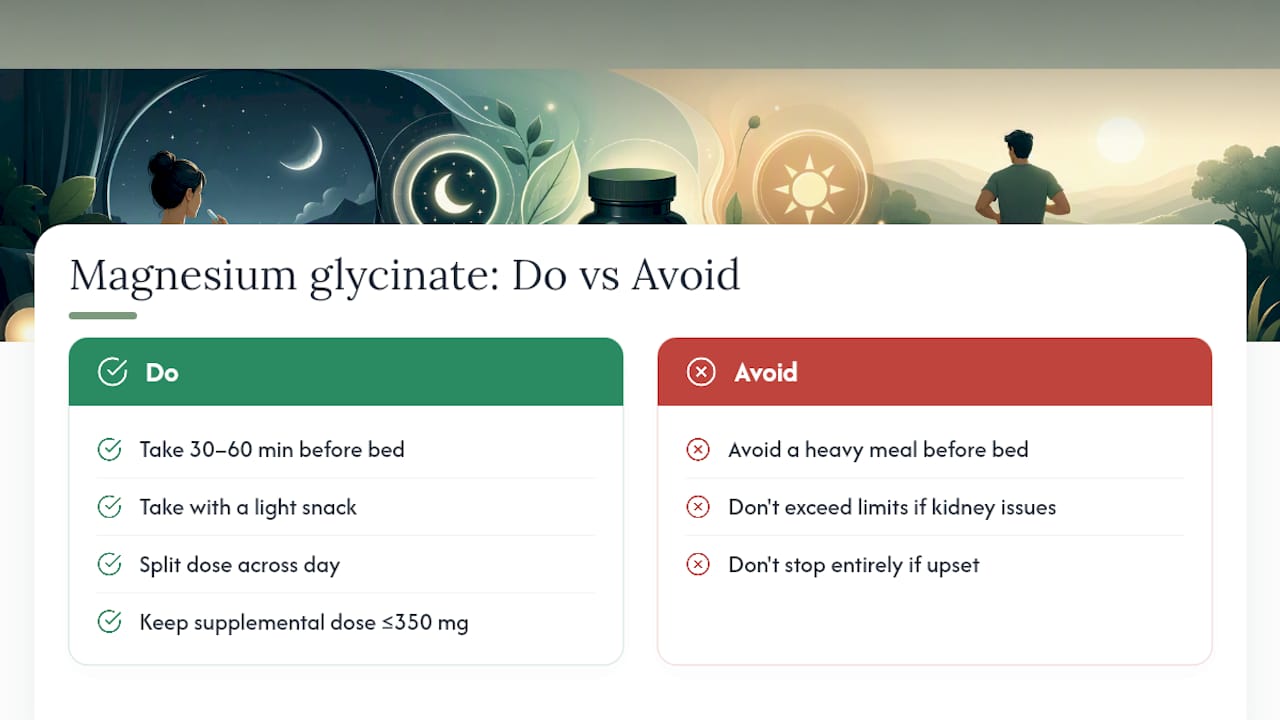
Consistency matters more than precision. Take your dose with a small amount of water or a light snack, sit or stand upright for 15 to 30 minutes afterwards rather than lying straight down, and pick a time you can realistically repeat every night.
- Avoid taking it immediately alongside a heavy, fatty meal; it can slow absorption slightly.
- Keep at least two hours’ gap from any interacting medication.
- Pick a fixed slot, ideally tied to an existing habit like brushing your teeth.
Pro Tip: Runners and shift workers should anchor the dose to their actual wind-down routine, not the clock. If bedtime shifts by two hours some nights, the magnesium dose shifts with it.
RunComplete’s Ready: built around this exact timing
RunComplete’s Ready capsules use magnesium bisglycinate formulated specifically for runners managing recovery and sleep, not generic gym-goers. The capsule dosing lines up with the 200–350 mg elemental range covered above, so a single evening dose fits comfortably inside the tested and recommended window.
- UK-made, with a 30-day guarantee if it doesn’t suit you.
- No unnecessary fillers, suitable for vegetarians and vegans.
- Designed to be taken 30–60 minutes before bed, matching the protocol most runners already follow.
Pro Tip: If you train in the evening, taking Ready straight after your cool-down often fits naturally into a pre-bed routine anyway.
What I’ve learned testing timing routines with runners
Most people overthink the exact minute and underthink consistency. The runners who get the most out of magnesium glycinate aren’t the ones who take it at a perfectly optimised time; they’re the ones who take it the same way, every night, for a month before deciding whether it’s working. Give it that long before judging it.

Magnesium glycinate works best for sleep when taken consistently, 30 to 60 minutes before bed, at a dose within the elemental magnesium guidelines.
| Point | Details |
|---|---|
| Best timing | Take magnesium glycinate 30–60 minutes before your target bedtime, every night. |
| Dose range | Stick to 200–350 mg elemental magnesium, checking labels for the true elemental content. |
| Medication spacing | Separate magnesium by at least two hours from thyroid medication, tetracyclines, or bisphosphonates. |
| Realistic timeline | Expect early signs within two weeks, with fuller effects assessed around four weeks. |
| Runner-friendly option | RunComplete’s Ready delivers UK-made magnesium bisglycinate dosed for this exact bedtime protocol. |
Ready: RunComplete’s answer to better sleep and recovery
Runners juggling training, work, and inconsistent sleep don’t need another generic supplement with a dozen unrelated ingredients. RunComplete built Ready specifically around the recovery and sleep needs of everyday runners, magnesium bisglycinate, dosed within the elemental ranges covered throughout this guide, made in the UK, with nothing extra padding out the capsule.

Because Ready is formulated at a dose that fits comfortably into the 30–60 minute bedtime window without pushing you near the supplemental upper limit, you don’t need to do any of the label-reading or elemental-magnesium maths described above. It’s already worked out. If cramps, restless nights, or slow recovery after evening runs sound familiar, check out Ready and see how it fits into your own bedtime routine, backed by a 30-day guarantee if it isn’t right for you.
Frequently asked questions
Is it better to take magnesium glycinate in the morning or at night for sleep? For sleep specifically, night wins. Taking it 30–60 minutes before bed lets glycine’s calming effect and magnesium’s role in GABA activity align with your natural wind-down period, which is exactly the protocol used in the clinical trial behind current guidance.
Should you take magnesium glycinate with food? Taking it with a light snack can reduce mild stomach upset, though it’s not strictly necessary given how well-tolerated glycinate already is compared with other forms. Avoid pairing it with a heavy meal right before bed, since that can slow absorption.
Can you take too much magnesium glycinate before bed? Staying within the 350 mg supplemental upper limit is the standard guidance for adults. Going beyond that, particularly for people with reduced kidney function, raises the risk of side effects like diarrhoea, and anyone with kidney disease should get medical advice first.
What if magnesium glycinate gives you an upset stomach? Lower the dose or split it, half at lunch and half in the evening, rather than stopping altogether. Glycinate already causes fewer digestive issues than magnesium citrate or oxide, so persistent symptoms are worth mentioning to a pharmacist.
This article is general information, not a substitute for advice from a qualified doctor. Consult a qualified healthcare professional about your own circumstances before acting on anything here.
Sources
- Randomised trial of magnesium bisglycinate for insomnia (PMC12412596)
- Magnesium — health professional fact sheet (ODS/NIH)
- Vitamins and minerals — NHS
- Magnesium interactions and recommended medication spacing (Capsure)
- Magnesium — Sleep Foundation

