
Magnesium bisglycinate can be vegan, but it isn’t automatically vegan just because it sounds like a mineral supplement. The magnesium ion itself is never the problem. What decides the answer is the capsule shell and any excipients hiding lower down the ingredients list. Check the capsule material first, then look for a vegan claim or third-party certification before you buy. We’ll walk through the full checklist further down, but that’s the one thing to do right now if you’ve got a bottle in your hand.
Key Takeaways
Magnesium bisglycinate is chemically vegan, but a finished supplement only qualifies once its capsule material and excipients are confirmed to be free of animal-derived ingredients.
| Point | Details |
|---|---|
| Chemistry isn’t the issue | Magnesium bisglycinate is a mineral salt of glycine, not an animal-derived compound in itself. |
| Capsules are the risk point | Gelatine capsules are non-vegan; look for HPMC, hypromellose, or pullulan instead. |
| Certification removes guesswork | A stated vegan claim or the Vegan Trademark beats assuming a product qualifies. |
| Check before you medicate | People with kidney disease or interacting medications should consult a clinician first. |
| Runcomplete’s Ready | Uses vegan capsules with transparent labelling, UK-made, backed by a 30-day guarantee. |
Table of Contents
- Is magnesium bisglycinate vegan by nature?
- Why some magnesium bisglycinate supplements aren’t vegan
- How do you check if magnesium bisglycinate is vegan?
- Safety notes and who should check with a doctor first
- A short vegan buying checklist you can actually use
- RunComplete Ready: our vegan-friendly magnesium bisglycinate
- Why transparency matters more than marketing here
- Ready for a magnesium supplement that doesn’t make you guess
- Frequently asked questions
- Sources
Is magnesium bisglycinate vegan by nature?
Magnesium bisglycinate is the magnesium salt of glycine, an amino acid. “Bis” simply means two glycine molecules are bonded to one magnesium ion. You’ll see it sold under a few interchangeable names:
- Magnesium glycinate
- Magnesium diglycinate
- Magnesium bisglycinate
Chemically, this compound is a mineral salt, not an animal product. PubChem describes magnesium glycinate as an orally available magnesium salt used as a dietary source of magnesium, with no reference to animal origin in its structure. Ingredient databases that classify products for vegan shoppers list magnesium bisglycinate itself as vegan, because there’s nothing inherently animal-derived about a magnesium ion bonded to glycine molecules.
So the raw ingredient rarely causes the problem. The issue sits one layer up, in how a brand turns that powder into something you can swallow, and what it wraps it in.
Why some magnesium bisglycinate supplements aren’t vegan
The compound passes the vegan test. The finished capsule doesn’t always.
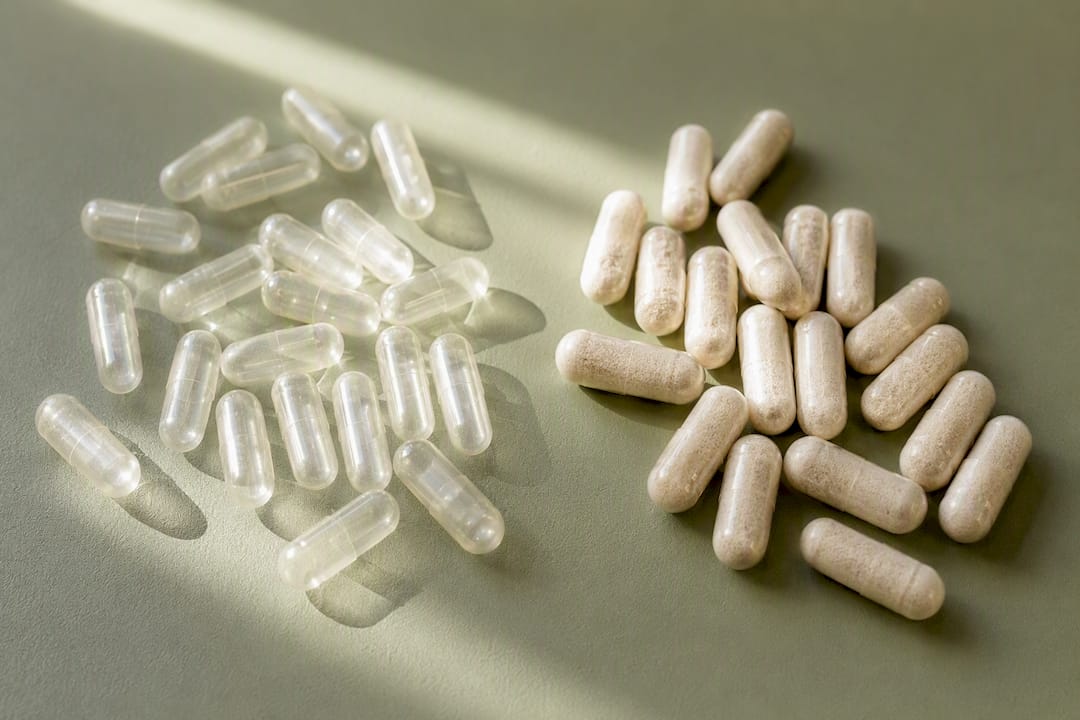
Traditional capsule shells are made from gelatine, which comes from boiled animal collagen, usually from cattle or pig bones and hides. Gelatine is unambiguously animal-derived, and it remains the default shell material across a huge share of the supplement market, simply because it’s cheap and well understood by manufacturers. A magnesium bisglycinate capsule can be vegan right up until you reach the shell, then fail outright.
Gelatine isn’t the only risk. Other places animal-derived material can sneak in:
- Glycerin used as a capsule plasticiser, which can be sourced from animal fat rather than vegetable oil
- Lactose used as a cheap bulking agent or flow aid in the powder blend
- Certain processing aids or coatings that aren’t always spelled out on the front label
Here’s where it gets confusing for a lot of shoppers: “vegetarian” and “vegan” aren’t the same claim, and a “vegetarian capsule” claim on its own tells you almost nothing reliable about vegan suitability, since vegetable-capsule marketing doesn’t automatically rule out animal-derived processing aids elsewhere in the formula. A brand can call a product vegetarian while it still contains gelatine derived from a source some people would consider borderline, or excipients that wouldn’t pass a strict vegan standard.
Pro Tip: If the capsule material isn’t printed on the label or product page, don’t guess. Email the manufacturer directly or ask for a certificate of analysis, most reputable brands will answer this within a day.
How do you check if magnesium bisglycinate is vegan?
You don’t need a chemistry degree to verify this. Four checks, in order, will settle it in a couple of minutes.
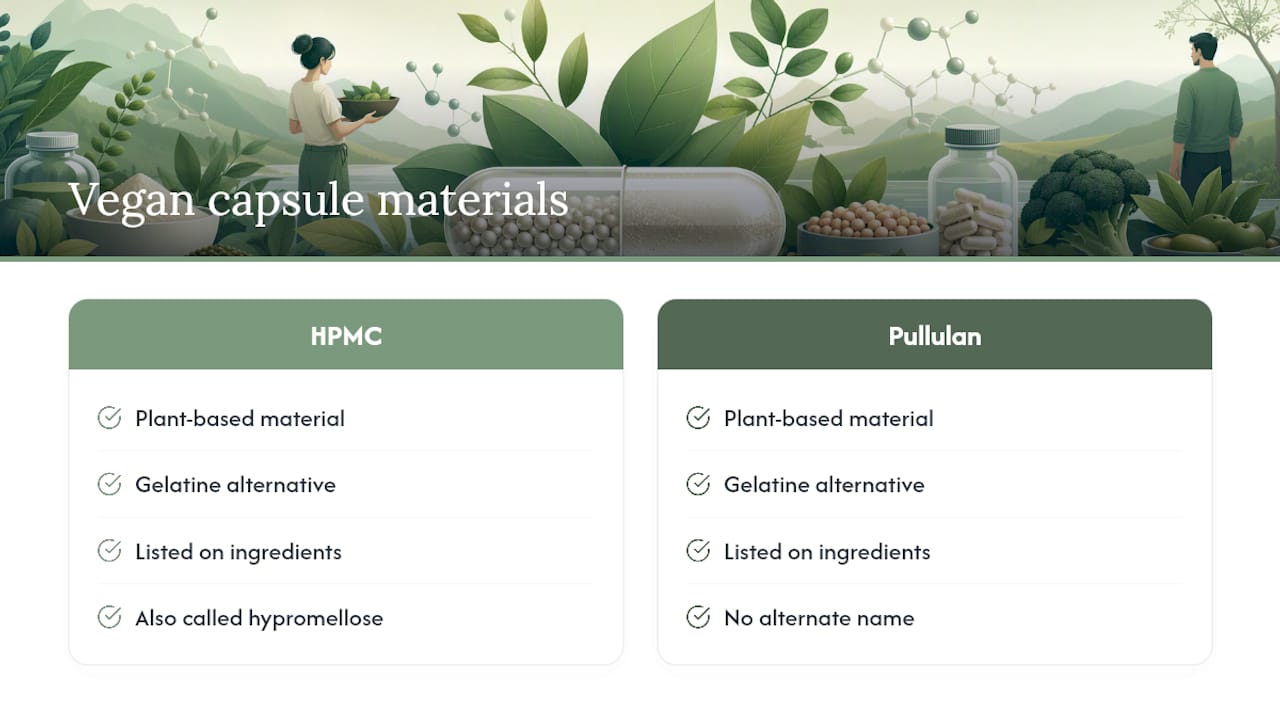
- Read the capsule material on the ingredients list. Look for HPMC (hypromellose) or pullulan, both plant-based polymers used specifically because they replace gelatine. If the label just says “capsule” with no material named, that’s a red flag, not a good sign.
- Look for an explicit vegan claim or a recognised mark. A stated “suitable for vegans” line, or better still, the Vegan Trademark, gives you third-party assurance rather than the manufacturer’s own word. This matters because there’s no legal definition of “vegan” that a regulator enforces, so credible certification is doing real work here, not just decoration.
- Check the glycine source, if the brand discloses it. Glycine can be produced synthetically or derived from plant fermentation, and manufacturers of the raw ingredient describe production as converting glycine with a magnesium source without always stating the glycine’s origin on retail packaging.
- Look for third-party testing or a certificate of analysis. A brand willing to publish a COA is usually a brand willing to answer questions about sourcing too.
Pro Tip: Bookmark the brand’s contact page before you order. Asking “is your glycine plant-derived or synthetic?” is a fair question, and how quickly they answer tells you a lot about how transparent the rest of their supply chain probably is.
Safety notes and who should check with a doctor first
Vegan status and safety are two separate questions, and it’s worth settling both before you start taking anything daily.
Magnesium glycinate is generally well tolerated, but a few groups need to be more careful:
- People with kidney disease, since impaired kidneys struggle to clear excess magnesium, raising the risk of toxicity
- Anyone on interacting medications, including certain antibiotics, bisphosphonates, and some diuretics
- People with existing heart conditions, where electrolyte shifts need closer monitoring
At high doses, the most common side effects are diarrhoea and stomach upset. Health, and toxicity risk rises sharply once kidney function is compromised. If you have a condition like colitis, or you’re managing a chronic illness of any kind, run it past your GP or pharmacist before adding a daily magnesium supplement, rather than assuming “natural” means “no interactions.”
A short vegan buying checklist you can actually use
Standing in front of a shelf, or scrolling a product page, run through this in order:
- Check the capsule material first. HPMC or hypromellose and pullulan are the two plant-based options to look for; gelatine means stop right there.
- Look for a vegan label or third-party certification. The Vegan Trademark or an equivalent recognised mark removes the guesswork.
- Confirm the glycine source if it’s stated. Plant-derived or synthetic both work for vegan purposes; ask the brand directly if the page is silent on it.
- Prefer brands with third-party testing or a published COA. Transparency about testing tends to correlate with transparency about ingredients generally.
- Be wary of vague terms. “Natural flavours,” unspecified “glaze,” or a “vegetarian” claim with no capsule material named are all worth a follow-up question before you buy.
RunComplete Ready: our vegan-friendly magnesium bisglycinate
Ready uses vegan capsules, not gelatine, and we say so plainly on the product page rather than leaving you to guess. It’s UK-made, backed by a 30-day guarantee, and formulated without unnecessary fillers.
For runners specifically, that matters in three practical ways:
- Magnesium bisglycinate is gentler on digestion than other magnesium forms, which counts when you’re already managing gut stress from training
- It supports deeper, more restorative sleep, where most actual recovery happens
- It’s associated with reduced muscle cramping and easier recovery after long runs
You can check the full ingredient breakdown, subscription terms, and guarantee details directly on the product page before you commit to anything.
Why transparency matters more than marketing here
The word “vegan” carries no legal weight, so it only means as much as the evidence behind it. That’s why a stated capsule material and a real certification mark matter more to me than a green leaf logo slapped on the front of a bottle with nothing to back it up.
If a product page doesn’t name its capsule material, that’s a gap worth asking about, not a detail to skip past. Health questions deserve the same treatment: if you’re on medication or managing a condition, a quick conversation with your GP beats a guess. For runners specifically curious about how magnesium bisglycinate fits training and recovery, our running-focused magnesium guides go into more depth than a single article can.
Ready for a magnesium supplement that doesn’t make you guess
Runcomplete built Ready around the one thing most runners actually want from a recovery supplement: something straightforward that works, with nothing to double check on the label. The capsules are vegan, the ingredients list is fully disclosed, and every batch is UK-made with a 30-day guarantee behind it.

No gelatine, no unspecified “natural flavours,” no vague sourcing questions left hanging. Whether you run three times a week or you’re deep into marathon training, Ready is built to support recovery and sleep without adding another ingredient you have to research first. If you’re just starting out with running nutrition more broadly, our beginner’s guide to fuelling a Couch to 5K plan is worth a read too. Head to the product page, check the batch details for yourself, and decide whether a one-time order or a monthly subscription suits your training better.
Frequently asked questions
Is magnesium glycinate the same as magnesium bisglycinate? Yes. Magnesium glycinate, magnesium diglycinate, and magnesium bisglycinate all refer to the same compound, the magnesium salt of two glycine molecules. Brands use the names interchangeably.
Are vegetarian magnesium supplements automatically vegan? No. A vegetarian label often still permits gelatine capsules, since gelatine is animal-derived but not meat. Check for a specific vegan claim or plant-based capsule material like HPMC rather than assuming vegetarian covers it.
What capsule materials are vegan friendly? HPMC (hypromellose) and pullulan are the two main plant-based capsule materials used as gelatine alternatives. Both appear on ingredient lists when a brand has deliberately chosen a vegan shell.
Can I take magnesium bisglycinate if I have kidney disease? Speak to a clinician before starting. Impaired kidney function reduces the body’s ability to clear excess magnesium, raising the risk of toxicity even at standard doses.
Does Runcomplete’s Ready use vegan capsules? Yes. Ready is made with vegan capsule material rather than gelatine, and the full ingredient list is disclosed on the product page alongside UK manufacturing details and the 30-day guarantee.
This article is general information, not a substitute for advice from a qualified doctor. Consult a qualified healthcare professional about your own circumstances before acting on anything here.
Sources
- Magnesium Glycinate - PubChem
- Veganism — Wikipedia
- Are Capsules Vegan? HPMC vs Gelatine Explained | Nutrivity
- Magnesium Bisglycinate | Mineral Salts - Jungbunzlauer
- Health

