
Most healthy adults start magnesium glycinate at 100–200 mg of elemental magnesium daily, working up to 200–400 mg if needed. That upper figure matters: the NHS confirms that 400 mg or less of magnesium from supplements a day is unlikely to cause harm in healthy adults, sitting above the UK Reference Nutrient Intakes of 300 mg for men and 270 mg for women from all sources.
Here’s the catch almost nobody explains on the label: that dosage refers to elemental magnesium, not the total weight of the magnesium glycinate compound. A 500 mg capsule of magnesium glycinate does not give you 500 mg of magnesium. It gives you roughly 10 to 14% of that, because most of the tablet’s weight is the glycine molecule carrying the mineral, not the mineral itself.
- Starting point: 100–200 mg elemental magnesium daily
- Common effective range: 200–400 mg elemental magnesium daily
- UK supplemental guidance: up to 400 mg elemental magnesium from supplements is considered unlikely to cause harm in healthy adults
- Watch for: loose stools or diarrhoea, a sign to reduce the dose
- Check first: kidney function, if you have known kidney disease, before supplementing at all
Check the label for elemental magnesium content specifically, not just the compound weight, before you decide on a dose. If you have kidney disease, are pregnant, or take regular medication, speak to a GP or pharmacist before starting.
Key Takeaways
Magnesium glycinate dosage should be based on elemental magnesium content, not compound weight, with 200–400 mg elemental daily covering most healthy adults’ needs within UK guidance.
| Point | Details |
|---|---|
| Dose in elemental magnesium | Aim for 100–200 mg elemental to start, rising to 200–400 mg elemental if needed. |
| Check the elemental fraction | Magnesium glycinate is roughly 10–14% elemental magnesium by compound weight. |
| Stay within UK guidance | The NHS states 400 mg or less from supplements daily is unlikely to harm healthy adults. |
| Split doses to reduce diarrhoea | Divide daily totals into two doses, ideally with food, to improve tolerance. |
| Get medical advice for complex cases | Kidney disease, pregnancy, and certain medications all need clinician input first. |
| Choose a labelled, tested product | Runcomplete’s Ready states elemental mg per serving and suits vegetarians and vegans. |
This article is general information, not a substitute for advice from a qualified doctor. Consult a qualified healthcare professional about your own circumstances before acting on anything here.
Table of Contents
- What is magnesium glycinate and why do people choose it over other forms?
- What’s the recommended magnesium dosage for adults in the UK?
- How do you convert magnesium glycinate to elemental magnesium?
- What are the side effects and upper limits of magnesium glycinate?
- When do you need medical supervision before taking magnesium glycinate?
- How should you start taking magnesium glycinate day to day?
- How Runcomplete thinks about magnesium bisglycinate for runners
- Sources
What is magnesium glycinate and why do people choose it over other forms?
Magnesium glycinate, also called magnesium bisglycinate, is magnesium bound to two molecules of the amino acid glycine. Chemically, this is a chelate: the mineral is held inside an organic molecule rather than sitting as a simple salt like magnesium oxide or magnesium citrate.
That structure changes how your gut handles it. Chelated magnesium tends to be absorbed through a different intestinal pathway than free magnesium ions, which is why glycinate has built a reputation for being gentler on the stomach than oxide, one of the most common and cheapest forms sold in supermarkets.
- Better tolerated at higher doses, with less osmotic pull into the bowel
- Glycine itself has a mild calming effect, which is part of why it’s popular before bed
- Typical elemental magnesium content sits around 10 to 14% of the tablet or capsule weight
- Widely used by people who’ve tried oxide or citrate and found the gastrointestinal effects too much
That last point is worth sitting with. If you’ve ever compared magnesium glycinate vs citrate and found citrate sends you to the bathroom faster, the difference usually comes down to absorption speed and osmotic load, not the amount of magnesium itself.
What’s the recommended magnesium dosage for adults in the UK?
The UK’s official Reference Nutrient Intakes, covering magnesium from all dietary sources, are 300 mg a day for men and 270 mg a day for women. Most adults already get somewhere close to this from food, with National Diet and Nutrition Survey data suggesting typical UK intakes of around 200–250 mg from diet alone. That gap between what people eat and what they need is exactly why supplementation appeals to so many.
Supplement practice in the UK generally follows a simple structure:
| Dosing stage | Elemental magnesium | Notes |
|---|---|---|
| Starting dose | 100–200 mg/day | Assess tolerance before increasing |
| Common maintenance dose | 200–400 mg/day | Often split into two doses |
| UK supplemental guidance ceiling | Up to 400 mg/day | NHS guidance for healthy adults |
| Prescribed deficiency treatment | ≈240–580 mg/day (10–24 mmol) | Supervised, with monitoring |
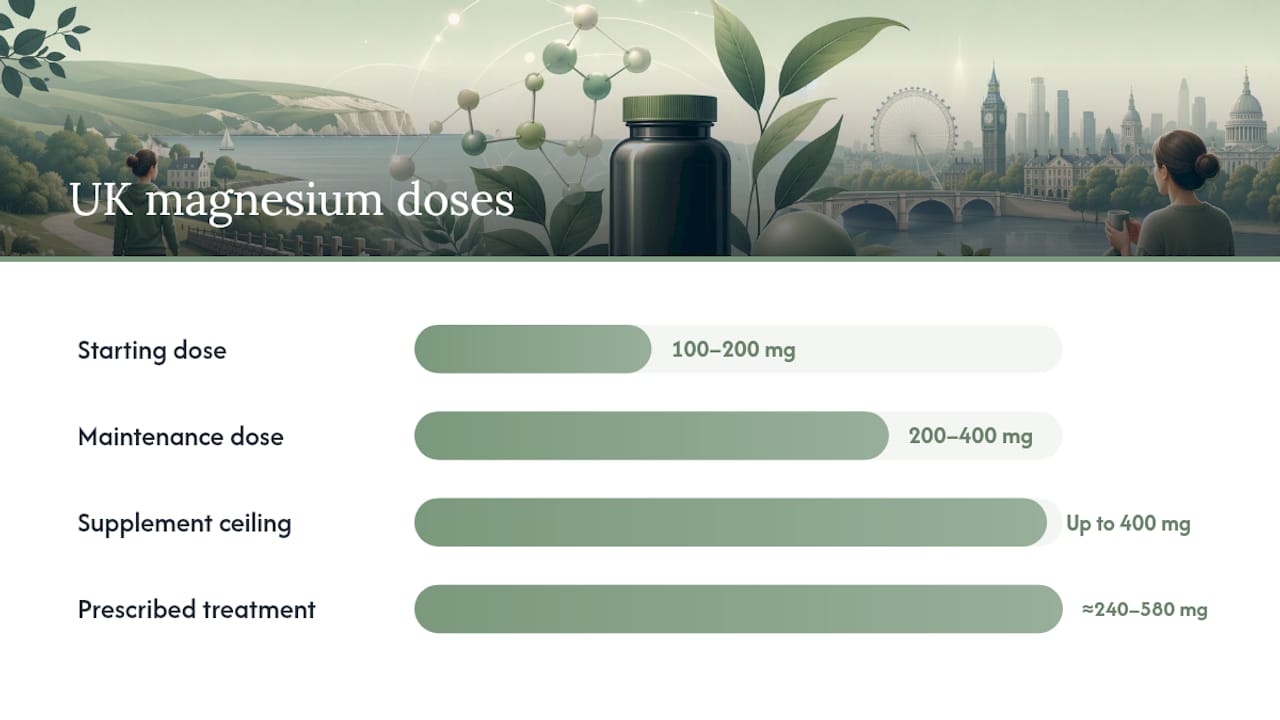
Splitting a 400 mg daily target into two 200 mg doses, one with breakfast and one before bed, tends to sit better with the gut than taking it all at once. This isn’t just comfort. Divided dosing is one of the more consistent findings in risk assessments of supplemental magnesium, which link tolerability improvements directly to smaller, more frequent doses rather than one large hit.
Clinical dosing sits in an entirely different bracket. When magnesium deficiency is confirmed through blood tests, prescribed regimens can run to 10 to 24 mmol daily, roughly 240 to 580 mg elemental magnesium, managed by a clinician with follow-up blood monitoring. That range is not a target for anyone self-supplementing. It’s a treatment protocol for a diagnosed medical condition, and trying to replicate it without supervision is not sensible.
- Self-purchased supplements are for maintaining adequate intake, not treating diagnosed deficiency
- Prescription-strength dosing is reserved for confirmed hypomagnesaemia, almost always with blood tests before and during treatment
- If you suspect a genuine deficiency (persistent cramps, fatigue, irregular heartbeat), see a GP rather than self-dosing upward
How do you convert magnesium glycinate to elemental magnesium?
The formula is straightforward: elemental magnesium (mg) = compound weight (mg) × elemental fraction. Magnesium glycinate’s elemental fraction typically falls between 10% and 14%, depending on the exact salt form and manufacturer.
- 500 mg capsule at 12% elemental fraction gives you roughly 60 mg of elemental magnesium. You’d need over three capsules to reach a 200 mg starting dose.
- 700 mg capsule at 14% elemental fraction gives you around 98 mg of elemental magnesium, closer to a single-capsule starting dose.
- Two 500 mg capsules daily at 12% elemental fraction total around 120 mg elemental, a reasonable entry point before stepping up.
This is precisely why two products both labelled “magnesium glycinate 500 mg” can deliver noticeably different actual magnesium. Reputable brands state the elemental content directly on the label or the nutrition panel, so you’re not left doing arithmetic with a calculator at the pharmacy shelf.
One more step matters if you’re being thorough: add your estimated dietary magnesium intake, roughly 200–250 mg for a typical UK adult, to your supplemental dose before comparing the total against the RNI of 270–300 mg. Most people find they’re already close to target through food alone, and the supplement is topping up a modest shortfall rather than replacing an empty tank.
What are the side effects and upper limits of magnesium glycinate?
The dominant side effect, by a wide margin, is diarrhoea. It’s dose-dependent, meaning it gets more likely and more pronounced the higher you go, and it happens because unabsorbed magnesium in the gut draws water in with it, an osmotic effect rather than an allergic one.
Guidance bodies don’t fully agree on where the ceiling sits, which is worth understanding rather than treating as inconsistency:
- The Scientific Committee on Food set a lower guidance figure of 250 mg for certain magnesium salts
- The US Institute of Medicine set a tolerable upper intake level of 350 mg for supplemental magnesium
- The UK’s Expert Group on Vitamins and Minerals set a guidance level considered appropriate for supplemental elemental magnesium in adults
- NHS practical advice indicates that supplemental magnesium below a certain upper range daily is unlikely to cause harm in healthy adults.
These figures aren’t contradictory so much as differently cautious. Each body weighed the same underlying evidence, mild diarrhoea as the sensitive endpoint, and drew the line at slightly different points. For a UK reader, NHS and EVM guidance is the most directly relevant, and 400 mg is the practical ceiling to work with.
If loose stools appear, the fix is usually simple: split the dose further, take it with food, or step back to the previous tolerated amount for a few days before trying again. Building up gradually over one to two weeks, rather than jumping straight to 400 mg, avoids most of this altogether. Persistent diarrhoea, cramping, or any sign of dehydration is your signal to stop and reassess, not push through.
When do you need medical supervision before taking magnesium glycinate?
Kidney function is the single biggest factor that changes this whole picture. Healthy kidneys clear excess magnesium efficiently, which is exactly why the NHS’s 400 mg guidance applies to healthy adults specifically. Impaired kidneys can’t clear it the same way, and magnesium can accumulate to dangerous levels. Anyone with diagnosed kidney disease should not self-supplement without a clinician’s input.
- Kidney impairment: accumulation risk means magnesium supplements need clinician sign-off, not a supermarket purchase
- Pregnancy and breastfeeding: discuss any supplement with a midwife or GP before starting, even at modest doses
- Medication interactions: proton pump inhibitors, diuretics, and aminoglycoside antibiotics can all interact with magnesium levels or absorption, sometimes needing dose timing adjustments
- Diagnosed deficiency: treated with supervised dosing in the 240–580 mg elemental range, alongside periodic serum magnesium checks, following formulary guidance used across NHS Scotland
Pro Tip: If you’re on a proton pump inhibitor long-term, mention it to your pharmacist before adding magnesium. PPIs are one of the more commonly flagged interactions for reduced magnesium absorption, and it’s a two-minute conversation that avoids guesswork.
How should you start taking magnesium glycinate day to day?
- Start at 100–150 mg elemental magnesium daily for the first week, taken with a meal to reduce any gut sensitivity.
- Increase gradually over one to two weeks, moving toward 200–400 mg elemental if you’re not seeing the benefit you want and tolerance is good.
- Split doses above 200 mg into morning and evening portions rather than one large dose.
- Time your evening dose one to two hours before bed if sleep is your main reason for supplementing; take it with food if digestion is more of a concern than sleep.
- Track how you respond, sleep quality, muscle cramps, and bowel habits, over two to three weeks before judging whether it’s working.
- Reduce or stop if diarrhoea, cramping, or any unusual symptoms appear, and speak to a pharmacist if they persist.
How Runcomplete thinks about magnesium bisglycinate for runners
Tim leads editorial content at Runcomplete, where the focus stays narrow and deliberate: magnesium bisglycinate for everyday runners rather than elite athletes or general gym-goers. That distinction shapes everything about how dosage gets discussed here.

Runners tend to reach for magnesium for two overlapping reasons: reducing cramps after longer sessions and improving sleep quality during heavier training blocks. Both fall comfortably within the ranges already covered, typically 200–400 mg elemental magnesium daily, split across the day rather than dumped in one dose. Nothing about being a runner changes the underlying UK guidance; it changes when and why you’re likely to reach for it.
Whatever product you’re considering, check these before buying:
- Elemental magnesium content stated clearly per serving, not just compound weight
- Independent or third-party testing of the finished product
- Vegetarian and vegan suitability if that matters to you
- Where it’s manufactured
- A guarantee period that lets you trial it without risk
A sensible approach to supplementing
Diet comes first. Most UK adults already get close to their RNI from food, so a supplement is a top-up, not a replacement. Start low, prefer bisglycinate for tolerance, and get a GP’s input if your health situation is more complicated than “healthy adult, occasional muscle cramps.” For runner-specific guidance on timing magnesium for sleep, Runcomplete’s resources go into more depth than this article has room for.
Ready by Runcomplete: built around the numbers in this guide
Runcomplete built Ready around exactly the questions this article just answered. Each serving states its elemental magnesium content plainly, so you’re not doing capsule-weight arithmetic to work out whether you’re anywhere near the 200–400 mg range that suits most healthy adults. It’s magnesium bisglycinate, chosen specifically for the tolerance advantages covered above, and it’s formulated without unnecessary fillers.

It’s vegetarian and vegan friendly, made in the UK, and backed by a 30-day guarantee, so trying it doesn’t mean committing blind. Runners buy it for the same two reasons covered throughout this guide: fewer cramps after harder sessions and better sleep during heavier training weeks. Before you buy anywhere, check the elemental magnesium per serving on the label, exactly as this guide has walked through, and compare it against what you’re already getting from food.
If that all lines up with what you’re after, you can start with Ready as a one-time purchase or a monthly subscription, whichever suits your routine better.
Sources
- Vitamins and minerals - Others - NHS
- Treating acute hypomagnesaemia in adults — SPS
- Risk assessment of magnesium in food — VKM report
- Calcium and magnesium — Right Decisions

