
Taking magnesium right before a run will not make you faster or stronger. The evidence for an acute, pre-run performance boost simply is not there. What actually works is treating magnesium as a daily habit, taken consistently and often in the evening, to support muscle recovery and sleep. For everyday runners, a tolerable daily magnesium bisglycinate supplement fits that pattern far better than a last-minute dose before you head out the door.
TL;DR:
- Taking magnesium immediately before a run does not improve performance; consistent daily supplementation supports recovery and sleep instead.
- Magnesium influences muscle recovery by regulating calcium flow and supporting energy production, with benefits becoming noticeable after one to two weeks of daily use.
- A daily dose of 300 to 500 mg of magnesium, especially in bisglycinate form, is generally effective, with the best results seen in runners with low baseline magnesium levels.
- Magnesium supplementation should be split into smaller doses post-run and in the evening for better absorption and stomach comfort, rather than taken right before exercise.
- Food sources like pumpkin seeds, almonds, spinach, lentils, and dark chocolate provide most magnesium needs, reducing the necessity of supplements for many runners.
Table of Contents
- How magnesium supports muscle function and recovery
- What does the evidence say about magnesium and running performance?
- Should you take magnesium before or after your run?
- How much magnesium should runners take, and in what form?
- Who is most likely to be deficient, and when should you get tested?
- A practical 4 to 8 week protocol for runners
- Which foods give runners the most magnesium?
- What safety issues should runners know about magnesium?
- Tim’s note: why timing matters less than consistency
- Ready to make magnesium part of your routine?
- Sources
How magnesium supports muscle function and recovery
Magnesium sits at the centre of hundreds of enzyme reactions in your body, and several of the most relevant ones for runners involve producing and using ATP, the molecule your muscles burn for energy. It also regulates how calcium moves in and out of muscle cells, which governs contraction and relaxation, including the neuromuscular signalling that tells a muscle when to fire and when to switch off.
When magnesium status runs low, that switching-off process gets sloppier. Muscles stay slightly more excitable, which is one reason chronic low intake has been linked to worse cramping and slower recovery after hard sessions.
This is why a single dose before a run rarely does much: your muscles respond to your overall magnesium status built up over weeks, not to what is in your stomach an hour before you lace up.
- Magnesium drives ATP-dependent reactions in every working muscle fibre
- It regulates calcium flow, which controls contraction and relaxation
- Chronic low levels, not a single missed dose, are what worsen soreness and slow recovery
What does the evidence say about magnesium and running performance?
The research on magnesium and exercise recovery is more consistent on soreness and sleep than on raw performance. A short trial found that 350 mg daily for 10 days reduced muscle soreness and improved perceived recovery compared with a placebo, with participants reporting a difference within about a week and a half of steady use.
In short: Studies using daily doses of 300 to 500 mg over one to two weeks show measurable drops in muscle soreness, but performance gains remain far less reliable.
A systematic review looking specifically at magnesium and delayed onset muscle soreness found reductions in soreness across several trials, with supplemental doses in that 300 to 500 mg range. Separately, a scoping review on magnesium and skeletal muscle health concluded that athletes may need 10 to 20% more magnesium than sedentary people, but admitted the evidence on ideal timing and dosage is still mixed.
Pulling that together for a realistic expectation:
- Soreness and sleep quality: often noticeably better within 1 to 2 weeks of consistent daily supplementation
- Performance metrics like pace or endurance: effects are inconsistent and far less proven
- Baseline status matters: runners with genuinely low magnesium intake tend to see the clearest benefit
Should you take magnesium before or after your run?
Popping a magnesium capsule 30 minutes before a run is not going to work like caffeine. It is not a stimulant, and it does not have an acute mechanism that speeds up muscle contraction or delays fatigue on the day you take it. Some of the studies referenced in the scoping review did test capsules taken roughly 2 hours before exercise, but the overall evidence still favours consistent daily use over any single pre-run timing trick.
Given that oral magnesium typically takes around an hour to start absorbing and peaks somewhere between 2 and 2.5 hours later, a dose taken minutes before a session will not even be active in your bloodstream while you are running. Practically speaking, this is what tends to work better:
- Post-run dose. Take a portion of your daily magnesium shortly after finishing a run, when your body is already shifting into repair mode.
- Evening dose. Take the rest before bed, aligning absorption with the overnight window when muscle repair and much of your recovery physiology happen.
- Consistency over the week. Aim for the same daily total most days rather than loading up only after hard sessions.
Pro Tip: If you are prone to a sensitive stomach, split your daily magnesium into two smaller doses (post-run and evening) rather than one large dose. It eases the load on digestion and gives you two absorption windows instead of one.
Avoid introducing any new supplement, magnesium included, in the final days before a race. If it does not agree with you, you want to find that out on a Tuesday training run, not on race morning.
How much magnesium should runners take, and in what form?
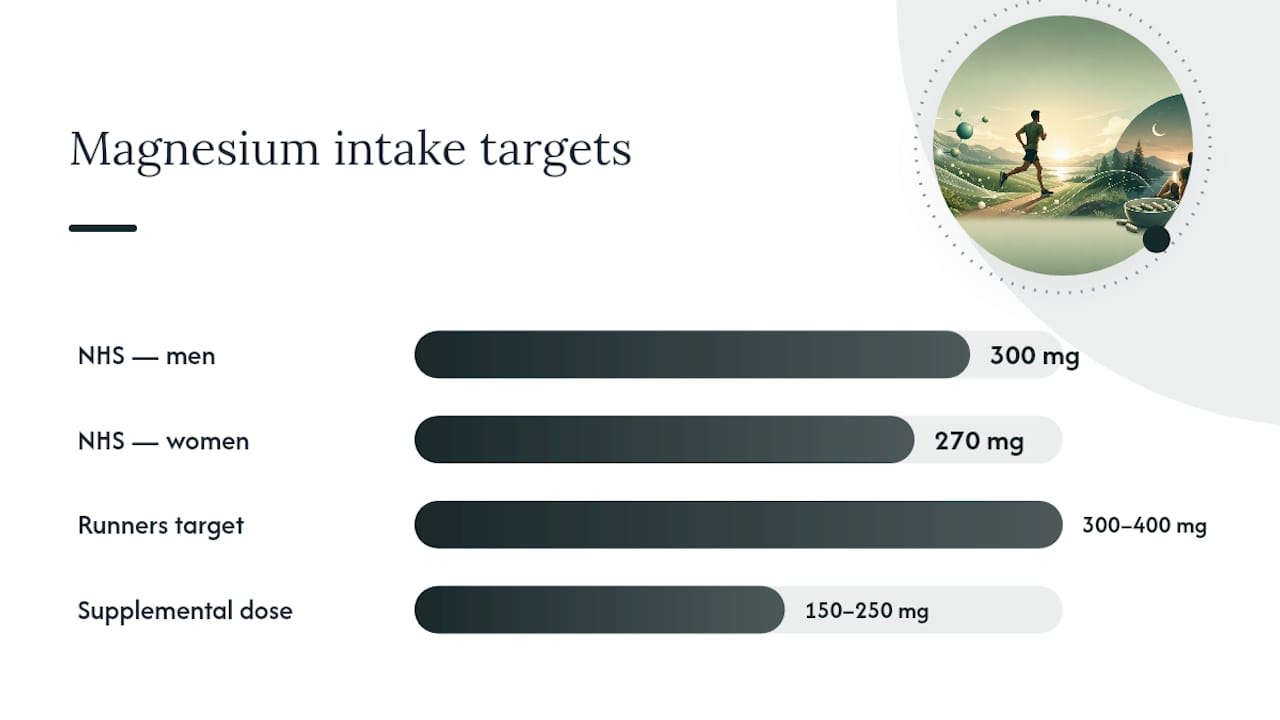
The NHS reference intake for adults aged 19 to 64 is 300 mg a day for men and 270 mg a day for women, from food alone. Runners training regularly are often advised to aim a bit higher, with a combined total (diet plus supplement) somewhere in the 300 to 400 mg range, reflecting the modestly increased needs endurance training can create.
Not every form of magnesium behaves the same way once it is in your gut, and this is where a lot of runners waste money on the wrong product:
- Magnesium bisglycinate (or glycinate): chelated to the amino acid glycine, which improves absorption and is generally the gentlest on digestion, making it the most practical daily choice for most runners
- Magnesium citrate: absorbed reasonably well but more prone to a loosening effect on bowels at higher doses
- Magnesium oxide: cheap and common in budget multivitamins, but poorly absorbed, so much of the dose passes straight through you
If you are starting fresh, begin with a modest supplemental dose, something in the region of 150 to 250 mg of elemental magnesium on top of what you already get from food, and only increase if your body tolerates it well. Watch your bowel habits in the first week or two; loose stools are the clearest early sign you have gone too high, too fast. For a closer look at how glycinate compares with citrate, it is worth reading further before you commit to a product.
Who is most likely to be deficient, and when should you get tested?
Not every runner needs to supplement. But some groups are genuinely more at risk of running low, and worth paying closer attention to:
- Heavy sweaters, particularly in warm conditions or during long sessions, since sweat carries magnesium out with it
- Anyone on a restrictive diet that cuts out whole grains, legumes, or leafy greens
- People with ongoing gut issues causing persistent losses, such as chronic diarrhoea
- Older runners, whose magnesium absorption tends to decline gradually with age
If you suspect a genuine deficiency rather than just wanting a recovery edge, a GP can request a serum magnesium test. UK primary care guidance typically works from a reference range around 0.7 to 1.0 mmol/L, and anyone on diuretics or with reduced kidney function should have supplementation discussed with a clinician first, since both can change how magnesium is processed and cleared.
A practical 4 to 8 week protocol for runners
Rather than guessing, run one of these two schedules consistently for at least a month before deciding whether magnesium is doing anything for you.
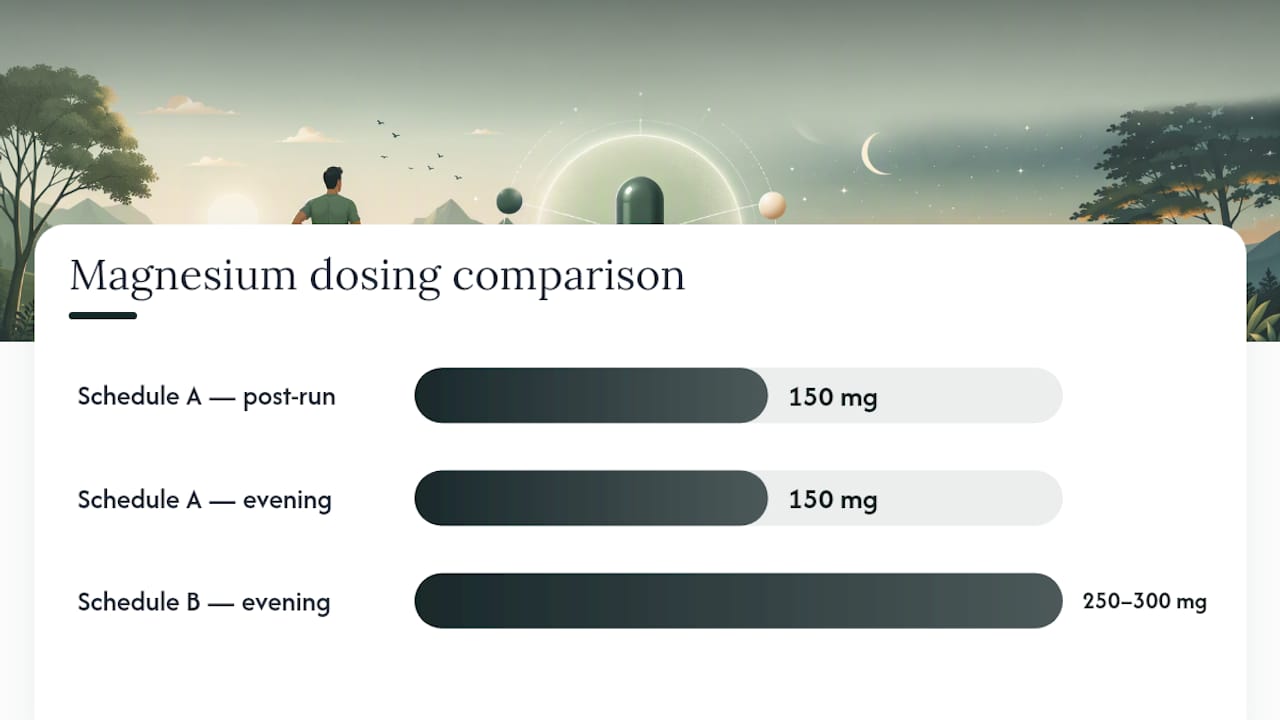
- Schedule A, split dosing. Take around 150 mg shortly after your run, then another 150 mg in the evening, roughly two hours before bed. This spreads the load across two absorption windows and tends to suit runners training most days.
- Schedule B, evening-only. Take a single 250 to 300 mg dose in the evening if you prefer simplicity or you are chasing sleep benefits specifically, since this timing lines up with your body’s main overnight repair window.
- Track three things weekly: bowel habit, sleep quality, and how sore you feel the morning after hard sessions.
Pro Tip: Keep a simple three-line note in your phone (sleep, soreness, digestion) after each run for the first month. Patterns show up faster than you would expect, usually within 10 to 14 days.
If digestion turns unsettled at any point, drop back to a lower dose or switch to bisglycinate if you started on citrate or oxide. Learn more about combining magnesium with meals to reduce stomach upset further.
Which foods give runners the most magnesium?
Food should do most of the heavy lifting before you reach for a supplement at all. A handful of everyday options add up quickly:
- Pumpkin seeds (30g): around 120 mg
- Almonds (30g): around 80 mg
- Cooked spinach (100g): around 80 mg
- Cooked lentils (100g): around 35 mg
- Dark chocolate (30g, 70% cocoa or higher): around 65 mg
Try tracking your food intake for a week before adding a supplement. You might discover you are closer to your target than you thought, and the gap you need to fill with a capsule is smaller than expected.
What safety issues should runners know about magnesium?
Magnesium is generally well tolerated, but it is not entirely without risk, and UK guidance is worth taking seriously rather than skimming.
Key figures: The NHS sets safe adult intakes at 300 mg (men) and 270 mg (women) daily, and recommends spacing supplemental magnesium roughly 2 to 3 hours away from certain oral medicines to avoid interfering with absorption.
- The most common side effect by far is diarrhoea, usually dose-related and often resolved by switching form or splitting the dose
- Space magnesium 2 to 3 hours from medicines where advised, particularly certain antibiotics and thyroid medication
- If you take prescription drugs, especially diuretics, or have any degree of kidney impairment, speak to your GP before starting regular supplementation
Tim’s note: why timing matters less than consistency
The temptation with any supplement is to look for the moment that unlocks the biggest effect: race morning, the hour before a long run, whatever feels like the trick. Magnesium does not work that way, and pretending otherwise sets runners-up to be disappointed after one dose and give up.
This bisglycinate formula is designed to sit in your routine day after day, not to be reached for on race morning. It often comes with a 30-day guarantee because it is best judged over weeks of consistent use rather than a single run. If you are ever unsure whether supplementation is right for you, a quick conversation with a GP beats guessing, and our magnesium glycinate benefits guide is worth a read if you want the fuller picture.
— Tim
Ready to make magnesium part of your routine?
These Ready capsules use magnesium bisglycinate because it is the gentlest form on the gut, with no fillers or unnecessary extras, designed for runners taking it every day rather than once before a big event. The formula suits vegetarians and vegans, often includes a 30-day guarantee, and is produced in the UK.

If you have read this far, you already know the smart move is to build magnesium into your evening routine rather than treat it as a pre-run trick. Head to the RunComplete landing page to choose a one-time purchase or monthly subscription, and pair it with our guide on choosing the best magnesium form for runners if you are still deciding between capsules, tablets, or spray.
This article is general information, not a substitute for advice from a qualified doctor. Consult a qualified healthcare professional about your own circumstances before acting on anything here.
Sources
- NHS — Vitamins and minerals: others
- Digitalcommons
- Effects of magnesium supplementation on muscle soreness: a systematic review (PMC)

