
Taking magnesium on an empty stomach is generally safe for healthy adults, but it raises your odds of nausea, cramping or loose stools compared with taking it alongside food. Timing barely moves the needle on absorption. What matters far more is the form you choose and the dose you take. The main exceptions are people with kidney disease or those on certain medications, who should check with a GP or pharmacist before settling on a routine.
TL;DR:
- Taking magnesium with food reduces the risk of stomach upset by extending absorption time, especially at higher doses or with poorly absorbed salts like oxide.
- Smaller doses split across the day improve bioavailability and lower bowel irritation, regardless of whether magnesium is taken on an empty or full stomach.
- Chelated forms such as magnesium bisglycinate or threonate are gentler on the gut and less likely to cause diarrhea, particularly for sensitive individuals.
- People with kidney disease or on certain medications should seek medical advice before supplementing, as magnesium can interfere with drug absorption or pose health risks.
- Beginning with low doses of chelated magnesium, gradually increasing, and monitoring stomach response help establish a tolerable routine, especially for runners or those with specific health conditions.
Table of Contents
- Why taking magnesium with food usually reduces stomach upset
- How magnesium is absorbed and what affects bioavailability
- Which magnesium forms are gentler on an empty stomach and why
- How much magnesium should you take, and when?
- When could taking magnesium on an empty stomach be unsafe?
- A simple routine for trying magnesium on an empty stomach
- A runner’s note on magnesium timing and tolerability
- A gentler bisglycinate option worth knowing about
- Sources
Why taking magnesium with food usually reduces stomach upset
The gut can only absorb so much magnesium at once. Whatever your intestines don’t take up sits in the bowel and pulls water in behind it, an osmotic effect that speeds up transit and often ends in diarrhoea. Food slows that transit down, giving your gut longer to absorb what it can before the rest moves through.
This is why clinical guidance consistently recommends taking magnesium with a meal rather than on its own. The effect is worse under specific conditions:
- Doses above a certain level, where NHS guidance flags a clear rise in diarrhoea risk
- Poorly absorbed salts such as magnesium oxide, where a larger share of each dose is left unabsorbed
- Taking a full day’s dose in one sitting rather than spreading it out
None of this means food is compulsory. It means food is a buffer, and skipping it removes that buffer.
How magnesium is absorbed and what affects bioavailability
Magnesium crosses into your bloodstream through two routes: a passive route between intestinal cells (paracellular) and an active route through channels called TRPM6 and TRPM7 (transcellular). The active route does the heavy lifting when magnesium is scarce in the gut. The passive route takes over as concentration rises, which is exactly why bigger doses don’t scale up absorption in a straight line.
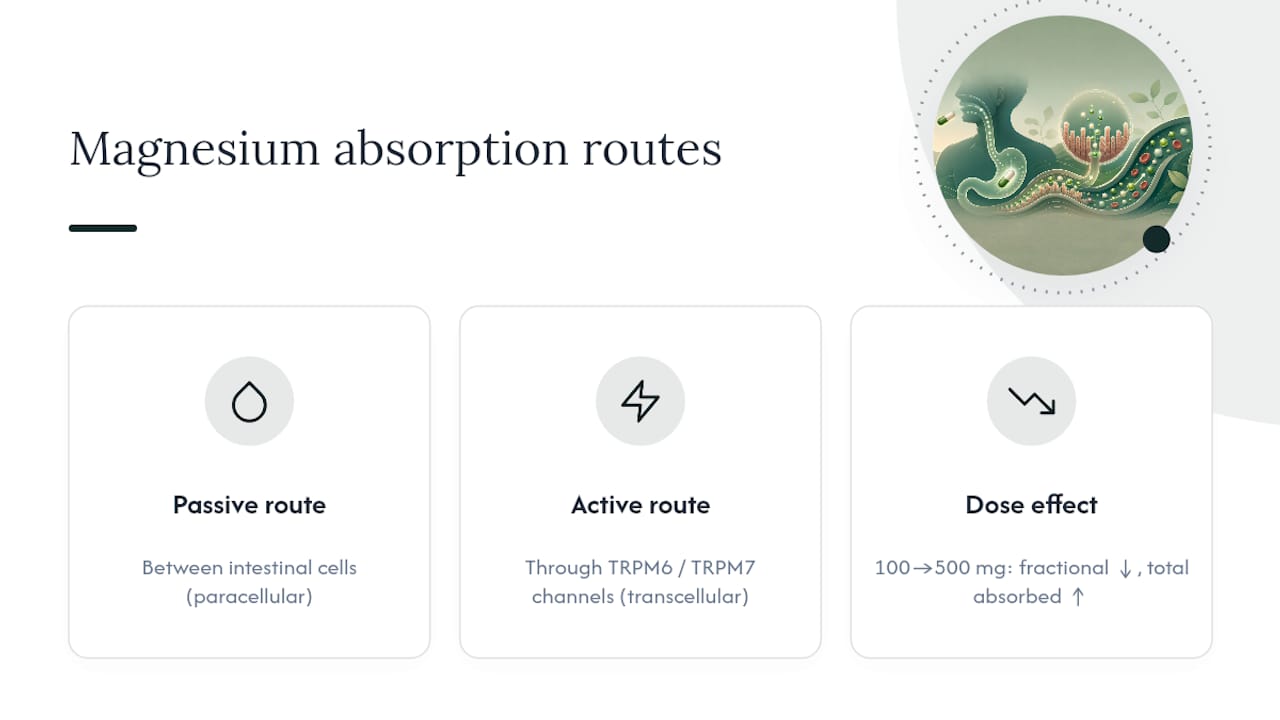
A peer-reviewed review of magnesium bioavailability found that fractional absorption falls as dose increases. Take 100 mg and your gut might absorb a good share of it. Take 500 mg in one go and the percentage absorbed drops, even though the total amount absorbed still rises. Splitting your daily total into two or three smaller doses consistently improves the fraction your body actually keeps.
Food itself plays a role beyond just slowing things down. Phytates and certain fibres bind magnesium and reduce uptake, while protein and some carbohydrates appear to support it. Empty stomach or not, dose and status matter more than the clock.
Which magnesium forms are gentler on an empty stomach and why
Not all magnesium supplements behave the same way once they hit your gut, and that difference explains most of the “it upset my stomach” complaints. Chelated organic forms, where magnesium is bound to an amino acid, tend to be absorbed more efficiently and leave less unabsorbed residue behind to cause trouble.
- Magnesium bisglycinate (glycinate): bound to glycine, generally well tolerated, a sensible default for daily use
- Magnesium threonate: also chelated, similarly gentle, often chosen for its association with cognitive support
- Magnesium citrate: moderate tolerability, sits between the chelated forms and oxide
- Magnesium oxide: cheap and common, but poorly absorbed, so more magnesium ends up in the bowel drawing in water
Consumer pharmacy guidance backs this pattern: bisglycinate and threonate rank as gentler options, while oxide carries the strongest laxative reputation. If you actually want that laxative effect, for short-term constipation relief, oxide or citrate can serve that purpose deliberately. For recovery or sleep support, that’s the opposite of what you want.
Pro Tip: If you’ve tried magnesium before and it upset your stomach, the problem was probably the salt form, not the timing. Switching from oxide to bisglycinate solves it for most people before anything else needs to change.
How much magnesium should you take, and when?
NHS guidance sets typical adult requirements at around 300 mg a day for men and 270 mg for women, most of which a reasonable diet already covers. Where supplements come in, the guidance points to roughly 400 mg a day as the level above which diarrhoea becomes noticeably more likely, so treat that as a practical ceiling rather than a target to hit.
Splitting your dose changes more than comfort. Taking, say, 200 mg in the morning and 200 mg in the evening rather than 400 mg in one sitting improves the fraction your gut absorbs and cuts the amount left to irritate your bowel.
Time of day is more about goal than biology. Many people find evening dosing suits relaxation and sleep, particularly with glycinate. Morning dosing alongside breakfast tends to reduce GI complaints simply because food is already in the mix. Neither timing changes absorption meaningfully on its own; the food and the split matter more than the clock.
When could taking magnesium on an empty stomach be unsafe?
Certain medications and health conditions turn a minor tolerability question into a genuine safety consideration.
- Levothyroxine, tetracycline and fluoroquinolone antibiotics: magnesium can bind to these drugs in the gut and blunt their absorption. Clinical guidance recommends separating doses by 2 to 4 hours.
- Bisphosphonates: the same binding issue applies, so the same separation window is worth building into your routine.
- Kidney disease: impaired renal function means magnesium isn’t cleared as efficiently, raising the risk of hypermagnesaemia. Anyone with reduced kidney function should get personalised advice from a GP before supplementing.
- Severe cardiac disease or polypharmacy: if you’re on several long-term prescriptions, a pharmacist consultation is worth the five minutes it takes.
None of this rules out magnesium. It just means the “just take it whenever” approach isn’t universal.
A simple routine for trying magnesium on an empty stomach
- Pick a gentle form first. Choose a chelated magnesium such as bisglycinate and check the elemental magnesium content per capsule, not just the total compound weight.
- Start low and hydrate. Begin below your target dose, taken with a full glass of water, and build up over a week or two if things feel fine.
- Adjust if symptoms appear. A small snack or splitting the dose across morning and evening usually settles mild nausea or looseness. Persistent or severe symptoms, or any existing kidney condition, warrant a GP conversation before you continue.
Pro Tip: Keep a short note of dose, timing and how your stomach felt for the first week. Patterns show up fast, and it saves you from guessing which variable actually caused the issue.
A runner’s note on magnesium timing and tolerability
Runners ask about magnesium empty stomach effects more than most, usually because they’re trying to protect sleep and next-day legs without adding a supplement that wrecks their gut before a run. In practice, bisglycinate with a split dose covers both goals without the trial-and-error that oxide tends to demand. Track your own response for a week or two, and loop in a GP if you’re on regular medication or have any kidney history.
— Tim
A gentler bisglycinate option worth knowing about
If tolerability is the deciding factor for you, Ready by Runcomplete is built around exactly the form this guide keeps circling back to: magnesium bisglycinate, formulated without unnecessary fillers, in capsules suited to vegetarians and vegans.

Such supplements may be made in the UK and could be backed by a satisfaction guarantee, allowing you to trial them against your own routine (split dose, consistent timing, hydration) without committing long term before you know how your stomach responds. For runners specifically, that combination of a well-tolerated form and a straightforward trial period removes most of the guesswork this article has walked through. If you want to put the bisglycinate approach into practice rather than just read about it, check out Ready and start with a low dose alongside your evening routine.
Sources
The guidance above draws on NHS advice on vitamins and minerals, the BNSSG oral magnesium supplementation guide used across NHS clinical settings, and a peer-reviewed review of magnesium bioavailability covering absorption pathways and dietary factors. For a consumer-facing view on timing and form, the Bolt Pharmacy guide to magnesium timing offers a useful second opinion.
This article is general information, not a substitute for advice from a qualified doctor. Consult a qualified healthcare professional about your own circumstances before acting on anything here.
- NHS — Vitamins and minerals: magnesium (and related guidance)
- Oral magnesium supplementation guide (Adults) 2023 — BNSSG / clinical guidance
- Factors influencing magnesium bioavailability — review (PMC 2017)
- When is the best time to take magnesium? — Bolt Pharmacy guide

