
Magnesium deficiency is a genuine and often overlooked reason runners cramp, sleep badly, and recover slowly between sessions. Most people can close the gap through food alone, but where symptoms are already present or training load is high, a short trial of a well-absorbed supplement is often considered a low-risk next step. Start by tracking your diet and training for a week; if calf cramps, twitches, or sluggish recovery persist, a short trial of magnesium bisglycinate may be worth considering, and any red-flag symptoms belong with your GP.
TL;DR:
- Magnesium deficiency symptoms in runners often include cramps, twitching, fatigue, heavy legs, and disrupted sleep, especially during heavy training or hot weather.
- Most athletes can meet their magnesium needs through food sources like seeds, nuts, spinach, and whole grains, with supplements reserved for persistent symptoms or low dietary intake.
- Supplementing with magnesium bisglycinate at 200 to 300 mg daily, split into doses and taken before bed, is generally well tolerated and may improve recovery and sleep quality.
- Severe deficiency signs, such as irregular heartbeat or seizures, require urgent medical attention, and those with underlying health conditions should consult a doctor before supplementing.
- A short, 2-4 week trial of magnesium bisglycinate can help determine if magnesium deficiency is contributing to persistent cramps or poor recovery, but diet should always be the first approach.
Table of Contents
- Symptoms of magnesium deficiency in runners
- How magnesium affects performance and recovery
- How much magnesium do runners actually need?
- Magnesium-rich foods and supplements for runners
- When magnesium deficiency needs a GP, not a supplement
- What Runcomplete’s runner data shows about fixing this
- What I’d actually do if I were you
- Try Ready if a food-first approach isn’t cutting it
- Official guidance and key studies
- Sources
- FAQ
Symptoms of magnesium deficiency in runners
Magnesium deficiency rarely announces itself with one dramatic sign. It tends to show up as a cluster of small, nagging problems that runners often blame on training load alone.
The most common symptoms include:
- Cramps during runs, particularly in the calves and feet during longer or hotter sessions.
- Nocturnal calf cramps that wake you a few hours after a hard run.
- Persistent post-run fatigue that doesn’t lift with a normal night’s sleep.
- Heavy, leaden legs even on easy days when pace and effort feel harder than they should.
- Eyelid or muscle twitches, especially in the evening after a big training day.
- Frequent, disproportionate DOMS that lingers well past the usual 48 hours.
- Disrupted sleep, including trouble settling or waking frequently through the night.
None of these on their own confirms deficiency. Plenty of runners get calf cramps from dehydration, poor pacing, or simple overreaching. What makes magnesium worth suspecting is the pattern: cramping and twitching that cluster with poor sleep and slow recovery, particularly during a heavy training block, a hot spell, or a period of low food intake. Runner’s World has noted that athletes may need 10 to 20% more magnesium than sedentary people because sweat and urine losses climb with training volume, which may contribute to these signs being more common in runners than casual exercisers.
Severe deficiency is a different matter entirely and needs urgent medical attention rather than a supplement trial. That means palpitations, tetany (sustained muscle spasm), confusion, or seizures, none of which are typical in runners with mild dietary shortfalls.
Pro Tip: Keep a simple symptom log alongside your training diary. Note cramps, sleep quality, and how heavy your legs feel each morning. A pattern across two or three weeks tells you far more than any single bad night.
How magnesium affects performance and recovery
Magnesium sits at the centre of several processes that determine how well you bounce back between runs. It’s needed to produce ATP, the molecule your muscles burn for energy, and it works opposite calcium to let muscles relax after they contract. Without enough magnesium, that relax phase gets less efficient, which is one plausible reason for cramping and twitching. It also plays a role in stabilising nerve signalling and maintaining the sodium-potassium-calcium-magnesium balance that keeps muscle contractions firing correctly.

The recovery evidence is where things get genuinely interesting. A one-week magnesium supplementation study from Coventry University found reductions in IL-6 and lower muscle soreness in the 24 to 72 hours following strenuous exercise. IL-6 is an inflammatory marker that rises after hard training, and a supplementation-linked drop suggests magnesium may support the body’s return to baseline faster. The effect appeared strongest in those starting with lower baseline magnesium, which fits the broader pattern: magnesium looks far more useful for shoring up a shortfall than for boosting an already-replete athlete.
That distinction matters for how you think about magnesium day to day. It isn’t a direct performance enhancer in the way caffeine or beetroot juice can be for athletes who already have adequate levels. Its value for a well-nourished runner is in supporting the machinery of recovery and sleep, not shaving seconds off a 5K. For a runner running short on it, though, correcting the deficit can be the difference between waking up ready to train again and dragging through an easy run on legs that never quite recovered.
How much magnesium do runners actually need?
The NHS sets the Reference Nutrient Intake at 300 mg a day for men and 270 mg for women aged 19 to 64, figures echoed in official government dietary reference tables. Those numbers are built for the general population, not people running 40 or 50 kilometres a week.
Testing your status isn’t as straightforward as a simple blood draw might suggest. Most of your body’s magnesium sits inside cells and bone rather than in the bloodstream, so a normal serum magnesium reading can still sit alongside a genuine tissue-level shortfall. Serum levels capture only a sliver of total body magnesium, which is why clinicians often lean on symptoms and risk factors rather than a single blood test result.
Several factors can increase the risk of low magnesium levels, including high-volume or high-heat training with heavy, sustained sweating.
- Gastrointestinal conditions such as coeliac disease or Crohn’s that limit absorption.
- Regular use of diuretics or proton pump inhibitors (PPIs) for reflux.
- Higher alcohol intake, which increases magnesium excretion via the kidneys.
If several of these apply and symptoms persist, it’s worth asking your GP whether testing or further investigation makes sense.
Magnesium-rich foods and supplements for runners
Food should be your first move, and it’s more achievable than most runners assume. A handful of pumpkin seeds (a rich source of magnesium per 30g), a small portion of almonds, a serving of spinach, black beans, or wholegrain toast each contribute meaningfully towards the daily target, and stacking two or three of these across a day gets most runners close to the RNI without any supplement at all.
Where diet alone isn’t cutting it, or where symptoms are already established, the form of supplement matters more than most people realise:
- Magnesium bisglycinate (glycinate) is chelated with the amino acid glycine, which improves absorption and tends to sit far more gently on the stomach than other forms, making it a sensible pick for an evening dose.
- Magnesium malate is another well-tolerated option, often favoured for daytime use alongside training.
- Magnesium citrate absorbs reasonably well but has a well-known laxative effect at higher doses, which can be unwelcome the night before a long run.
- Magnesium oxide, the cheapest and most common form on supermarket shelves, is poorly absorbed and the most likely to cause digestive upset relative to the magnesium it actually delivers.
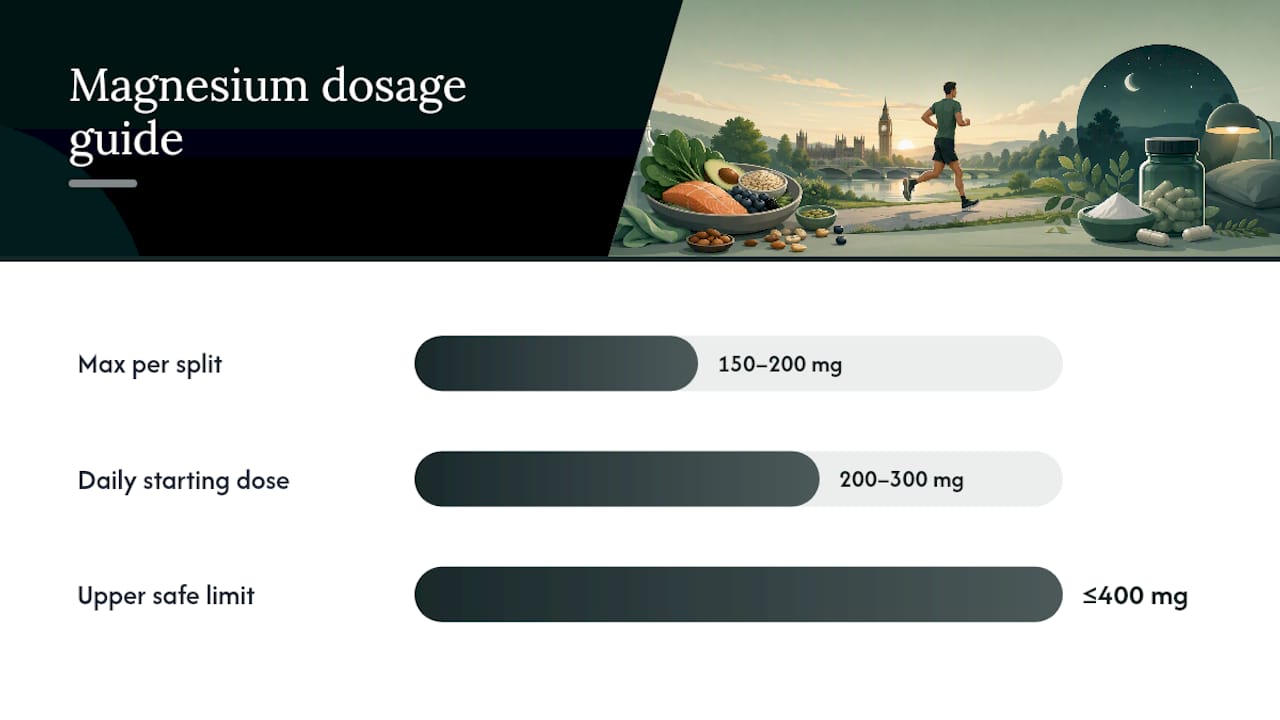
On dosing, a practical starting point for most runners considering supplementation is 200 to 300 mg of supplemental elemental magnesium a day, split rather than taken as one large dose. Splitting doses under roughly 150 to 200 mg each improves absorption and cuts the risk of a laxative effect, and an evening dose taken 30 to 60 minutes before bed can support the deeper sleep that’s often the first thing to improve.
Safety note: The NHS states that supplemental magnesium at 400 mg or less per day is unlikely to cause harm for most adults. Diarrhoea is the main limiting side effect at higher intakes, so it’s worth backing off the dose rather than pushing through if your stomach reacts.
When magnesium deficiency needs a GP, not a supplement
Most magnesium-related symptoms in runners are mild and manageable through diet or a modest supplement trial. A smaller set of symptoms should send you to a GP instead:
- Palpitations or an irregular heartbeat.
- Fainting or severe, unexplained weakness.
- Persistent vomiting or diarrhoea, particularly if it’s ongoing rather than a one-off reaction to a supplement.
- Any sudden, marked worsening of cramping or weakness.
It’s also worth mentioning magnesium supplementation to your GP if you’re on diuretics or PPIs, have kidney disease, or are pregnant, since these can change how your body handles magnesium and how safe a given dose is. If you start a supplement and get severe gastrointestinal side effects, stop and seek medical advice rather than persisting through it.
What Runcomplete’s runner data shows about fixing this
Runcomplete builds its Ready supplement specifically around magnesium bisglycinate because of its better absorption and gentler tolerance for runners taking an evening dose. That focus on everyday runners rather than elite athletes shapes a practical routine worth trying: track your diet for seven days first, and if cramps, soreness, or poor sleep persist, trial 200 mg of bisglycinate in the evening (with an optional smaller morning split) for 2 to 4 weeks. Track cramps, soreness, sleep quality, and morning resting heart rate over that window. If nothing shifts, the cause likely sits elsewhere.
What I’d actually do if I were you
Food first, always. Most runners can improve magnesium intake with deliberate meal choices before reaching for a bottle. If cramps or poor sleep persist after a genuine dietary effort, a short, well-absorbed bisglycinate trial is a reasonable next step, kept modest and split across the day. When in doubt, or if anything feels more serious than routine training fatigue, a GP conversation beats guesswork every time.
— Tim
Try Ready if a food-first approach isn’t cutting it
If you’ve tracked your diet, tightened up your meals, and you’re still waking with calf cramps or dragging through easy runs, a magnesium bisglycinate supplement provides a straightforward next step without the guesswork of comparing numerous generic sports supplements. These kinds of supplements are often formulated specifically for recovery demands of everyday running, made without unnecessary fillers.

Ready is available as a one-off purchase at a set price or through the Subscribe & save plan if you’d rather not think about reordering mid-training-block. It fits naturally into the evening routine covered above: one capsule 30 to 60 minutes before bed, alongside your usual wind-down. Every order carries a 30-day guarantee, so testing whether it makes a difference to your sleep and soreness costs you nothing beyond the trial itself. Head to the Ready product page to check current pricing and start your own trial.
Official guidance and key studies
- NHS — Vitamins and minerals: other vitamins and minerals
- Coventry University — One week of magnesium supplementation lowers IL-6 and muscle soreness
- Government dietary recommendations — mineral reference tables
- Elmntlab — Magnesium in sport: effects, dosing and best forms
This article is general information, not a substitute for advice from a qualified doctor. Consult a qualified healthcare professional about your own circumstances before acting on anything here.
Sources
- NHS — Vitamins and minerals: other vitamins and minerals
- Coventry University — One week of magnesium supplementation lowers IL‑6 and muscle soreness
- Government dietary recommendations — mineral reference tables
FAQ
Can I take magnesium if I have colitis?
If you have colitis or another inflammatory bowel condition, speak to your GP before starting a magnesium supplement, since absorption and tolerance can both be affected. Bisglycinate tends to be gentler on the gut than citrate or oxide, but a medical conversation should come first given the underlying condition.
What are the five signs of magnesium deficiency in runners?
The most common runner-specific signs are calf cramps during or after runs, nocturnal cramping, persistent post-run fatigue, muscle or eyelid twitches, and disrupted sleep. None of these confirm deficiency on their own, but a cluster of them during heavy training is worth investigating.
Is one banana a day enough magnesium?
No. A medium banana provides roughly 30 mg of magnesium, a fraction of the NHS reference intake of 300 mg for men and 270 mg for women. Pumpkin seeds, almonds, spinach, and wholegrains contribute far more per portion and are worth prioritising over relying on fruit alone.
What are the seven signs your body needs magnesium?
Beyond the core running-related symptoms, watch for muscle weakness, irritability or low mood, poor concentration, and irregular heartbeat alongside cramps, twitches, and sleep disruption. Severe or sudden versions of any of these, particularly palpitations or fainting, warrant a GP visit rather than a supplement trial.
How much magnesium should a runner take daily?
A practical supplemental range for runners considering a top-up is 200 to 300 mg of elemental magnesium a day, split rather than taken in one dose. UK guidance considers 400 mg or less per day unlikely to cause harm, with diarrhoea the main limiting side effect at higher amounts.

