
Your legs feel wrecked but your brain is wide awake, and that mismatch has a physiological reason: hard or unusually long runs push up cortisol, adrenaline and core body temperature, all of which delay sleep onset regardless of muscle fatigue. Tonight, cool down properly, cut caffeine and alcohol, and try slow breathing before bed. The rest of this guide covers why it happens, what to do about it this week, and when it stops being normal.
TL;DR:
- Completing runs within two to three hours of bedtime or after dehydration and inadequate carbohydrate intake significantly increases the risk of post-run sleep disruption.
- Cooling down with a shower or cold towels, rehydrating with electrolytes, and avoiding caffeine late in the day effectively counteract the hormone and temperature factors delaying sleep.
- Magnesium bisglycinate may modestly improve sleep for runners with low magnesium levels if taken consistently over two to four weeks, but it is not a cure-all.
- Athletes who habitually perform very intense or long sessions late in the evening are more prone to sleep issues, especially if they are not accustomed to that workload.
- Repeating a single sleep-support intervention for at least a week and tracking its effects helps identify effective habits and avoid unnecessary changes that could worsen sleep.
Table of Contents
- What happens to your body after long or intense runs
- How to get to sleep tonight and support recovery in the next 24 hours
- Does magnesium actually help runners sleep better?
- When is it more than normal post-run sleeplessness?
- Training load, sleep, and the discipline of changing one thing at a time
- If you want a ready-to-try magnesium option
- Sources
- FAQ
What happens to your body after long or intense runs
Muscle tiredness and sleep readiness are not the same thing, and that gap is exactly why so many runners lie awake after a session that should have knocked them out. Long or hard runs trigger a cascade of stress hormones designed to keep you alert and mobile, not to wind you down.
Cortisol and adrenaline rise sharply during exertion, and for very long or unusually intense sessions, norepinephrine can stay elevated for up to 48 hours afterwards in some people. That persistence helps explain why the disturbed sleep sometimes shows up the night after a hard session, not just the same evening, according to research on norepinephrine persistence after exhaustive exercise. Your nervous system is still running the session hours after your legs have stopped.
Core temperature adds a second layer to the problem. Falling asleep depends on your body dropping its internal temperature by around half a degree, and a long run can leave you a degree or more above baseline for over an hour after you finish. Sweat loss and dehydration compound this because a dehydrated body struggles to dissipate heat efficiently, keeping your heart rate higher than it should be as you try to drift off.
There is also a straightforward autonomic story: elevated heart rate and sympathetic nervous system activity persist beyond the run itself. This is the “fight or flight” branch of your nervous system, and it does not switch off the moment you stop moving. A review on exercise, temperature and sleep identifies core temperature and sympathetic activation as the two most modifiable drivers of this kind of post-exercise insomnia, which is good news: both respond to fairly simple interventions.
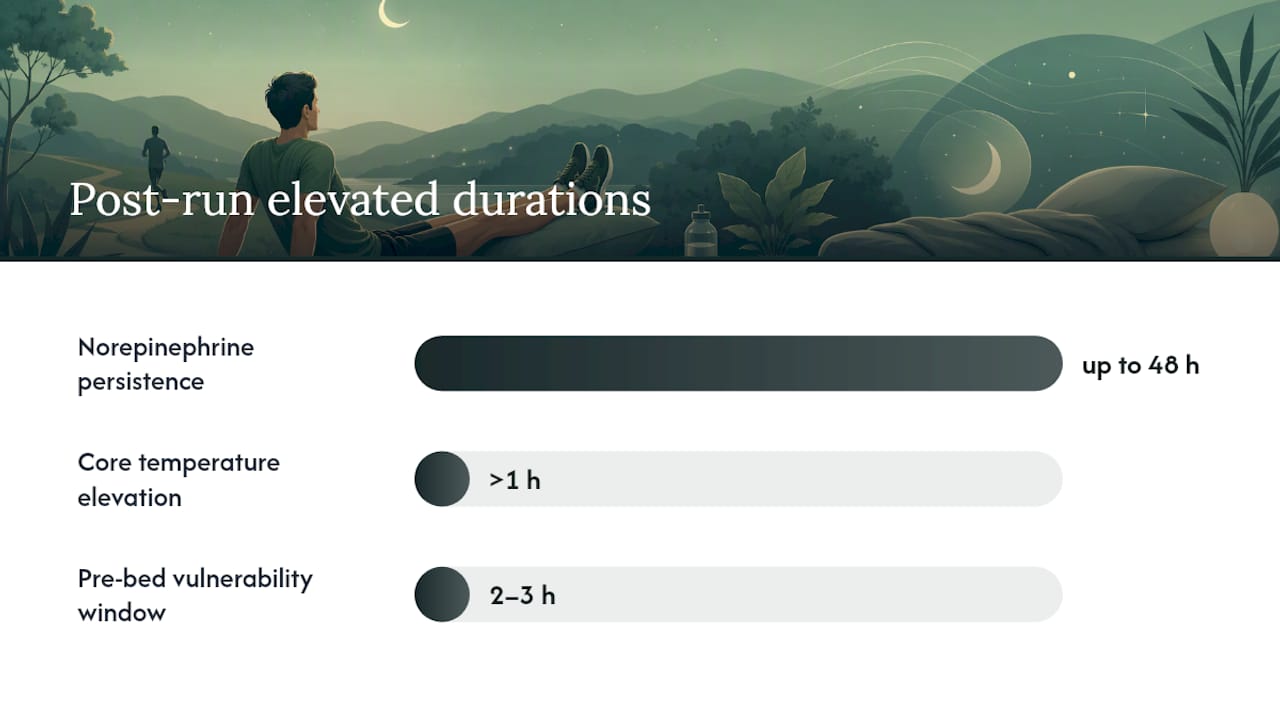
Not every hard session causes this. Evidence from polysomnography studies in endurance-trained runners shows that high-intensity exercise in the early evening often fails to disrupt sleep at all, and can sometimes improve total sleep time, when the runner is used to that kind of session, according to research published in the European Journal of Applied Physiology. Habituation matters. It is usually the outlier session, the one well beyond your normal training load, that causes the trouble.
In practice, three things tend to predict a bad night after running:
- A session significantly longer or harder than your recent training average
- Finishing within two to three hours of your usual bedtime
- Finishing dehydrated or without adequate carbohydrate replacement
Quick reference: In a 2025 randomised, placebo-controlled trial, magnesium bisglycinate improved insomnia severity scores by 3.9 points over four weeks, against 2.3 points for placebo, a small but statistically significant effect concentrated in people with low baseline magnesium intake, according to the trial published on magnesium bisglycinate and sleep.
How to get to sleep tonight and support recovery in the next 24 hours
Most of what disrupts sleep after a hard run is fixable with fairly ordinary tactics, applied at the right time and in the right order, as detailed in this safe effective workouts guide for busy adults. Here is a sequence that targets each of the mechanisms above, from the moment you finish to the moment you get into bed.
- Cool down deliberately, not passively. A cool shower 60 to 90 minutes before bed, or cold towels on your neck and wrists for 20 to 30 minutes if a shower is not practical, helps bring core temperature down faster than simply waiting it out. Avoid genuinely cold or ice baths right before bed. They can spike alertness rather than settle it, even though they help temperature in the short term.
- Rehydrate with electrolytes, not just water. Mild dehydration keeps your heart rate elevated, which works against sleep onset. Replace fluid losses with a drink containing sodium and potassium rather than plain water alone, particularly after runs over 90 minutes or in hot conditions.
- Set a hard caffeine cutoff. Caffeine has a half-life of five to six hours, so a gel or coffee taken during a late-afternoon run can still be active in your system at 10pm. If you race-fuel with caffeinated products, plan your last dose for at least six hours before your intended bedtime.
- Eat a proper recovery meal, not just a snack. A meal combining carbohydrate and protein within two hours of finishing supports the hormonal shift out of “stress mode” and into recovery. Skipping food, or relying on sugary snacks alone, tends to leave blood sugar and cortisol more erratic through the evening.
- Use a breathing technique with a genuine physiological effect. The 4-7-8 method (inhale for four seconds, hold for seven, exhale for eight) slows your heart rate through extended exhalation, directly countering the elevated sympathetic tone from your run. Progressive muscle relaxation, tensing and releasing each muscle group for a few seconds, works well too, and it doubles as a way to notice and let go of residual tightness from the run itself.
- Keep alcohol out of the equation. It might feel like it helps you drop off, but it disrupts the second half of the night’s sleep architecture, which is exactly when your body does the heavy lifting on muscle repair.
Pro Tip: If you’re still wired 30 minutes after trying to sleep, get up rather than lying there frustrated. Do a short, low-light stretch or read something unstimulating for ten minutes, then try again. Fighting for sleep tends to raise cortisol further, which is the opposite of what you need.
Napping the next day needs care. A short nap of 20 to 30 minutes in the early afternoon can offset a rough night without damaging the following night’s sleep pressure. Anything longer, or anything after 3pm, risks pushing your next bedtime back and repeating the same cycle. If you train early morning and struggled to sleep the night before, a brief nap is a legitimate recovery tool. It is not a substitute for fixing the underlying pattern.

Timing your sessions also matters more than most training plans acknowledge. Some athletes on two-a-day schedules or very early morning sessions accumulate chronic sleep debt that a single good-night routine cannot fully undo, according to a 2024 review on training timing and athlete sleep. If evening sessions are consistently wrecking your sleep, shifting your hardest workouts earlier in the day, where practical, is a more durable fix than any bedtime tactic on its own.
Does magnesium actually help runners sleep better?
Magnesium is genuinely relevant here, but the evidence supports a modest effect, not a miracle fix. It is worth understanding what it actually does before deciding whether it belongs in your routine.
Magnesium plays a direct role in muscle relaxation and in regulating GABA, the neurotransmitter responsible for calming nervous system activity. That gives it a plausible, mechanism-based reason to help with both the muscle tension and the racing-mind side of post-run insomnia. It is not a sedative. It works by supporting a process your body already runs, rather than switching anything off artificially.
The clinical picture backs a real but limited benefit. A 2025 randomised, double-blind, placebo-controlled trial found magnesium bisglycinate, dosed at 250mg of elemental magnesium daily, produced a small but statistically significant improvement in insomnia severity over four weeks, with the largest gains seen in people who started with low dietary magnesium, according to the trial on magnesium bisglycinate supplementation. Separate meta-analysis work on magnesium and sleep quality points the same direction, with subjective sleep improvements concentrated in people with lower baseline magnesium. Runners are a plausible group for that low-baseline pattern, since magnesium is lost through sweat during endurance training, and the NHS notes that low magnesium intake can show up as muscle tightness, restless legs and sleep disturbance.
Practical points for runners considering magnesium:
- Bisglycinate (sometimes called glycinate) is generally better tolerated on the gut than citrate or oxide forms, which more commonly cause loose stools at effective doses.
- Take it in the evening, before bed, so it aligns with the muscle-relaxation and wind-down window rather than the middle of the day.
- Give it two to four weeks before judging results, tracking sleep onset time, night wakings and next-day muscle soreness rather than expecting an overnight change.
- Magnesium supplements can interact with certain antibiotics and with reduced kidney function; anyone with renal impairment or on regular medication should check with a GP first.
If you want to understand the mechanism in more depth, this piece on how magnesium supports overnight muscle recovery covers the timing and dosing logic in more detail, and this guide to choosing a quality bisglycinate product is useful if you decide to try one. Magnesium will not fix a training load problem or chronic underfuelling on its own. It is one lever among several, not a replacement for the cooling, hydration and timing habits covered above.
When is it more than normal post-run sleeplessness?
A rough night after a hard race or a personal-best effort is expected. A pattern that will not settle, or symptoms alongside the sleeplessness, is a different matter and worth flagging to a GP rather than working around indefinitely.
Get it checked promptly if you notice any of the following:
- Chest pain, palpitations that will not settle, or fainting around or after exercise
- Insomnia that persists beyond two weeks, well past when a single hard session should have resolved
- Severe restless legs, new snoring, or breathing pauses noticed by a partner
- Sleeplessness accompanied by unexplained weight loss, resting heart rate that stays high for days, or persistent fatigue that does not improve with rest
Before an appointment, keep a short sleep diary noting bedtime, wake time, and how long it took to fall asleep, alongside your training load for the preceding two weeks and any caffeine, alcohol, or supplement use. That record turns a vague “I’m not sleeping well” into something a GP can actually act on. Depending on what it shows, next steps might be a straightforward GP review, a referral to a sleep clinic for suspected apnoea, or a cardiac check if palpitations or chest symptoms are part of the picture. None of this applies to the occasional bad night after a big effort. It matters when the pattern will not break on its own.
Training load, sleep, and the discipline of changing one thing at a time
Sleep is one of the earliest signals of overreaching, often showing up before performance does. If a runner tells me their sleep has gone from reliable to patchy over two or three weeks, I look at their training log before I look at anything else.
The instinct when sleep goes wrong is to change everything at once: cooling, supplements, bedtime, caffeine, all in the same night. That makes it impossible to know what actually worked. Pick one intervention, run it consistently for seven to fourteen days, and track it against a simple sleep diary before adding the next variable.
The habits that hold up over a season are boring ones: a consistent bedtime buffer after evening sessions, a fixed wind-down routine, sensible load progression. None of that fixes a bad night immediately, but it is what stops bad nights turning into a bad month.
*— Tim
If you want a ready-to-try magnesium option
Runcomplete built Ready — Magnesium for Runners specifically for the evening recovery window this article has been describing, using the bisglycinate form for its better gut tolerance and its fit with the muscle-relaxation and wind-down role magnesium plays. It is formulated without unnecessary fillers, made in the UK, and suitable for vegetarians and vegans.
If you decide to test whether magnesium makes a difference to your own sleep, treat it the way this article recommends treating any single intervention: use it consistently for two to four weeks and track sleep onset, night wakings and next-day soreness rather than judging it after one night. Ready is available as a one-off purchase, or through the Subscribe & save plan if you want it to arrive automatically each month, and it comes with a 30-day guarantee if it does not work out for you. Head to the Ready product page to start your trial.
Sources
- NHS — Vitamins and minerals: others
- Effect of magnesium bisglycinate supplementation on sleep and fatigue parameters in healthy adults reporting poor sleep quality (2025)
- High-intensity exercise in the early evening does not disrupt sleep in endurance runners (European Journal of Applied Physiology, 2019)
- Frontiers in Physiology — training timing and athlete sleep (2024)
- Open-access review on exercise, temperature and sleep (PMC article)
FAQ
Can running give you insomnia?
Yes, particularly after sessions that are much longer or harder than your normal training load, since elevated cortisol, adrenaline and core temperature can all delay sleep onset. This is usually short-lived and tends to ease as your body cools down and hormone levels settle over the following hours.
What is post-marathon syndrome?
Post-marathon syndrome describes the cluster of symptoms some runners experience after a marathon or similarly extreme effort, including disrupted sleep, low mood, fatigue and muscle soreness lasting days rather than hours. It reflects the scale of hormonal and physical stress from an event well beyond normal training, and it typically resolves within one to two weeks with rest, hydration and gradual return to activity.
Why is the first 20 minutes of running so hard?
The first 20 minutes feel harder because your cardiovascular and muscular systems need time to shift from resting state to steady aerobic output, including redirecting blood flow to working muscles and adjusting breathing rate. This has no direct bearing on post-run sleep, but the same slow physiological adjustment applies in reverse when you finish, which is part of why cooling down properly matters.
What is the 80% rule in running?
The 80% rule suggests structuring roughly 80% of weekly training at an easy, conversational pace and reserving about 20% for harder, higher-intensity work. Following it consistently reduces the frequency of the kind of unusually intense sessions most likely to disrupt sleep, since your body stays better adapted to your typical training load rather than being repeatedly shocked by outlier efforts.

