
Move, hydrate, refuel, sleep, in that order, within the first few hours of finishing a run or landing after a flight. Travel fatigue usually clears within a day or two; true jet lag, especially after flying east, can take longer and is worth tracking through sleep quality rather than guesswork.
TL;DR:
- Proper recovery involves moving gently and frequently during travel to prevent blood pooling and reduce stiffness, especially after long flights or races.
- Hydration with electrolytes and carb-protein refueling within two hours of finishing a run enhances recovery, while alcohol and caffeine may impair it.
- Managing jet lag with light exposure, sleep hygiene, and careful sleep scheduling shortens adjustment, but most travel fatigue resolves within a day per time zone crossed.
- Compression socks during long flights and a minimal travel recovery kit support circulation, mobility, and skin health without needing extensive equipment.
- Magnesium bisglycinate helps improve sleep quality and muscle relaxation when incorporated into a routine but should complement, not replace, core recovery habits.
Table of Contents
- Travel-friendly active recovery you can do anywhere
- Hydrate and refuel: what actually travels well
- How do you beat jet lag versus travel fatigue?
- Compression and gear that genuinely help
- Packable recovery tools: your one-bag checklist
- Where magnesium bisglycinate fits into your recovery routine
- Managing soreness and inflammation without a treatment room
- Should you train normally while travelling?
- Mental recovery: handling travel stress without losing motivation
- Foot and skin care while you’re away from your usual routine
- Stretching and foam rolling when you barely have floor space
- A habit worth stealing before your next trip
- Runcomplete’s magnesium bisglycinate: a simple addition, not a fix-all
- Sources
Travel-friendly active recovery you can do anywhere
You don’t need a gym or even much floor space to kick-start recovery. Blood tends to pool in the legs after a race or a long flight, and the fix is short bursts of deliberate movement rather than total stillness. Practical guidance from destination-race coaches backs simple in-seat and in-aisle movement as a low-risk way to cut stiffness.
Try these, done little and often rather than all at once:
- Legs-up-the-wall (or seat-back). Lie down, prop your calves against a wall or airline seat in front, and hold for two to three minutes. This helps venous return after standing on your feet for hours.
- Ankle circles. Ten rotations each direction, both feet. Works even sitting in an economy seat.
- Calf pumps. Point and flex your toes for 30 seconds, repeated every hour you’re seated. Runner’s World’s travel-friendly recovery moves list this as one of the easiest wins on a long flight.
- Half squats. Ten slow reps by a departure gate or hotel corridor to wake the glutes and quads.
- Standing hip flexor stretch. Fifteen seconds each side, useful after sitting for a race transfer.
- Shoulder rolls and neck tilts. Often ignored, but travel tension sits in the upper back as much as the legs.
- Short walk. Ten minutes at arrivals or during a layover beats sitting through the whole wait.
Keep intensity gentle, especially after a hard race. Stop immediately if you feel sharp pain rather than general stiffness.
Hydrate and refuel: what actually travels well
Rehydration should start before you feel thirsty. Sweat losses from a race or dry cabin air both leave you behind on fluids, and plain water alone won’t replace lost sodium and potassium.
Pack electrolytes that survive a security check and a warm bag:
- Electrolyte tablets or sachets that dissolve in a water bottle
- A low-sugar sports drink powder
- Salty snacks like pretzels or trail mix with added salt
For refuelling, aim for a mix of carbohydrate and protein within two hours of finishing your run, a window runner-specific travel recovery advice also flags as the practical target for busy travel days. A banana with peanut butter, a protein bar with 20g or so of protein, or even a chicken sandwich from an airport shop all do the job.
Go easy on alcohol and excess caffeine straight after a race or on a flight. Both dehydrate you further and can disrupt the sleep you need for recovery.
Pro Tip: At airport concessions, skip the pastry case and look for a protein bar, a bag of nuts, or a yoghurt pot. They travel well and refuel far better than sugar alone.
How do you beat jet lag versus travel fatigue?
Travel fatigue is general tiredness from the journey itself. Jet lag is your circadian rhythm being out of step with local time, and it behaves differently depending on direction. A critical review of long-haul travel’s effects on athletes found that eastward travel disrupts nocturnal sleep and delays sleep onset more than travelling west, largely because your body clock finds it easier to stay up later than to fall asleep earlier.
Sleep hygiene does most of the heavy lifting here:
- Keep your bedroom (or hotel room) dark, cool, and phone-free in the last 30 minutes before sleep
- Time light exposure to your destination: seek morning light after flying west, evening light after flying east, a pattern supported by circadian research on long-haul athletes
- Nap for no more than 20 to 30 minutes if you land in daylight and are desperate for rest
- Consider short-term melatonin only with caution, and be aware the evidence for athletes specifically remains limited
Multifactorial approaches combining light, timed exercise, and sleep hygiene are what a systematic review on managing travel fatigue in athletes recommends, precisely because no single fix reliably works alone.
Tracking your sleep duration or heart-rate variability through a watch or app gives you an honest signal of where you stand. Most travel fatigue resolves within a day per time zone crossed, though this varies person to person.
Compression and gear that genuinely help
Compression socks aren’t a gimmick if you use them at the right time. For long flights, knee-length graduated compression socks reduce the feeling of heavy, swollen legs. Evidence on in-transit movement and compression points to combining compression with regular movement, not compression instead of it.
A short packing shortlist, ranked by how often you’ll actually use each item:
- Compression socks — worth the drawer space for any flight over four hours; fit them snugly but not painfully tight
- A resistance band — packs flat, useful for hip and glute activation in a hotel room
- A small massage ball or mini roller — good for feet and calves, less bulky than a full foam roller
If you have any diagnosed circulatory condition, check with a clinician before wearing compression garments on long flights. This isn’t a universal fix, just a sensible one for most healthy runners.
Packable recovery tools: your one-bag checklist
Keep this simple enough that you never have to think about it before a trip.
- Electrolyte sachets — for the flight and the first hours after landing
- Compression socks — worn during transit, not just after
- Resistance band — for hotel-room mobility work
- Protein bar or two — for refuelling before proper food is available
- Earplugs and an eye mask — non-negotiable for sleep on planes and in unfamiliar rooms
- A small travel-size roller or ball — for calves and feet
On arrival, run through a short routine: a 10 to 15 minute walk outside, five minutes of the mobility moves above, a proper meal with carbohydrate and protein, then a nap capped at 20 to 90 minutes depending on how close it is to your destination’s bedtime. Roll everything into a single pouch so packing becomes automatic rather than a decision each time.
Where magnesium bisglycinate fits into your recovery routine
Magnesium bisglycinate is a form of magnesium bound to the amino acid glycine, chosen because it tends to sit more gently in the stomach than cheaper forms like magnesium oxide. Runners lose magnesium through sweat, and heavier training weeks or hot-climate races can leave you running a modest deficit that food alone doesn’t always close.
The plausible benefits worth knowing:
- Magnesium plays a role in muscle relaxation, which is why some runners associate it with fewer night cramps
- It’s linked with supporting sleep quality, relevant when you’re already fighting jet lag or a strange hotel bed
- It works as one part of a routine, not a replacement for hydration, food, or sleep hygiene
Runcomplete’s own guidance goes into more depth on how magnesium supports overnight recovery, and on pairing magnesium with food for better tolerance. Endurance athletes commonly show higher magnesium turnover than sedentary people, which is part of the reasoning behind treating supplementation as a genuine adjunct rather than a nice-to-have.
Pro Tip: If you’re using magnesium to support sleep while travelling, taking it in the evening rather than the morning lines up with when you actually want its calming effect to kick in.
Managing soreness and inflammation without a treatment room
You won’t have access to an ice bath or a physio table in a hotel room, but that doesn’t mean you’re stuck. A gel ice pack from a chemist, or even a bag of ice from a hotel bar wrapped in a towel, works fine for 10 to 15 minutes on particularly sore calves or knees.
Diet matters more than most runners give it credit for on travel days. Heavily processed airport food and excess sugar can nudge inflammation markers up at exactly the point your body is trying to repair itself. Leaning towards whole foods, oily fish where available, and plenty of colourful vegetables at your first proper meal after arrival gives your recovery a better base than a pastry and a coffee.
Topical treatments have their place too. A menthol-based gel or a simple anti-inflammatory cream packed in a toiletries bag is easy to apply in a hotel room and doesn’t require refrigeration or special equipment. Avoid overusing oral anti-inflammatory medication as a default; it can mask pain signals that would otherwise tell you to ease off. If soreness feels more like sharp, localised pain than the dull ache of normal muscle fatigue, that’s a signal to rest rather than push through with painkillers and hope.
Compression, gentle movement, and hydration (all covered above) work alongside these measures rather than replacing them. The goal on a travel day isn’t to eliminate every ache. It’s to stop soreness from tipping into something that needs a physio when you get home.
Should you train normally while travelling?
No, not at full intensity, at least not in the first 48 hours after a long-haul flight or a hard race. Trying to hold your normal training load while jet-lagged or travel-fatigued tends to backfire: you run slower than usual, feel demoralised, and risk picking up a niggle because your coordination and reaction times are quietly impaired by poor sleep.
The better approach is to scale volume and intensity down, then build back gradually. A light 20 to 30 minute jog or a walk covers the “keep moving” box without adding real training stress. Save intervals, tempo runs, or long efforts for once your sleep has normalised, usually a day per time zone crossed as a rough guide.
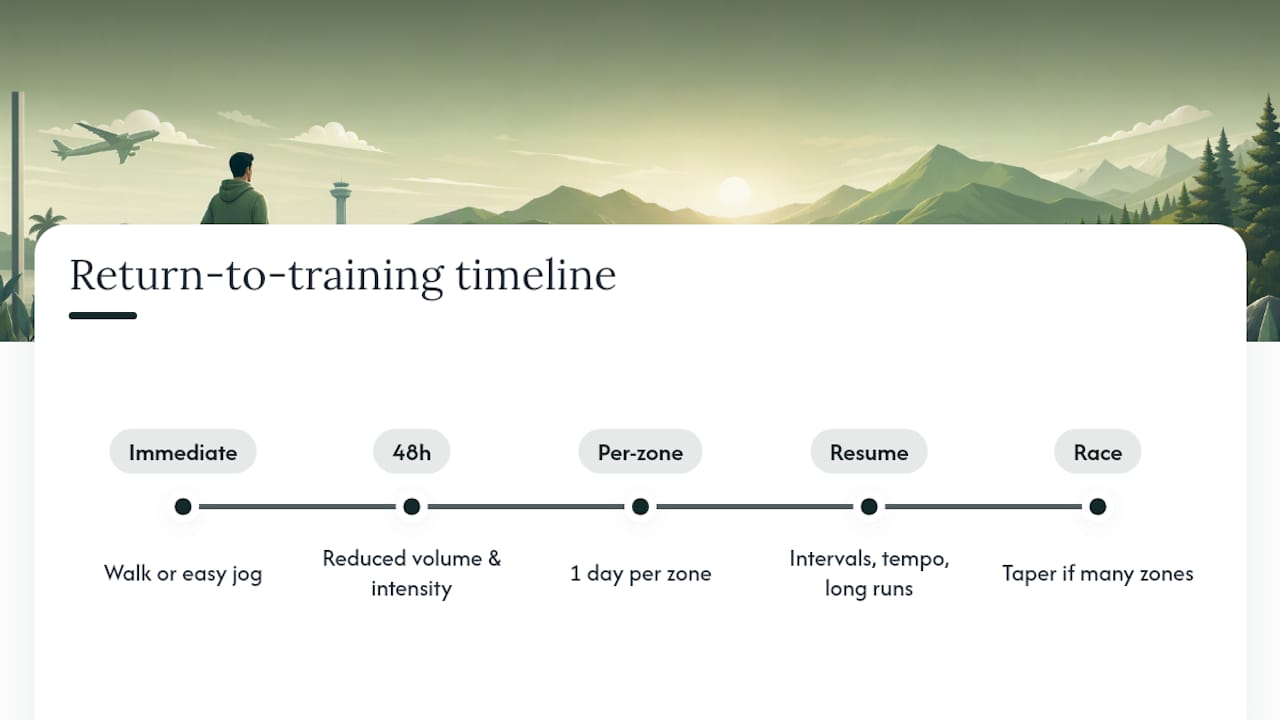
If you’re travelling for a race rather than recovering from one, the same logic applies in reverse: taper your final pre-race efforts slightly harder than usual if the trip involves crossing several time zones, because your body is absorbing two stressors (training and travel) at once. Everyday and club runners often assume missing a scheduled session is a setback. On a travel week, it’s frequently the smarter call.
Mental recovery: handling travel stress without losing motivation
Travel stress is real and it compounds physical fatigue in ways that are easy to underestimate. Delayed flights, unfamiliar time zones, and disrupted routines all chip away at the mental bandwidth you’d otherwise spend on staying motivated to train.
A few things help more than they might sound like they would. Building in slack, extra time at airports, a buffer day before a race, removes a surprising amount of low-grade anxiety that otherwise bleeds into how you feel about running at all. Sticking to small, familiar rituals (the same pre-run playlist, the same stretching sequence) gives your brain a sense of control when everything else about the trip feels unfamiliar.
It also helps to separate “I feel unmotivated” from “I am actually too fatigued to train well.” The first is often solved by a short walk outside and some daylight. The second is solved by rest. Confusing the two is how runners end up forcing a hard session on legs that needed an easy day, which usually makes both the run and the mood worse.
Foot and skin care while you’re away from your usual routine
New shoes worn for a race, hours spent walking around an unfamiliar city, and dry cabin air are a combination that punishes feet and skin more than most runners expect. Blisters, cracked heels, and chafing tend to show up on travel days precisely because your normal footwear and skincare routine gets disrupted.
Pack a small foot-care kit: blister plasters, a travel-size foot cream, and a spare pair of moisture-wicking socks to change into after a race or a long walk. Dry cabin air on flights also dehydrates skin faster than people realise, so a simple moisturiser applied before and after a flight reduces cracking, particularly around heels and toes where friction from running shoes is highest.
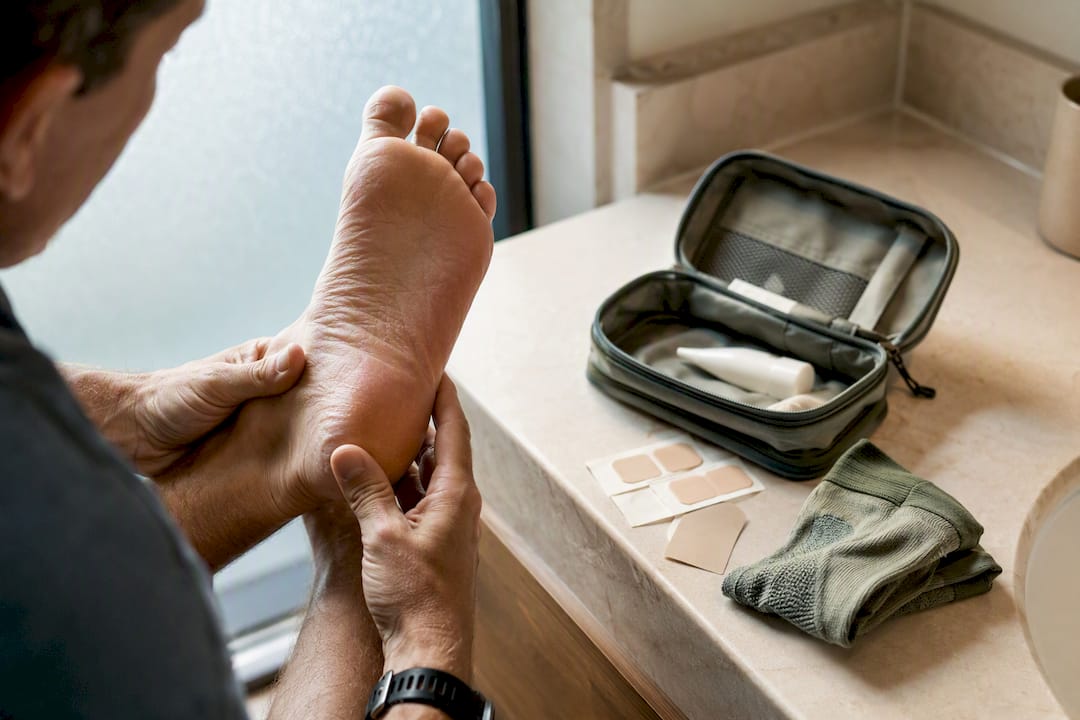
Check your feet properly at the end of each travel day, not just when something hurts. A hot spot caught early is a five-minute fix with tape or a blister plaster. Left unchecked overnight, it can turn into something that affects your gait the next day, which then risks knock-on strain elsewhere. This is a small habit, but it’s one of the most overlooked pieces of travel recovery for runners who focus entirely on legs and sleep and forget the feet doing all the work underneath.
Stretching and foam rolling when you barely have floor space
Full foam-rolling routines don’t survive contact with a cramped hotel room or an airport floor, but you don’t need the full version to get most of the benefit. A compact massage ball, small enough to fit in a washbag, covers calves, feet, and glutes without needing to lie flat on the floor.
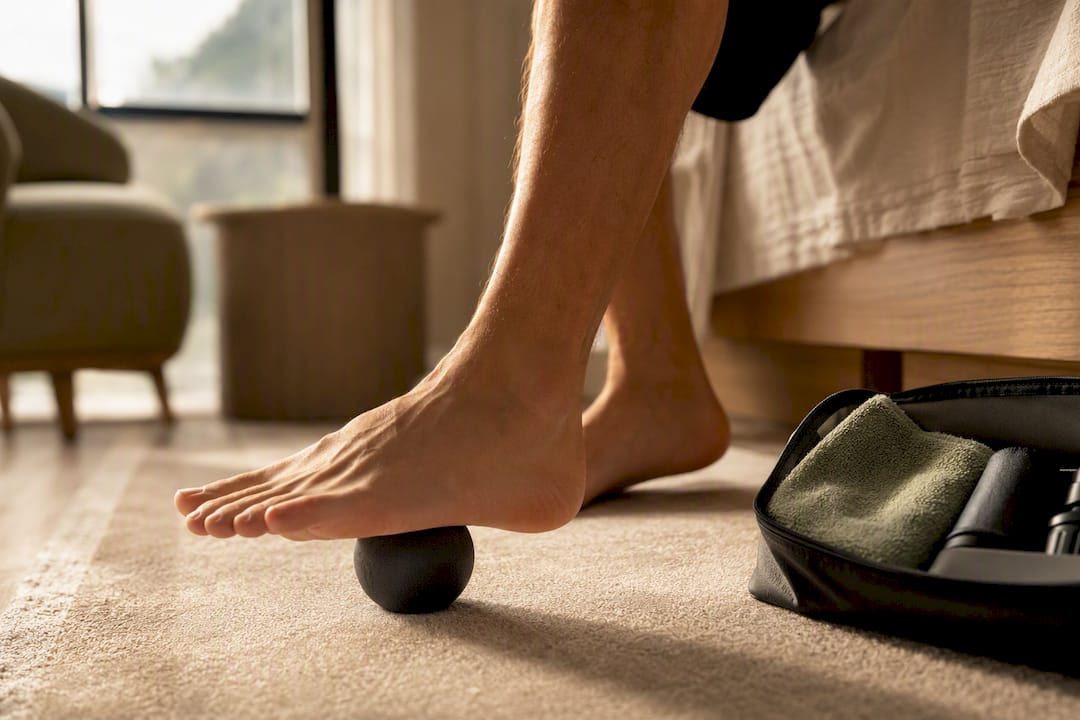
Timing matters more than duration here. A few minutes of rolling or static stretching right after a flight, before you sit down again for a taxi or dinner, does more good than a longer session done hours later once stiffness has properly set in. Hold each stretch for 20 to 30 seconds rather than bouncing, and focus on calves, hamstrings, and hip flexors, the areas most affected by hours of sitting.
If you genuinely have no space at all, even standing calf stretches against a wall or door frame in a hotel room work. The goal on a travel day isn’t a perfect routine. It’s doing something consistent enough that your legs don’t arrive at the next run feeling like they’ve been in a cast.
A habit worth stealing before your next trip
Pack the same recovery kit for every race, the electrolytes, the compression socks, the resistance band, so you stop making decisions when you’re tired and just reach for the pouch. Try the checklist above once, in full, and you’ll likely keep half of it for good…
— Tim
Runcomplete’s magnesium bisglycinate: a simple addition, not a fix-all
Ready is a magnesium bisglycinate supplement designed with everyday runners in mind rather than elite athletes or gym-goers.
This supplement is free of unnecessary fillers, suitable for vegetarians and vegans, and backed by a 30-day guarantee if it doesn’t suit you. It won’t replace the hydration, movement, and sleep habits covered above, but it’s a straightforward way to support the sleep quality and muscle recovery those habits are already working towards, particularly on weeks when travel makes everything else harder to get right. If you want more detail on dosing and timing before you decide, Runcomplete’s guide to magnesium timing walks through when it fits best around a run. Otherwise, head to the Ready product page to see whether a one-off order or a monthly subscription suits your race calendar better.
Sources
- Impact of long‑haul airline travel on athletic performance and recovery: A critical review of the literature
- Management of travel fatigue and jet lag in athletes: a systematic review
- How to travel for a destination race

