
Most runners with restless legs straight after a session are dealing with a short, activity-related reaction that settles within minutes. If the twitching, crawling or urge to move returns most evenings or disrupts sleep, that pattern looks more like restless legs syndrome (RLS) and deserves a proper check. Right now: get up and walk for a couple of minutes, skip the late coffee or nightcap, and if it keeps happening, ask your GP for a ferritin test.
TL;DR:
- Most post-run restless leg symptoms are temporary reactions that improve within minutes after gentle activity like walking or stretching.
- Persistent or evening-occurring symptoms might indicate restless legs syndrome, which is linked to brain iron and dopamine levels, and often worsens with dehydration, poor iron stores, or late, intense exercise.
- Immediate relief involves walking, calf stretching, massage, heat therapy, avoiding caffeine and alcohol, and staying well-hydrated, with persistent symptoms warranting medical advice.
- Preventative strategies include scheduling vigorous workouts earlier in the day, maintaining consistent sleep routines, and improving iron levels through diet or tests, especially if symptoms are frequent.
- For ongoing concerns, a serum ferritin test can identify iron deficiency, and magnesium bisglycinate supplement is a low-risk support option, but proper diagnosis and treatment require consulting a healthcare professional.
Table of Contents
- What causes restless legs after running, and how does RLS differ from cramps or DOMS?
- Immediate relief: what to try straight after symptoms start
- Prevention: training, timing and evening routines that cut the risk
- When to see a GP and what to request
- Supplements and the evidence: magnesium, iron and other dietary approaches
- What actually works for runners, in practice
- Try RunComplete’s magnesium bisglycinate for evening recovery
- Sources
- FAQ
What causes restless legs after running, and how does RLS differ from cramps or DOMS?
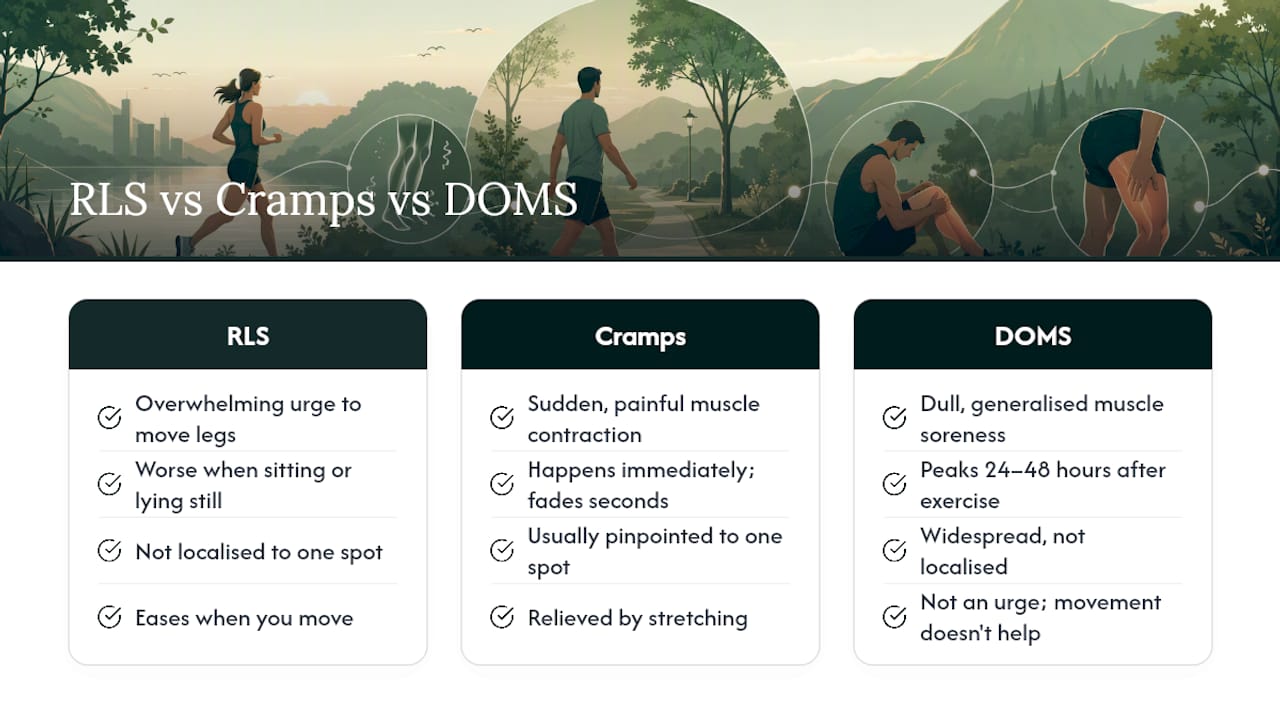
RLS is a distinct neurological condition, not just tired muscles. The NHS defines it as an overwhelming urge to move the legs, usually paired with crawling, itching or aching sensations that get worse when you’re sitting or lying still, particularly in the evening. Move, and it eases. Sit back down, and it comes back. That’s the giveaway.
Cramps and DOMS behave differently. A cramp is a sudden, painful muscle contraction you can usually pinpoint to one spot, and it fades within seconds once you stretch it out. DOMS is a dull, generalised soreness that peaks 24 to 48 hours after a hard session and has nothing to do with an urge to move. RLS has no obvious muscular trigger at all. It’s linked to how the brain handles iron and dopamine, which explains why it tends to flare in the evening when dopamine activity naturally dips.
Running itself can bring on symptoms even in people who wouldn’t otherwise notice them. Late, high-intensity efforts close to bedtime, a strong coffee before or after a run, dehydration, and low iron stores all seem to act as triggers. The NHS estimates RLS affects a moderate share of adults, so most runners feeling restless after a session are experiencing a passing post-exercise effect rather than the syndrome itself.
Immediate relief: what to try straight after symptoms start
Movement is the fastest lever you have. NHS Wales advises walking, stretching, massage or a warm bath during an attack, and most runners find a short, easy walk works within a few minutes.
- Walk or pace gently for 3 to 5 minutes rather than lying still and fighting it.
- Stretch your calves and hamstrings, then massage the lower leg firmly with your hands or a foam roller.
- Try a warm bath or heat pack for muscular tightness; a cold pack can help if the leg feels inflamed or swollen rather than restless.
- Skip caffeine, energy drinks and alcohol in the hours after an evening run.
- Rehydrate properly and check you’re not running consistently short on electrolytes.
- Stop self-managing and speak to a GP if symptoms happen most nights, wake you repeatedly, or come with numbness or weakness.
Pro Tip: Keep the post relief routine boring and repeatable. A five-minute walk plus two stretches you do every single time trains your body to expect the sequence, which seems to shorten how long the restlessness lasts.
Prevention: training, timing and evening routines that cut the risk
Timing your training matters more than most runners assume. Guidance for runners suggests vigorous exercise close to bedtime can worsen RLS in people prone to it, while regular moderate daytime activity tends to help rather than hurt. If your only slot for intervals or a hard tempo run is 9pm, that’s worth reconsidering.
- Push heavy or anaerobic sessions to at least two to three hours before you plan to sleep.
- Keep a consistent bedtime and wake time, even on rest days.
- Cut evening caffeine and reduce alcohol, both of which are flagged in NHS Wales self-care advice as common aggravators.
- Add a short mobility routine after late runs rather than going straight from shoes-off to sofa.
- Pay attention to iron-rich foods (red meat, lentils, spinach) and raise supplements with your GP rather than self-prescribing.
None of this needs to be complicated. A ten-minute wind-down after an evening session, done consistently, does more for symptom control than any single remedy tried once.
When to see a GP and what to request
Book an appointment if you notice new numbness, weakness, visible swelling, or if lost sleep is starting to affect your day-to-day functioning. These aren’t typical RLS signs and need proper assessment rather than home management.
Ask specifically for a serum ferritin test. Clinical guidance from the Lancashire and South Cumbria primary-care formulary treats RLS as rooted in brain iron and dopamine pathways rather than a behavioural issue, and the ferritin target used to justify iron therapy sits around 75 ng/mL, well above the cut-off used for standard anaemia screening. A “normal” result on a general blood panel doesn’t rule this out.
Mention any medicines you’re taking, since several common drug classes can worsen RLS, and flag other conditions like pregnancy or kidney disease, which raise the likelihood of secondary RLS. Most cases are managed in primary care; referral usually only follows if first-line measures and iron correction don’t help.
Supplements and the evidence: magnesium, iron and other dietary approaches
The evidence here is real but modest, and it’s worth being honest about that rather than overselling it. A 2024 systematic review of ten randomised trials covering 482 participants found mixed trial quality overall, but reported improvements in sleep and symptom scores with magnesium oxide and vitamin B6, alongside clear benefit from oral iron in people who were actually iron deficient.
A separate 2024 pilot study gave 12 adults 200mg of magnesium citrate daily for 8 weeks and recorded lower RLS symptom scores by the end. Twelve people is a small signal, not proof, but it points the same direction as the wider review.
- Test ferritin before starting iron, since supplementing when levels are already adequate offers no benefit and can cause side effects.
- Discuss dosing and duration with your GP rather than guessing.
- Treat magnesium and vitamin B6 as adjuncts that support sleep and recovery, not as a cure for diagnosed RLS.
Magnesium bisglycinate tends to be better tolerated than magnesium oxide or citrate, with less of the digestive upset that puts people off supplementing consistently, which is one reason practitioners often favour it for sleep and muscle relaxation support. If restless evenings are a recurring pattern for you, understanding what’s actually driving the sensation matters more than reaching for any single tablet.
What actually works for runners, in practice
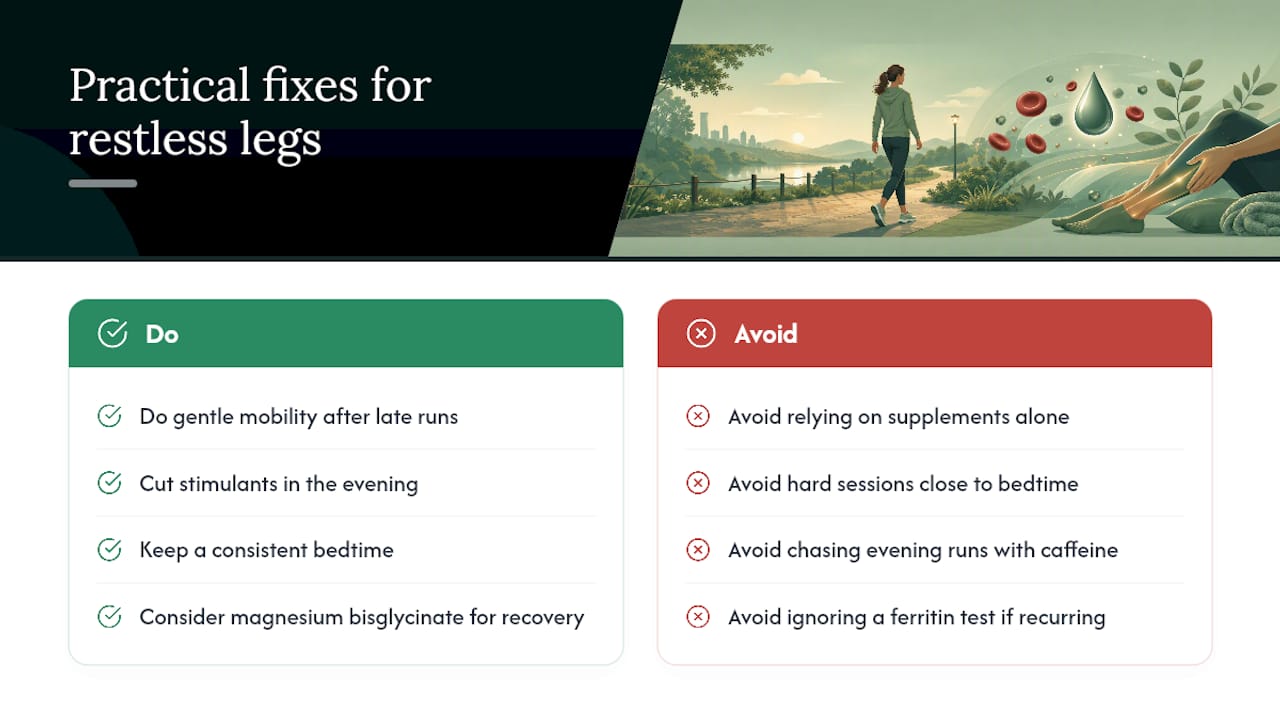
Most restless-leg complaints I see from runners have a boring, fixable cause: a hard session too close to bedtime, too much caffeine chasing an evening run, or a training block that’s quietly run the legs into an iron deficit nobody’s checked. The clinical evidence backs a genuinely simple routine: gentle mobility after a late run, cut stimulants in the evening, keep bedtime consistent, and consider a well-tolerated form of magnesium to support sleep and recovery.
Where I’d push back on the wellness-industry version of this advice is the idea that supplements alone fix anything. They’re a support, not a substitute for a ferritin test if symptoms keep coming back. Runcomplete builds specifically around magnesium bisglycinate for exactly this reason. Talk to your GP if the pattern persists.
— Tim
Try RunComplete’s magnesium bisglycinate for evening recovery
If you’ve read this far because your legs won’t settle after a late run, a well-formulated magnesium bisglycinate supplement is one of the lower-risk, better-tolerated options to try alongside the lifestyle changes above. A UK-made magnesium bisglycinate capsule is available, built specifically for everyday runners rather than gym-goers or elite athletes, with no unnecessary fillers and no complicated dosing schedule to remember.
It suits runners who train regularly and want extra support for sleep and muscle recovery, available for one-time purchase or as a monthly subscription. It is formulated to suit vegetarians and vegans. If symptoms are frequent, severe or disrupting your sleep most nights, see your GP and get ferritin checked first; supplements work best as a support alongside that, not instead of it. Every order comes with a 30-day guarantee, so there’s no risk in trying Ready for yourself and seeing whether your evenings settle down.
Sources
- Restless legs syndrome | NHS
- Effects of dietary supplementation in patients with restless legs syndrome: systematic review (2024)
- PubMed: 2024 pilot magnesium citrate study
- Restless legs syndrome (NHS Wales advice)
FAQ
What is the 80% rule in running?
It’s a training guideline suggesting roughly 80% of your weekly running should be easy or moderate effort, with only about 20% at high intensity. Keeping hard sessions to a smaller share of your week, and away from late evenings, is also one of the practical steps linked to fewer post-run restless-leg flare-ups.
How long does it take for legs to recover after running?
General muscle soreness (DOMS) typically peaks at 24 to 48 hours and resolves within a few days, but a genuine urge to move that returns at rest, especially in the evening, points to RLS rather than ordinary recovery time and won’t simply pass with rest.
What is a runner’s leg?
“Runner’s leg” isn’t a medical term. It’s a catch-all for the fatigue, tightness and mild soreness runners feel after training, distinct from RLS, which is a specific neurological urge to move rather than general tiredness or ache.
What immediately helps restless legs?
Walking, stretching, massage or a warm bath during an attack are the standard first-line responses, since movement gives temporary relief even though symptoms often return once you’re still again.

