
Cramps on hills are usually caused by neuromuscular overload, not dehydration. Your calves, quads and glutes are being asked to work in ways they haven’t trained for, and fatigue disrupts the nerve signals that control muscle contraction. Hill-specific training and strength endurance work fix this at the source. Hydration and electrolytes still matter, but they’re a support act, not the headline.
TL;DR:
- Hill-related cramps mainly stem from neuromuscular fatigue caused by specific muscle loading during uphill and downhill running, not dehydration.
- Endurance training for hill climbs and controlled downhill repeats significantly reduce cramp risk by improving muscle tolerance to eccentric and concentric loads.
- Prevention should focus on tailored training and pacing strategies rather than solely on hydration or electrolyte intake, especially in mild weather conditions.
- Static stretching during cramps offers the most reliable immediate relief, while magnesium supplements may support recovery but do not replace proper training.
- Persistent or severe cramps require medical assessment to rule out underlying biomechanical issues or deficiencies.
Table of Contents
- What causes cramps on hills running?
- The evidence against the dehydration myth
- How to train so hills stop cramping you
- Race-day tactics for hilly routes
- What to do the moment a cramp hits
- Where magnesium fits into cramp prevention
- When hill cramps need a doctor, not just a training plan
- My take on the training-first approach
- A steady daily habit for the recovery side of your training
- Sources
What causes cramps on hills running?
Uphill and downhill running load your muscles in completely different ways, and that’s the root of most hill-related cramping. Climbing demands sustained concentric effort. Your calves, quads and glutes contract and shorten repeatedly to drive you upward, and if you haven’t built the endurance for that specific pattern, those muscles fatigue fast.
Descending flips the problem. Here, your quads work eccentrically, lengthening under load to control your speed and absorb impact. This eccentric demand causes far more microscopic muscle damage than climbing does, and it’s a major driver of the neuromuscular fatigue that shows up as a cramp later in the run, according to research on downhill running and eccentric muscle actions.
Once a muscle group is sufficiently fatigued, the nervous system’s control over contraction and relaxation gets sloppy. That’s when a muscle locks into an involuntary spasm rather than a smooth, coordinated contraction.
Here’s how the loading compares:
- Calves: concentric overload on climbs, driving propulsion off the toes.
- Quadriceps: heavy eccentric load on descents, controlling braking forces.
- Glutes: sustained concentric demand on climbs, especially steep or sustained ones.
- Hamstrings: stabilising role on both ascents and descents, often overlooked in training.
The evidence against the dehydration myth
For decades, cramping got blamed almost entirely on dehydration and lost electrolytes. That theory has not held up well under scrutiny. An evidence-based review of exercise-associated muscle cramps concludes the condition is multifactorial, but altered neuromuscular control driven by fatigue sits at the centre of the picture, not fluid balance.
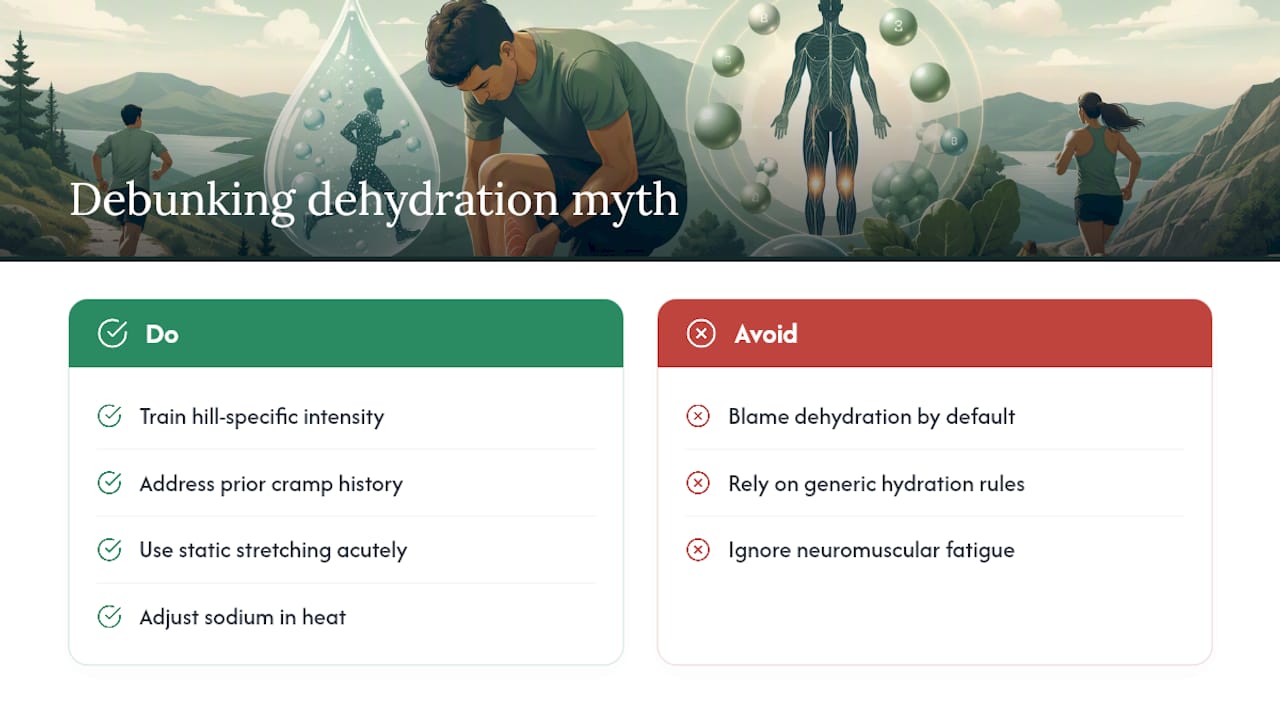
A separate narrative review in the British Journal of Sports Medicine makes a similar point: a history of previous cramping and running at a relatively higher intensity than you’re conditioned for predict cramps far more reliably than dehydration or blood sodium levels do. If dehydration were the main driver, cramps would cluster in the hottest, sweatiest races. Instead, they cluster in the hilliest ones, regardless of temperature.
That doesn’t mean fluid and salt are irrelevant. Heavy sweaters and runners in genuinely hot conditions can tip into a state where sodium loss compounds fatigue, and hydration becomes a real contributing factor rather than an excuse. But for most recreational and trail runners cramping on a hilly course in mild weather, the mechanism is fatigue, not fluid.
Static stretching of the affected muscle remains the most consistently effective acute treatment for exercise-associated muscle cramps, and prevention works best when it’s built around the individual runner’s own risk factors rather than a generic hydration rule.
That framing, drawn from the PMC review, is worth sitting with. It shifts the whole conversation from “drink more” to “train the specific demand that’s breaking down.”
How to train so hills stop cramping you
Training is the actual fix, not a supporting measure. You’re teaching your muscles to tolerate the exact loads that hills impose, so fatigue sets in later and less severely.
- Add progressive hill repeats. Start with 4 to 6 repeats on a moderate gradient, building volume every two to three weeks rather than jumping straight to steep, long efforts.
- Accumulate elevation on long runs. Route long runs over rolling or hilly terrain to help your legs experience climbing and descending fatigue together, which matches race-day conditions.
- Expose yourself to downhill running deliberately. Controlled downhill repeats build tolerance to eccentric loading, and a narrative review on downhill running confirms that prior exposure blunts the muscle damage response on subsequent efforts.
- Build strength endurance, not maximal strength. Single-leg calf raises, eccentric squats, glute bridges, and Nordic hamstring curl progressions all target fatigue resistance when done at higher repetitions with controlled tempo.
- Progress gradually and recover properly. Two hill-focused sessions a week is plenty for most recreational runners; hammering hills every session invites overuse injury before it builds resilience.
Pro Tip: Put a short hill session towards the end of a long run rather than at the start. Practising hill mechanics while already fatigued trains the exact neuromuscular resilience you need for the last climb of a race, when cramps actually strike.
Research on uphill racing backs this up directly: runners with greater lower-limb power show smaller fatigue-related declines in running mechanics during uphill marathon efforts, which is exactly the adaptation strength-endurance work targets.
Race-day tactics for hilly routes
Training builds the capacity. Pacing and technique decide whether you spend that capacity wisely on the day.
- Hold back on early climbs. Use perceived effort rather than pace to gauge intensity uphill, since chasing a flat-ground pace on a climb burns through your neuromuscular reserve far too early.
- Shorten your stride on descents. A quicker cadence with shorter steps reduces the eccentric braking force through your quads, easing the fatigue that builds into cramps later.
- Use poles only if you’ve trained with them. Poles can offload leg muscles on sustained climbs, but an untrained pole technique wastes more energy than it saves.
- Drink to thirst rather than on a schedule. Forcing fluid intake beyond what your body signals does nothing for neuromuscular fatigue and can cause its own problems.
- Reach for sodium selectively. If you’re a heavy sweater or running in genuine heat, added sodium can help, in line with practical guidance on preventing muscle cramps. Otherwise, it’s not doing the heavy lifting you might assume.
What to do the moment a cramp hits
Stopping fast matters more than what you do next.
- Slow down or stop immediately. Continuing to load a cramping muscle only deepens the spasm.
- Stretch the muscle gently and statically. Hold until the tension eases, usually 20 to 30 seconds, rather than yanking it hard.
- Walk it out. Gentle contraction and lengthening, alongside light massage or compression if you’re carrying a strap, helps restore normal control.
- Know when to call it a day. If the cramp returns within minutes of restarting, or the muscle feels tight and swollen rather than just fatigued, stop running rather than pushing through on painkillers or aggressive rubbing that could mask a strain.
Static stretching is the acute treatment with the most consistent support behind it, according to the PMC review of EAMC treatment and prevention, well ahead of massage, heat, or electrolyte tablets taken mid-cramp.
Where magnesium fits into cramp prevention
Magnesium supports normal muscle contraction and relaxation, and low status has been linked to poorer recovery and sleep. The evidence specifically tying magnesium supplementation to preventing exercise-associated cramps is limited, though, so it belongs alongside your training plan, not instead of it.
- Bisglycinate is a gentler form on the stomach than magnesium oxide or citrate, which matters if you’re taking it daily.
- Regular daily dosing corrects low magnesium status over weeks, rather than acting as a same-day fix before a hilly race.
- Anyone on medication affecting kidney function should check with a doctor before regular supplementation.
A bisglycinate formula offers runners an option for consistent daily support without complicated dosing. Tim, who writes much of Runcomplete’s supplement guidance, has covered the evidence on magnesium and electrolytes for cramp risk in more depth, alongside a breakdown of magnesium’s role in DOMS recovery.
Pro Tip: If you’re cramping despite solid hill training, check for magnesium deficiency signs like eyelid twitching or restless legs before assuming it’s a training gap.
When hill cramps need a doctor, not just a training plan
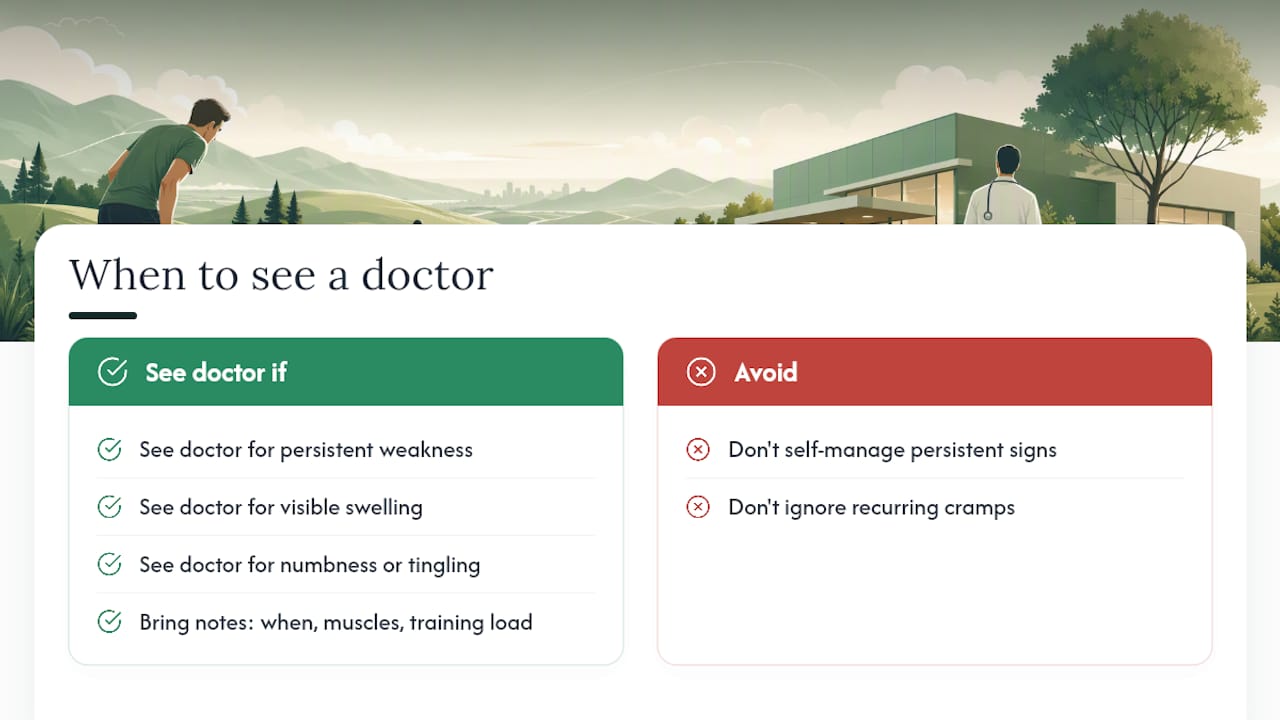
Most hill cramps respond to the training and tactics above. Some signs mean it’s time to see a professional rather than adjust your plan yourself: persistent weakness after the cramp resolves, visible swelling, numbness or tingling, or cramps that keep recurring despite sensible training and pacing changes.
Bring a note of when cramps happen, which muscles are affected, and your recent training load. A physiotherapy assessment often uncovers a motor-control or biomechanical pattern worth correcting, rather than a deficiency.
My take on the training-first approach
Cramps on hills are a training signal, not a hydration failure. Fix the specific demand, climbing strength and eccentric tolerance on descents, and the cramping largely resolves itself. Considered magnesium use through something like Runcomplete’s Ready can support that process, but it’s the supporting act. Get the hill sessions right first.
— Tim
A steady daily habit for the recovery side of your training
Some magnesium bisglycinate supplements offer a simple daily capsule approach, formulated specifically for runners with no fillers. Such supplements may come with manufacturing assurances and purchasing options including one-off and subscription models.

While hill repeats and strength-endurance sessions do the real work of preventing cramps, certain supplements can support the recovery window afterwards, aiding sleep and muscle recovery without the hype that surrounds a lot of sports supplements. If you want to see how it fits alongside the training advice above, visit the Runcomplete Ready page and try it against your own hill sessions.
Sources
For deeper reading on the mechanisms and evidence behind this article, the PMC review of EAMC pathophysiology and treatment covers the full clinical picture, the BJSM narrative review tackles the dehydration debate directly, and the Springer review on downhill running explains eccentric loading in detail.
This article is general information, not a substitute for advice from a qualified doctor. Consult a qualified healthcare professional about your own circumstances before acting on anything here.
- An evidence-based review of the pathophysiology, treatment, and prevention of exercise-associated muscle cramps
- Cause of exercise associated muscle cramps (BJSM)
- How to Prevent Muscle Cramps — Outside Online
- Narrative review on downhill running and eccentric muscle actions

