
In the UK, food supplements are regulated as food, not medicine, and no regulator pre-approves them before sale. The business placing a product on the market carries full legal responsibility for its composition, labelling and any claims made. Anyone selling supplements should register as a Food Business Operator, check ingredients against permitted lists, and contact the MHRA if a product edges towards medicinal-sounding claims.
TL;DR:
- Supplements must comply with composition, labeling, and claim restrictions, verified through proper record-keeping, testing, and sourcing according to UK regulations.
- Making medicinal claims or presenting a product as a treatment without MHRA approval risks reclassification as medicine, which involves complex authorization procedures.
- Importers are treated as manufacturers and bear full liability for product safety, ingredients, and compliance, requiring thorough checks before UK sale.
- Registration as a Food Business Operator is mandatory at least 28 days before launching, with ongoing responsibilities including traceability, claims validation, and record retention.
- Strict adherence to approved ingredients, accurate labeling, and authorized claims provide a legal safeguard and a competitive advantage in the UK supplement market.
Table of Contents
- What legally counts as a food supplement in the UK
- Who makes and enforces the rules across the UK
- Registering as a food business operator and your core duties
- Labelling rules and what claims you can actually make
- Permitted ingredients, novel foods and substances you cannot use
- Borderline products: when a supplement becomes a medicine
- Importing supplements: why you inherit full manufacturer liability
- A step-by-step compliance checklist before you launch
- Why compliance is a competitive advantage, not just a legal box to tick
- Runcomplete: UK-made recovery supplements built on compliance you can check
- Sources
What legally counts as a food supplement in the UK
A food supplement is defined in law as a concentrated source of a nutrient or other substance with a nutritional or physiological effect, sold in dose form, such as capsules, tablets, or liquid ampoules, intended to supplement the normal diet. That definition comes from the framework set out in The Food Supplements (England) Regulations 2003 and the equivalent devolved instruments across Scotland, Wales and Northern Ireland. The wording sounds dry, but the practical test it creates is anything but trivial.
Classification hinges on two things: composition and presentation. A magnesium capsule marketed to help “support normal muscle function” sits comfortably in food supplement territory. Change the label to claim it “treats muscle cramps caused by a medical condition” and you have likely stepped into medicinal product territory, whatever the actual formula contains. Regulators look at what you say the product does, not just what is in it.
This is where three categories often get confused. A food supplement supports a generally healthy diet. A Food for Special Medical Purposes (FSMP), such as a clinical nutrition product prescribed for malabsorption, is formulated and labelled for the dietary management of a specific disease under medical supervision, with its own separate compositional and labelling rules. A medicinal product, by contrast, is defined by its intended therapeutic action and requires a marketing authorisation before it can be sold at all.
The boundary matters practically because getting it wrong is expensive. A brand that markets creatine as supporting “muscle recovery” is on food supplement ground. A brand that claims the same product “reduces inflammation associated with injury” risks the MHRA reading that as a medicinal claim, regardless of the dose or the ingredient’s safety profile. Composition rarely changes the classification on its own; wording usually does.
Who makes and enforces the rules across the UK
Supplement policy in the UK is devolved, which surprises a lot of first-time sellers who assume there is one national regulator to satisfy. The Department of Health and Social Care sets policy in England, while Food Standards Scotland, the Welsh Government and the Food Standards Agency in Northern Ireland each hold equivalent responsibility in their own nations. The practical rules on composition and labelling are broadly harmonised across all four, but the body you would contact for policy clarification differs depending on where your business is based.

The MHRA sits apart from this food policy structure entirely. Its job is not to police everyday supplement compliance but to draw the line between food and medicine when a product’s presentation or claims push it toward medicinal territory. If the MHRA determines a product is being presented or functions as a medicine, it needs a marketing authorisation before it can legally go on sale, a process built for pharmaceuticals, not vitamin capsules.
Day-to-day enforcement happens locally. Trading Standards and environmental health officers at council level are the ones who actually inspect premises, sample products, and act on consumer complaints. They do not pre-approve anything; their role is reactive and investigative, checking that what is already on shelves complies with the law rather than signing products off before launch. This means the practical burden of getting things right, before anyone official ever looks at your product, sits entirely with you.
Registering as a food business operator and your core duties
There is no central supplements register in the UK, which trips up a lot of newcomers expecting something like a licensing scheme. Instead, anyone manufacturing, importing, or selling food supplements as a business must register as a Food Business Operator (FBO) with their local authority, typically the council where the business premises are based. Registration is free and must happen at least 28 days before trading starts.
Once registered, your responsibilities depend on where you sit in the supply chain, but a few duties apply almost universally:
- Maintain traceability records showing where every ingredient batch came from and where finished stock went.
- Apply basic HACCP (Hazard Analysis and Critical Control Points) principles proportionate to your operation, even if you outsource manufacturing.
- Keep records of supplier due diligence, including Certificates of Analysis for raw materials.
- Notify your local authority of significant changes, such as a change of premises, business structure, or the nature of what you produce.
- Retain evidence supporting any claims made on packaging or marketing material.
Manufacturers carry the heaviest compliance load since they control formulation and initial labelling. Importers, as covered later, inherit that same level of liability the moment a product crosses the border. Retailers selling under their own brand, even via a contract manufacturer, are treated as the business placing the product on the market and cannot simply point to a supplier if something goes wrong.
Record-keeping is not bureaucratic box-ticking. If Trading Standards ever investigates a complaint or a batch fails testing, the paperwork you can produce, supplier certificates, formulation records, claims substantiation, is what separates a quick resolution from a prolonged enforcement action.
Labelling rules and what claims you can actually make
UK supplement labels must carry a specific set of mandatory particulars, and missing even one is one of the most common reasons products get flagged. Under the Food Information Regulations and the food supplements framework, every pack needs:
- The name of the category “food supplement” (not just a brand name or vague descriptor).
- The recommended daily dose or portion for consumption.
- A clear warning not to exceed the stated recommended dose.
- A statement that supplements should not replace a varied and balanced diet.
- An instruction to store out of the reach of young children.
- The amount of each vitamin, mineral or other active ingredient per stated daily portion.
- The name and UK (or Northern Ireland) address of the Food Business Operator responsible for the product.
- Full allergen labelling for any of the fourteen recognised allergens present.
Where a nutrient has an EU-derived Nutrient Reference Value, such as most vitamins and minerals, the label should express the amount per daily portion and, where relevant, as a percentage of that reference value. A surprising number of labels get this wrong by quoting a percentage without stating the underlying reference used, or by rounding milligram amounts inconsistently between the front-of-pack claim and the back-of-pack nutrition panel. Both are easy fixes and both are common reasons a product gets pulled up on inspection.
Pro Tip: Print a draft label and check every mandatory particular against the list above line by line before you approve final artwork. It takes ten minutes and catches the errors that inspectors find first.
Claims are where businesses get themselves into genuine trouble, usually through enthusiasm rather than dishonesty. Nutrition and health claims permitted on food labels must be authorised and worded precisely as approved, generic statements like “supports normal energy-yielding metabolism” for B vitamins are fine because they match an authorised claim. Anything implying a supplement can treat, cure, or prevent a disease is prohibited outright on a food product, however true the underlying science might be. There is no official UK register recording every approved product, which means the paper trail proving your claims are substantiated, and your ingredients are what you say they are, is entirely your own responsibility to build and keep.
Permitted ingredients, novel foods and substances you cannot use
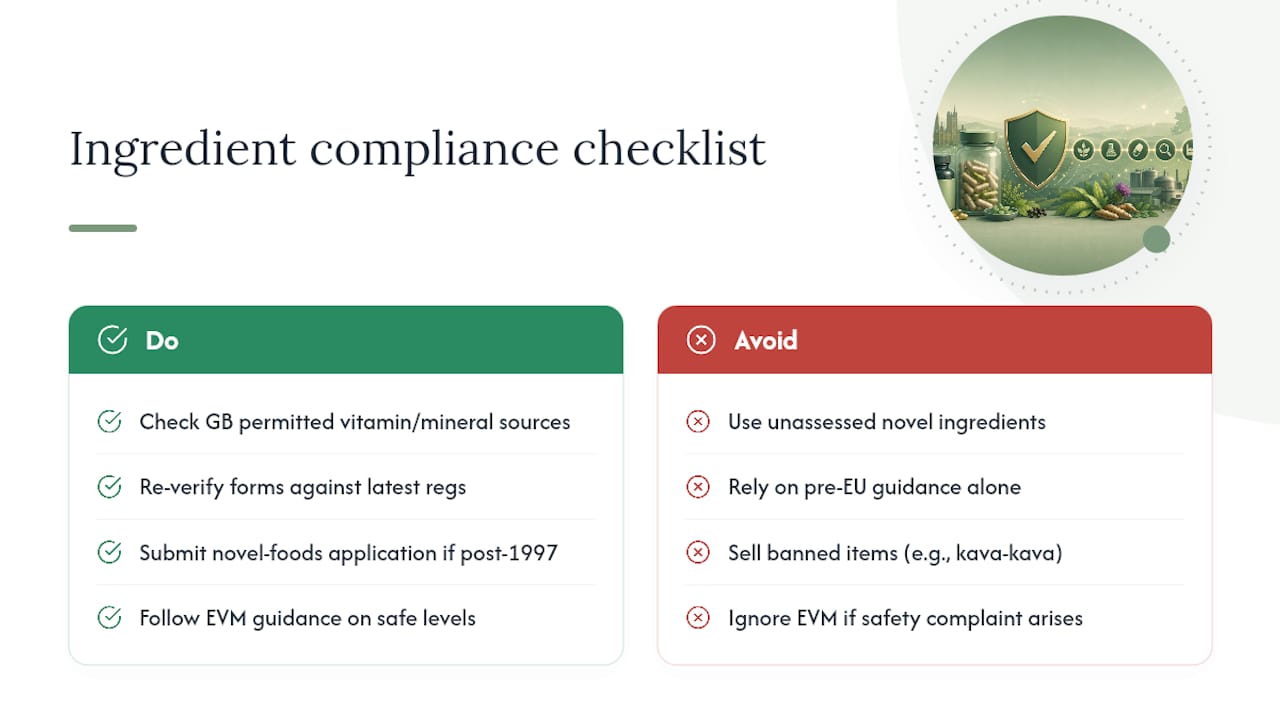
Every vitamin and mineral used in a UK supplement must come from a permitted source listed in the relevant schedules. After EU exit, the permitted vitamins and minerals lists that previously sat in Directive 2002/46/EC were retained in domestic GB law, with the power to amend those schedules now sitting with UK ministers rather than Brussels. In practice this means the permitted-forms list a brand checked five years ago may no longer be current, and it is worth re-verifying against the latest domestic amendment regulations rather than relying on old EU guidance.
Anything not already established as a food ingredient before 1997, or not authorised since under the novel foods regime, requires a novel foods application before it can legally go into a UK supplement. This catches out a lot of importers bringing in trendy ingredients from the US or Asia that have never been through UK or EU novel food assessment. CBD isolates, certain algae-derived compounds, and some newer probiotic strains have all gone through this authorisation process in recent years, and selling an unauthorised novel ingredient is a straightforward compliance breach regardless of how popular the ingredient is elsewhere.
The UK also maintains outright prohibitions and restrictions on specific substances. Kava-kava is banned in food supplements over liver toxicity concerns. Tryptophan carries restrictions tied to its history of contamination-related illness. Beyond outright bans, the Expert Group on Vitamins and Minerals (EVM) publishes voluntary guidance on safe upper levels for nutrients where no statutory maximum exists in law. Following EVM guidance is not legally compulsory in most cases, but ignoring it and later facing a safety complaint leaves a business with very little defence.
Borderline products: when a supplement becomes a medicine
The MHRA does not decide medicinal status purely on ingredients. It weighs presentation, the claims made, and the pharmacological effect a substance has, and a product can tip into medicine territory even with a formulation that looks entirely unremarkable. Guidance Note 8 sets out exactly how this borderline assessment works, and it is worth reading in full if you are launching anything with an ingredient history in traditional medicine.
The consequence of reclassification is severe: a product found to be medicinal cannot legally be sold without a marketing authorisation, a process built around clinical evidence, manufacturing standards, and regulatory review timelines that bear no resemblance to a typical supplement launch. Businesses that discover this after stock is already on shelves face a forced withdrawal, not a grace period to adjust labelling.
The safeguard is straightforward, if underused: keep claims conservative, avoid any language implying treatment, prevention, or cure of a named condition, and describe function using the kind of generic, authorised wording covered earlier. Where an ingredient has any history of being used medicinally, at any dose, get MHRA advice before launch rather than after a complaint. Presentation and claims wording carry more weight in this assessment than most first-time brand owners expect, and conservative copywriting is often the cheapest compliance measure available.
Importing supplements: why you inherit full manufacturer liability
If you import a supplement made overseas and sell it in the UK, you are legally treated as the manufacturer, not merely a distributor. That means full liability for composition, safety and labelling accuracy rests with you, even if the product has been sold compliantly in its country of origin for years.
This catches out a lot of businesses bringing in stock from the US, where dosages and permitted ingredients often diverge significantly from UK rules. A product legally sold in an American pharmacy can contain an ingredient that has never been authorised as a novel food here, or a dose well above UK guidance levels. Relabelling is often the minimum requirement; reformulation is sometimes unavoidable.
Practical steps include confirming a UK or Northern Ireland business address appears on the label as the responsible FBO, checking every ingredient against GB permitted lists before the first shipment lands, and factoring customs and border requirements into your timeline. None of this is optional paperwork; it is the difference between a compliant launch and a product that has to be pulled before it ever reaches a customer.
A step-by-step compliance checklist before you launch
Before any supplement goes on sale in the UK, run through this sequence rather than jumping straight to packaging design:
- Confirm classification. Check whether your product is genuinely a food supplement, and not drifting toward FSMP or medicinal territory based on planned claims.
- Check every ingredient against permitted lists. Verify vitamin and mineral sources against GB schedules and confirm nothing requires novel foods authorisation.
- Draft labelling against the mandatory particulars list. Include dosage, warnings, allergens, and FBO address before finalising artwork.
- Verify claims wording. Match any nutrition or health claim to an authorised form; strip anything implying disease treatment or prevention.
- Commission testing and Certificates of Analysis. Confirm actual content matches label claims and screen for contaminants.
- Register as a Food Business Operator. Do this with your local authority at least 28 days before trading.
- Document everything. Keep supplier due diligence, formulation records, and claims substantiation together in one place.
Pro Tip: Treat step five as non-negotiable even for small-batch launches. A Certificate of Analysis costs far less than a product recall, and it is the single document Trading Standards will ask for first if a complaint ever lands.
If you hit a genuine grey area, contact the relevant body directly rather than guessing: MHRA for anything touching medicinal borderline questions, your local authority’s Trading Standards or environmental health team for labelling and composition queries, and the Food Standards Agency or Food Standards Scotland for broader policy questions depending on where you trade. Red flags that should stop a launch outright include an ingredient with no clear permitted status, a claim you cannot substantiate with authorised wording, or a Certificate of Analysis showing content that does not match your label. None of these are worth pushing through and hoping nobody notices.
Why compliance is a competitive advantage, not just a legal box to tick
Most brands treat UK supplement law as a hurdle to clear once, at launch, then forget about. That is backwards. The absence of a central pre-approval register means every serious buyer, and every serious retailer considering stocking you, is quietly running their own version of due diligence. A brand that can produce a Certificate of Analysis on request looks fundamentally different from one that goes quiet when asked.
Runcomplete builds around that reality rather than around it. Every batch of the Ready magnesium bisglycinate formula goes through third-party testing, with results kept on file rather than buried in a drawer somewhere. UK manufacture removes an entire layer of the importer liability problem covered earlier in this piece, since there is no relabelling gap, no customs uncertainty over composition, and no question about which address is legally responsible for the product. Internally, that means running the same pre-market questions covered in the checklist above on every formulation change: is the ingredient source permitted, does the claim wording match what testing actually supports, and does the label carry every mandatory particular before it goes to print.
Runcomplete: UK-made recovery supplements built on compliance you can check
Runcomplete makes this practical rather than theoretical; you can also explore private label services that support supplement brand development through trusted manufacturing partners. Ready is manufactured in the UK, tested by an independent third party on every batch, and backed by a satisfaction guarantee, so you are never taking a formulation on trust alone. If you have read this far because you care about what actually goes into a recovery supplement and whether the company behind it can prove its claims, that is exactly the standard Ready is built to meet.
You can check the Certificates of Analysis and product details for Ready directly on the Runcomplete site before deciding whether it fits your recovery routine. For runners considering a monthly subscription versus a one-off purchase, both options are available on the same product page, with no long-term commitment required beyond a single month at a time.
— Tim
This article is general information, not a substitute for advice from a qualified doctor. Consult a qualified healthcare professional about your own circumstances before acting on anything here.

