
Magnesium can ease perceived muscle soreness for some runners, but it is not a substitute for the basics: carbohydrate, protein and fluids come first. The single best move at the finish line is a simple snack and a drink within minutes, not a supplement. If you want to trial magnesium, World Athletics and NHS guidance both point the same way: eat first, supplement later, ideally with food.
TL;DR:
- Magnesium may help reduce muscle soreness perception for runners but does not speed up muscle repair or performance recovery.
- The only strong evidence shows a week of pre-exercise magnesium intake can lower soreness and inflammation markers, but not enhance strength or running speed.
- Magnesium should be taken after nutrition and fluids post-race, with a trial recommended during training to assess gut tolerance and sleep quality.
- Supplement labels should specify elemental magnesium, and individuals with kidney issues or on certain medications should consult a healthcare professional before use.
- Routine magnesium supplementation is not necessary for most runners, but it can be useful during heavy training periods or after multiple consecutive races.
Table of Contents
- What does the evidence actually say about magnesium after marathon soreness?
- Why might magnesium help, and why doesn’t that guarantee faster recovery?
- When should you take magnesium after a marathon?
- How much magnesium is safe, and what interacts with it?
- Does routine magnesium supplementation make sense for most runners?
- Where does magnesium actually fit across a training year?
- Should you trial Ready, Runcomplete’s magnesium for runners?
- Sources
- FAQ
What does the evidence actually say about magnesium after marathon soreness?
The strongest single piece of evidence comes from a 2019 double blind crossover trial in nine recreational male runners. They took 500mg of magnesium daily for seven days before an exercise bout, and the results were genuinely interesting: reported soreness dropped noticeably over the first 72 hours, with the effect growing progressively from day 1 to day 3, alongside lower IL-6, an inflammatory marker. Maximal force and running performance did not improve.
That gap between “feels less sore” and “performs the same” matters more than it first appears. It tells you magnesium may dull the sensation of muscle damage without actually speeding up the physical repair. Two limitations temper the finding further:
- The sample was small (nine runners), so individual variation could easily skew the average result.
- The protocol loaded magnesium for a week before exercise, not as a single dose taken after a race, which means the study cannot confirm that a post-marathon dose works the same way.
A broader 2024 systematic review backs this cautious reading. It found that small, mixed-quality trials do suggest magnesium can reduce delayed onset muscle soreness, but the dose, form and timing across studies varied so much that no standardised marathon-specific prescription exists yet.
What this means in practice: expect a possible reduction in how sore you feel, not a guaranteed shortcut to faster recovery or better next-week performance.
Why might magnesium help, and why doesn’t that guarantee faster recovery?
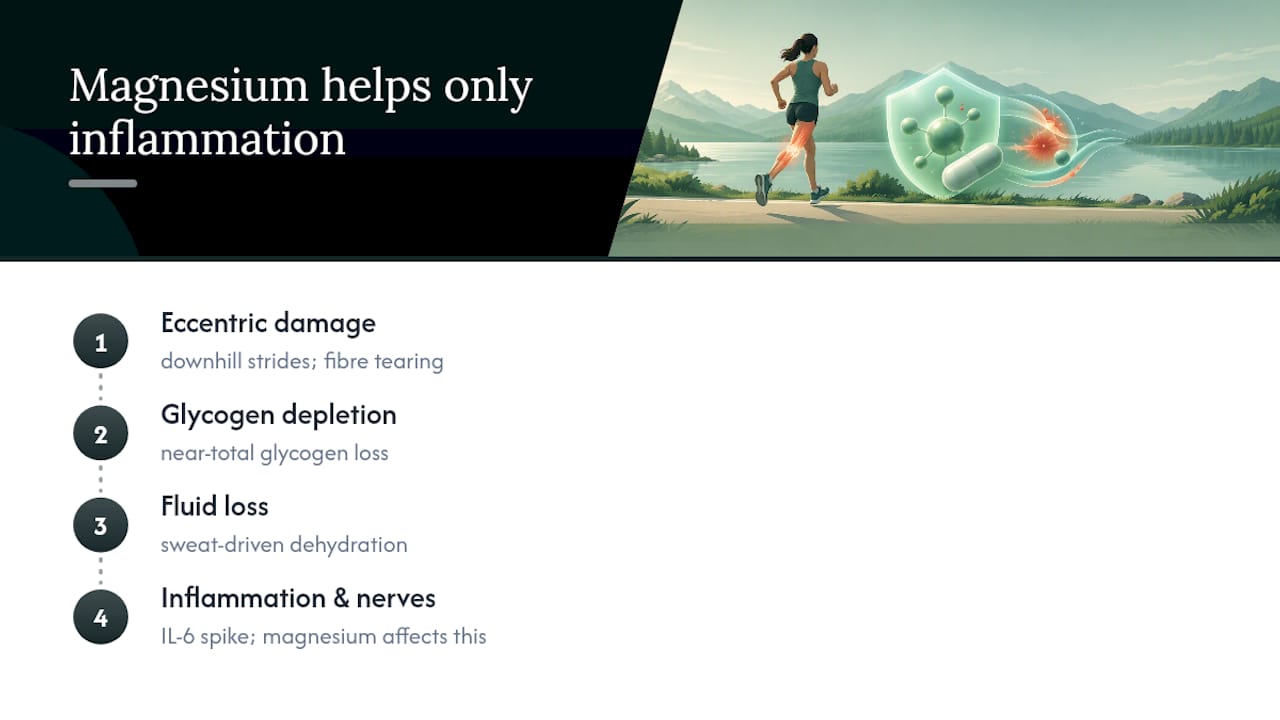
Magnesium plays a genuine role in muscle contraction, nerve signalling and how your body handles glucose after hard eccentric exercise, the kind of muscle-lengthening load your quads take on every downhill stride of a marathon. It also appears to influence inflammatory markers like IL-6, which spike after long, damaging efforts.
Here is the disconnect worth understanding: lowering an inflammatory marker or dulling perceived soreness is not the same as rebuilding muscle fibre or restoring glycogen stores. Marathon damage is a combination of repeated eccentric loading on hard road surfaces, near-total glycogen depletion, and significant fluid loss through sweat. Magnesium touches one small piece of that picture, the inflammatory and neuromuscular side, while leaving the fuel and fluid deficits entirely untouched. You can feel less sore and still be running on empty tanks.
When should you take magnesium after a marathon?
The sequence matters more than the supplement. World Athletics recommends an easy-to-eat carbohydrate and protein snack, plus fluids, within around 20 minutes of finishing. A proper meal should follow within about two hours. Magnesium, if you choose to use it, belongs after that sequence, not instead of it.
- At the finish: a banana, a recovery drink, or a snack combining carbs and protein such as ready-made endurance snacks, plus water or an electrolyte drink.
- Within two hours: a full meal covering carbohydrate, protein and fluids.
- Later that day or evening: magnesium with food, if you are trialling it, to reduce the chance of stomach upset.
Pro Tip: Never trial a new magnesium dose for the first time on race day. Test it on an ordinary training evening a week or two beforehand, so you already know how your gut reacts before you rely on it after 26.2 miles.
Testing on a training day first also lets you judge whether it affects your sleep or morning stiffness, which is a large part of why runners try it in the first place.
How much magnesium is safe, and what interacts with it?
Supplement labels sometimes list the weight of the magnesium compound rather than the actual elemental magnesium it delivers, and the two numbers can differ substantially. Always check for “elemental magnesium” on the label so you’re comparing products fairly.
UK guidance flags a few practical safety points worth taking seriously:
- Take oral magnesium with food, which reduces the stomach upset that high single doses can otherwise cause.
- People with kidney disease should be cautious, since magnesium is cleared through the kidneys and impaired function raises the risk of it building up.
- Magnesium can interact with tetracycline and quinolone antibiotics, bisphosphonates, and levothyroxine, generally by reducing how well the body absorbs them.
If you take regular medication, check with a pharmacist or GP before adding a magnesium supplement. Novel magnesium formulations, such as magnesium L-threonate, have also been through UK safety assessment for tolerable intake, which is worth knowing if you see less familiar forms marketed for recovery or cognitive benefits. Standard forms like magnesium bisglycinate or citrate have a longer track record for everyday use.
Does routine magnesium supplementation make sense for most runners?
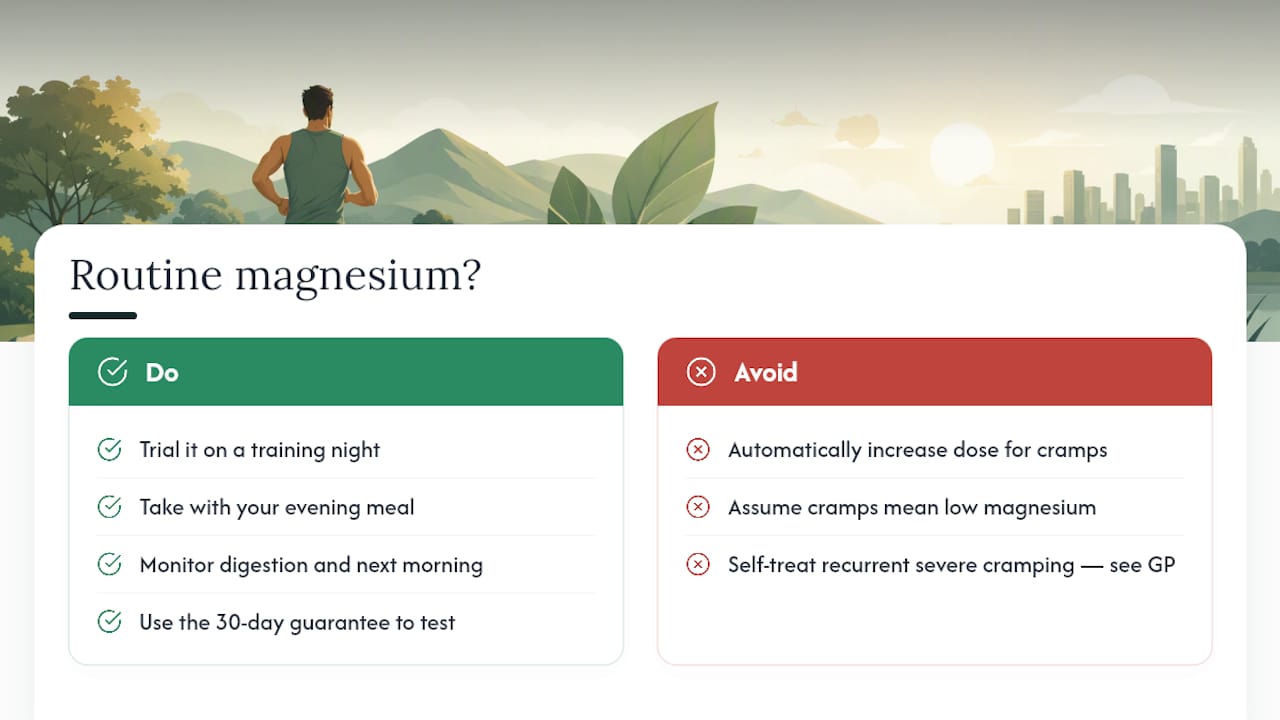
Not automatically. Genuine magnesium deficiency is uncommon in people eating a varied diet, and the NHS notes that cramps aren’t always caused by low magnesium, so repeatedly increasing a dose in response to cramp isn’t the right first move. Recurrent or severe cramping is worth raising with a GP rather than treating as a magnesium problem by default.
At Runcomplete, the view is straightforward: magnesium bisglycinate is chosen because chelated forms tend to sit more comfortably with sensitive stomachs than cheaper oxide forms, though no study has proven bisglycinate outperforms other forms specifically for marathon recovery. The product is backed by a 30-day guarantee, which gives you room to test it properly rather than committing blind. A sensible starting protocol: trial it on a training night first, take it with your evening meal, and monitor both digestion and how you feel the next morning. For more detail on timing and dosing patterns, Runcomplete’s guide on when to take magnesium for running and the deeper look at magnesium and DOMS both go further into the mechanics.
Where does magnesium actually fit across a training year?
Magnesium earns its place during specific stretches, not every week of the year. Heavy training blocks, back-to-back race weekends, or periods of poor sleep are where a trial makes sense, because that’s when the small effect it does have is most likely to be noticeable. Chasing a single dose as a finish-line fix misses the point entirely. What matters more is a practised recovery routine you’ve already tested, food and fluids first, magnesium second, and paying attention to how your own body responds over weeks rather than one race.
— Tim
Should you trial Ready, Runcomplete’s magnesium for runners?
Runcomplete built Ready — Magnesium for Runners specifically for people training and racing regularly, not gym-goers or elite athletes with sports science teams behind them. It’s a magnesium bisglycinate capsule, free of unnecessary fillers, made in the UK, and suitable for vegetarians and vegans.

Given everything the evidence actually supports, here’s a sensible way to try it: pick a normal training evening, take one dose with your meal, and note how your gut and sleep respond over a week or two before deciding whether it belongs in your race-week routine. Every order comes with a 30-day guarantee, so testing it properly costs you nothing if it isn’t for you. It’s available as a one-off purchase or through the Subscribe & Save plan if you’d rather not reorder manually. Head to the Ready product page to start your trial.
Sources
A food-first approach makes sense before reaching for a supplement, partly because balanced recovery nutrition should come first, and partly because whole foods bring fibre, potassium and other nutrients that a capsule cannot replicate.
- NHS — Leg cramps
- One week of magnesium supplementation lowers IL‑6 and muscle soreness (2019)
- Systematic review — magnesium supplementation and muscle soreness (2024)
- FSA science — safety assessment: magnesium L‑threonate (2026)
A practical post-race mini-meal that hits several targets at once: wholegrain toast with peanut butter and a banana, or Greek yoghurt with oats and a handful of pumpkin seeds. Both deliver carbohydrate, protein and a meaningful magnesium contribution without needing a supplement at all.
FAQ
Is magnesium safe to take with lamotrigine?
There’s no established direct interaction between magnesium supplements and lamotrigine in standard UK guidance, but anyone on anticonvulsant medication should check with a GP or pharmacist before adding any new supplement. This matters more broadly whenever you’re on regular prescribed medicines, since magnesium can interact with several other drug classes.
What are the signs your body might need more magnesium?
Common signs people associate with low magnesium include muscle cramps, fatigue, poor sleep and general muscle tightness, though the NHS notes cramps aren’t always caused by magnesium deficiency. If symptoms are recurrent or severe, see a GP rather than self-treating with escalating supplement doses.
Can I take diltiazem with magnesium?
Diltiazem is a calcium channel blocker, and combining it with magnesium supplements should be discussed with a pharmacist or GP first, since magnesium can affect cardiac and vascular function similarly to some blood pressure medicines. This is a case where professional advice is worth seeking rather than guessing.
Is magnesium good for running recovery?
Evidence suggests magnesium may reduce perceived muscle soreness for some runners, based on a small 2019 crossover trial, but it hasn’t been shown to improve strength or race performance. It works best as a supporting piece of recovery, used after carbohydrate, protein and fluids, not instead of them.
How much does Runcomplete’s magnesium supplement cost?
Ready — Magnesium for Runners costs £34.99 as a one-off purchase, with a Subscribe & Save option also available for regular reordering. Both come with a 30-day guarantee, so you can trial it properly before deciding whether to continue.

